Review
. 2023 Jan 17;133(2):e165307.
doi: 10.1172/JCI165307.

Entry receptors - the gateway to alphavirus infection

Affiliations
Review

Entry receptors - the gateway to alphavirus infection

Ofer Zimmerman et al. J Clin Invest. .

Abstract

Alphaviruses are enveloped, insect-transmitted, positive-sense RNA viruses that infect humans and other animals and cause a range of clinical manifestations, including arthritis, musculoskeletal disease, meningitis, encephalitis, and death. Over the past four years, aided by CRISPR/Cas9-based genetic screening approaches, intensive research efforts have focused on identifying entry receptors for alphaviruses to better understand the basis for cellular and species tropism. Herein, we review approaches to alphavirus receptor identification and how these were used for discovery. The identification of new receptors advances our understanding of viral pathogenesis, tropism, and evolution and is expected to contribute to the development of novel strategies for prevention and treatment of alphavirus infection.


Conflict of interest statement

Conflict of interest: MSD is a consultant for Inbios, Vir Biotechnology, Senda Biosciences, Merck, Novavax, Moderna, and Immunome. The Diamond laboratory has received unrelated funding support in sponsored research agreements from Vir Biotechnology, Moderna, Immunome, and Emergent BioSolutions.

Figures

Figure 1
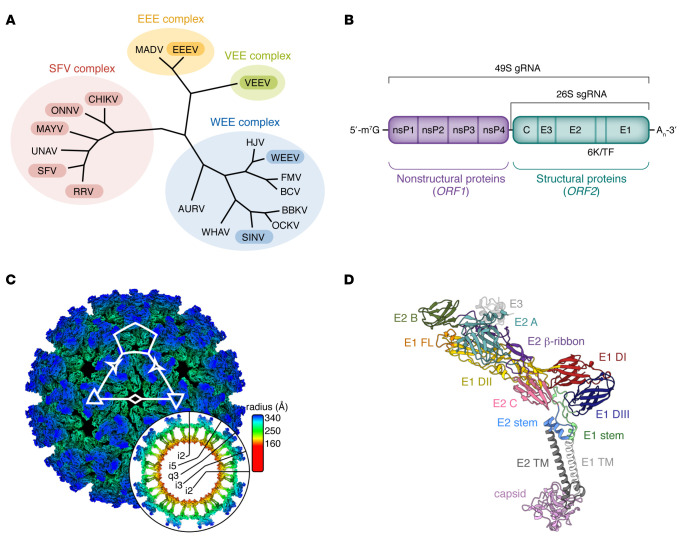
Figure 1. Alphavirus phylogeny, genome composition, and virion structure.
(A) Phylogenetic tree constructed from pairwise distances between alphavirus structural protein (E1 and E2) sequences, visualized in R using the ggtree package (179). Viruses include chikungunya (CHIKV, NCBI GenBank: QKY67868.1), Mayaro (MAYV, QED21311.1), Una (UNAV, YP_009665989.1), O’nyong’nyong (ONNV, AAC97205.1), Semliki Forest (SFV, NP_463458.1), Ross River (RRV, AAA47404.1), Eastern equine encephalitis (EEEV, ANB41743.1), Madariaga (MADV, AXV43855.1), Venezuelan equine encephalitis (VEEV, AGE98294.2), Sindbis (SINV, AAM10630.1), Aura (AURV, NP_632024.1), Ockelbo (OCKV, P27285.1), Western equine encephalitis (WEEV, QEX51909.1), Buggy Creek (BCV, AEJ36227.1), Babanki (BBKV, AVN98166.1), Fort Morgan (FMV, YP_003324588.1), Highlands J (HJV, YP_002802300.1), and Whataroa (WHAV, AEJ36239.1) viruses. Viruses with known receptors are in shaded bubbles. (B) The alphavirus genome consists of two open reading frames, a 49S genomic RNA encoding both nonstructural and structural proteins, and 26S subgenomic RNA encoding only the structural proteins. (C) Cryo–electron microscopy reconstruction of VEEV virus-like particle (EMD-24117) (167) colored radially, with an equatorial cross section shown as a round inset. Axes of symmetry are designated by a pentagon (5-fold; i5), triangles (3-fold; i3), three-pointed stars (quasi-3-fold; q3), and a diamond (2-fold; i2), with axial orientations displayed in the inset. (D) Model of VEEV structural proteins (Protein Data Bank 7FFE), including E3, which is cleaved during viral maturation, colored by domain as indicated. Cryo–electron microscopy map and model visualized using ChimeraX (180). FL, fusion loop; TM, transmembrane. Panels C and D use structural data from Basore et al. (165) and Ma et al. (168).
Figure 2
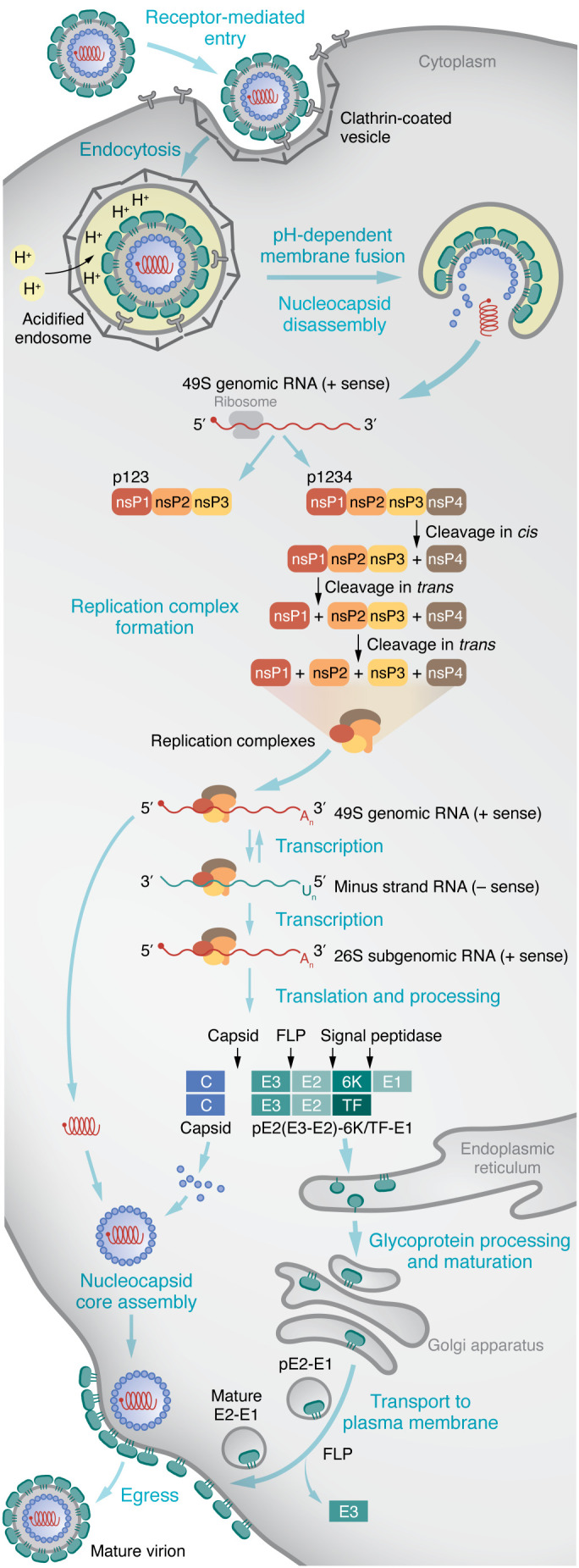
Figure 2. Alphavirus infection cycle.
Alphaviruses can engage attachment factors (e.g., HS) and specific receptors (e.g., MXRA8, LDLRAD3, VLDLR, and ApoER2) at the cell surface to mediate binding and entry. Virions enter cells principally through endocytosis of clathrin-coated vesicles. The acidic environment of the transiting endosome triggers conformational changes in the envelope proteins, allowing for fusion with endosomal membranes, penetration into the cytoplasm where nucleocapsid disassembly occurs, and translation of the incoming positive-strand genomic RNA. At early stages of infection, genomic RNA is translated to yield P123 and P1234 polyproteins (52). P1234 is cleaved in cis by the nsP2 protease to generate the viral proteins necessary for transcription and replication (53, 54). The early replicase, P123 and nsP4, is processed into a short-lived nsP1, P23, and nsP4 complex and, further, into a late replicase consisting of nsP1, nsP2, nsP3, and nsP4. The early replicase synthesizes negative-strand RNA, which is used for production of genomic and subgenomic RNAs (26S) (–58). The subgenomic mRNA drives expression of structural polyproteins C-pE2-6K/TF-E1 (56, 57). The E2 envelope glycoprotein is translated and covalently linked to E3 to form the polyprotein pE2, which associates with E1. The transframe (TF) protein is produced by ribosomal frameshift during translation of the 6K gene. The viral capsid (C) protein is released by its autoprotease activity and associates with newly synthesized genomic RNA to form the nucleocapsid. The remaining structural polyprotein is processed and matured in the endoplasmic reticulum, where host signal peptidases cleave pE2, 6K/TF, and E1 (, , –72). Furin-like proteases (FLP) in the Golgi network cleave pE2 into the component envelope glycoproteins E2 and E3 (for some alphaviruses, i.e., SINV, SFV, and VEEV, E3 may remain associated with the virion) (–76). Mature E2-E1 glycoproteins are transported to the plasma membrane where nucleocapsid associates to trigger budding and egress of mature virions (–86).
Figure 3
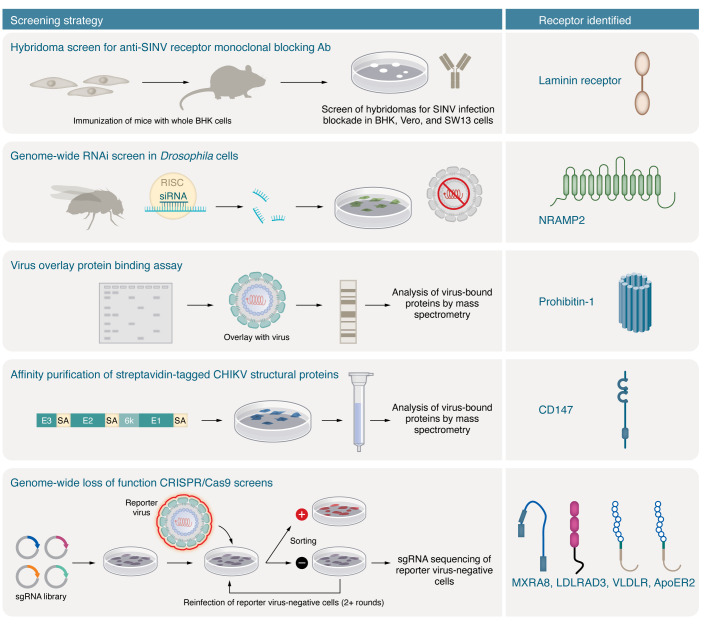
Figure 3. Alphavirus receptor identification and screening methods.
Eight alphavirus receptors have been reported to date using the screening methods annotated here and in the main text. Laminin receptor was identified as a receptor for SINV using a blocking mAb screen. NRAMP, a metal ion transporter, was identified as a receptor for SINV in an RNA interference (RNAi) screen in Drosophila cells. The mammalian homolog, NRAMP2 (pictured), was shown to mediate SINV binding and infection in mammalian cells. Prohibitin-1 was identified as a possible receptor for CHIKV through virus overlay assays and mass spectrometry. CD147 was identified as a possible receptor for CHIKV by affinity chromatography and mass spectrometry. Four alphavirus receptors were discovered through loss-of-function, negative-selection, CRISPR/Cas9–based genome-wide screens: MXRA8, a receptor for arthritogenic alphaviruses; LDLRAD3, a receptor for VEEV; and VLDLR and ApoER2, which promote cellular entry of SFV, EEEV, and SINV.

References

    1. Weaver SC, et al. Alphavirus infections. In: Guerrant RL, et al., eds. Tropical Infectious Diseases: Principles, Pathogens and Practice. 3rd ed. Saunders; 2011:519–524.
    1. Silva LA, Dermody TS. Chikungunya virus: epidemiology, replication, disease mechanisms, and prospective intervention strategies. J Clin Invest. 2017;127(3):737–749. doi: 10.1172/JCI84417. - DOI - PMC - PubMed
    1. Garmashova N, et al. The Old World and New World alphaviruses use different virus-specific proteins for induction of transcriptional shutoff. J Virol. 2007;81(5):2472–2484. doi: 10.1128/JVI.02073-06. - DOI - PMC - PubMed
    1. Weaver SC, et al. Recombinational history and molecular evolution of western equine encephalomyelitis complex alphaviruses. J Virol. 1997;71(1):613–623. doi: 10.1128/jvi.71.1.613-623.1997. - DOI - PMC - PubMed
    1. Hahn CS, et al. Western equine encephalitis virus is a recombinant virus. Proc Natl Acad Sci U S A. 1988;85(16):5997–6001. doi: 10.1073/pnas.85.16.5997. - DOI - PMC - PubMed

Publication types