Review
. 2023 Jan 17;133(2):e163450.
doi: 10.1172/JCI163450.

Impact of epigenetic reprogramming on antitumor immune responses in glioma

Affiliations
Review

Impact of epigenetic reprogramming on antitumor immune responses in glioma

Brandon L McClellan et al. J Clin Invest. .

Abstract

Epigenetic remodeling is a molecular hallmark of gliomas, and it has been identified as a key mediator of glioma progression. Epigenetic dysregulation contributes to gliomagenesis, tumor progression, and responses to immunotherapies, as well as determining clinical features. This epigenetic remodeling includes changes in histone modifications, chromatin structure, and DNA methylation, all of which are driven by mutations in genes such as histone 3 genes (H3C1 and H3F3A), isocitrate dehydrogenase 1/2 (IDH1/2), α-thalassemia/mental retardation, X-linked (ATRX), and additional chromatin remodelers. Although much of the initial research primarily identified how the epigenetic aberrations impacted glioma progression by solely examining the glioma cells, recent studies have aimed at establishing the role of epigenetic alterations in shaping the tumor microenvironment (TME). In this review, we discuss the mechanisms by which these epigenetic phenomena in glioma remodel the TME and how current therapies targeting epigenetic dysregulation affect the glioma immune response and therapeutic outcomes. Understanding the link between epigenetic remodeling and the glioma TME provides insights into the implementation of epigenetic-targeting therapies to improve the antitumor immune response.


Figures
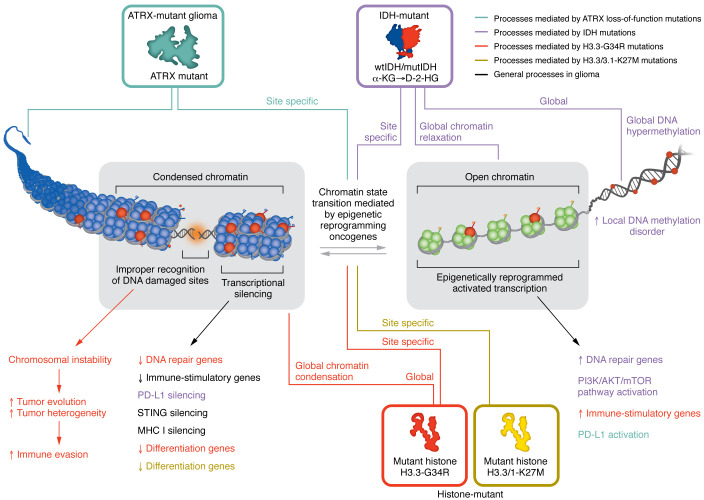
Figure 1
Figure 1. Effects of epigenetic mutations in molecular mechanisms that modulate immune cell activity within the TME.
The effects of epigenetic mutations on chromatin are indicated by color-coded arrows. The molecular effects of epigenetic changes that affect the immune TME are indicated below the chromatin.
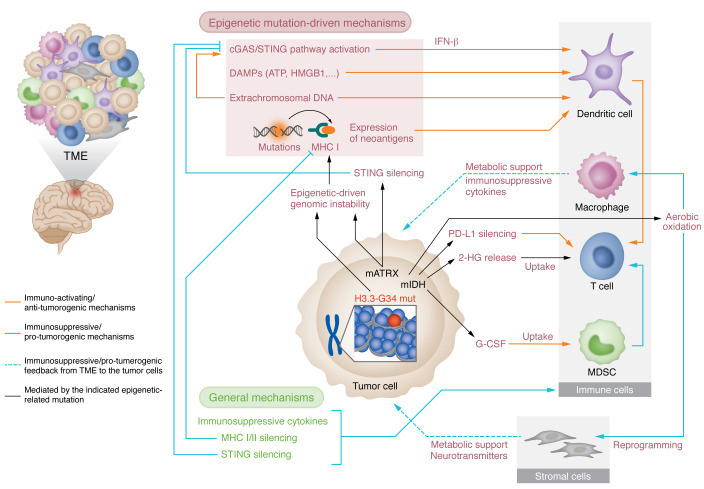
Figure 2
Figure 2. Epigenetic mechanism–mediated interactions between glioma cells and nontumoral cells that shape the TME.
Connections are indicated by arrows, and the color of the arrows indicates whether the interactions lead to immunosuppressive/protumoral or immune-activating/antitumoral mechanisms. The start of the black arrows indicates the mutations in the glioma cells that elicit the epigenetic mechanisms.
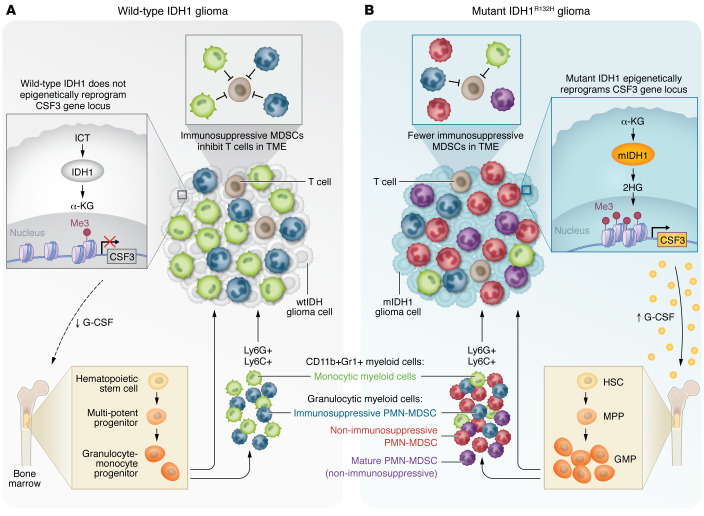
Figure 3
Figure 3. Model of aberrant granulocyte differentiation in mIDH1 tumors.
(A) In WT IDH1 tumors, tumor cells express low levels of G-CSF and the TME contains a high number of immunosuppressive MDSCs. (B) Through epigenetic reprogramming mediated by mIDH1-induced 2-HG accumulation, mIDH1 glioma cells express and secrete G-CSF. Circulating G-CSF has a direct effect on hematopoiesis in the bone marrow and spleen, promoting the expansion, differentiation, and mobilization of granulocytic myeloid cells. As a result, the granulocytes recruited to the TME are mainly neutrophils and preneutrophils, with inhibitory PMN-MDSCs, constituting a smaller fraction of the total granulocytes in the mIDH1 tumor. Figure adapted from Alghamri et al. (63).

References

    1. Ostrom QT, et al. CBTRUS statistical report: primary brain and other central nervous system tumors diagnosed in the United States in 2013-2017. Neuro Oncol. 2020;22(12 suppl 2):iv1–iv96. - PMC - PubMed
    1. Louis DN, et al. The 2021 WHO classification of tumors of the central nervous system: a summary. Neuro Oncol. 2021;23(8):1231–1251. doi: 10.1093/neuonc/noab106. - DOI - PMC - PubMed
    1. Weller M, et al. European Association for Neuro-Oncology (EANO) guideline on the diagnosis and treatment of adult astrocytic and oligodendroglial gliomas. Lancet Oncol. 2017;18(6):e315–e329. doi: 10.1016/S1470-2045(17)30194-8. - DOI - PubMed
    1. Uddin MS, et al. Epigenetics of glioblastoma multiforme: from molecular mechanisms to therapeutic approaches. Semin Cancer Biol. 2022;83:100–120. doi: 10.1016/j.semcancer.2020.12.015. - DOI - PubMed
    1. Jones C, Baker SJ. Unique genetic and epigenetic mechanisms driving paediatric diffuse high-grade glioma. Nat Rev Cancer. 2014;14(10):10.1038/nrc3811. - PMC - PubMed

Publication types