. 2023 Apr;67(4):323-351.
doi: 10.1111/jir.13007. Epub 2023 Jan 17.

Health in Down syndrome: creating a conceptual model

Affiliations

Health in Down syndrome: creating a conceptual model

S L Santoro et al. J Intellect Disabil Res. 2023 Apr.

Abstract

Background: Down syndrome (DS) has a unique medical and psychological profile that could impact how health is defined on three dimensions: physical, social and mental well-being.

Methods: In 2021, we presented our proposed conceptual model to three expert panels, four focus groups of parents of individuals with DS age 0-21 years and four focus groups of individuals with DS age 13-21 years through videoconferencing technology. Participants gave feedback and discussed the concept of health in DS.

Results: Feedback from participants resulted in iterative refinement of our model, retaining the three dimensions of health, and modifying constructs within those dimensions. Experts and parents agreed that individuals with DS have unique health concerns that necessitate the creation and validation of a syndrome-specific health model. We present key themes that we identified and a final conceptual model of health for individuals with DS.

Conclusion: Health in DS is a multi-dimensional, multi-construct model focused on relevant constructs of causal and effect indicators. This conceptual model can be used in future research to develop a syndrome-specific measure of health status.

Keywords: Down syndrome; genetics; health inequities; mental health; methodology in research; quality of life.


Conflict of interest statement

Conflict of Interest: SLS has received research funding from LuMind IDSC Down Syndrome Foundation to conduct clinical trials for people with DS within the past two years. She serves in a non-paid capacity on the Medical and Scientific Advisory Council of the Massachusetts Down Syndrome Congress, the Board of Directors of the Down Syndrome Medical Interest Group (DSMIG-USA), and the Executive Committee of the American Academy of Pediatrics Council on Genetics.

BGS occasionally consults on the topic of DS through Gerson Lehrman Group. He receives remuneration from DS non-profit organizations for speaking engagements and associated travel expenses. Dr. Skotko receives annual royalties from Woodbine House, Inc., for the publication of his book, Fasten Your Seatbelt: A Crash Course on Down Syndrome for Brothers and Sisters. Within the past two years, he has received research funding from F. Hoffmann-La Roche, Inc., AC Immune, and LuMind IDSC Down Syndrome Foundation to conduct clinical trials for people with DS. Dr. Skotko is occasionally asked to serve as an expert witness for legal cases where DS is discussed. Dr. Skotko serves in a non-paid capacity on the Honorary Board of Directors for the Massachusetts Down Syndrome Congress and the Professional Advisory Committee for the National Center for Prenatal and Postnatal Down Syndrome Resources. Dr. Skotko has a sister with DS.

The other authors do not have any conflicts to disclose.

Figures
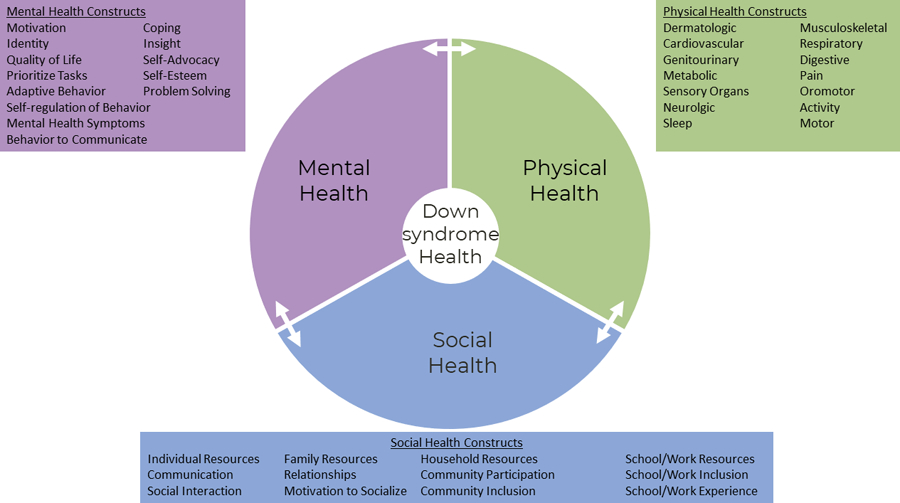
Figure 1:
Figure 1:
Conceptual model of health in Down syndrome with interconnection among physical, mental, and social dimensions

References

    1. Koh HK, Blakey CR, Roper AY. Healthy People 2020: a report card on the health of the nation. JAMA 2014;311(24):2475–2476. doi: 10.1001/jama.2014.6446 - DOI - PubMed
    1. Forrest CB, Tucker CA, Ravens-Sieberer U, et al. Concurrent validity of the PROMIS® pediatric global health measure. Qual Life Res 2016;25(3):739–751. doi: 10.1007/s11136-015-1111-7 - DOI - PubMed
    1. Juniper EF, Guyatt GH, Cox FM, Ferrie PJ, King DR. Development and validation of the Mini Asthma Quality of Life Questionnaire. Eur Respir J 1999;14(1):32–38. doi: 10.1034/j.1399-3003.1999.14a08.x - DOI - PubMed
    1. Nanigian DK, Nguyen T, Tanaka ST, Cambio A, DiGrande A, Kurzrock EA. Development and validation of the fecal incontinence and constipation quality of life measure in children with spina bifida. J Urol 2008;180(4 Suppl):1770–1773; discussion 1773. doi: 10.1016/j.juro.2008.03.103 - DOI - PubMed
    1. Modi AC, Junger KF, Mara CA, et al. Validation of the PedsQL Epilepsy Module: A pediatric epilepsy-specific health-related quality of life measure. Epilepsia 2017;58(11):1920–1930. doi: 10.1111/epi.13875 - DOI - PubMed

Publication types
