. 2023 Jan 17;13(1):874.
doi: 10.1038/s41598-023-28099-w.

Phonetic categorization relies on motor simulation, but combinatorial phonological computations are abstract

Affiliations

Phonetic categorization relies on motor simulation, but combinatorial phonological computations are abstract

Iris Berent et al. Sci Rep. .

Abstract

To identify a spoken word (e.g., dog), people must categorize the speech steam onto distinct units (e.g., contrast dog/fog,) and extract their combinatorial structure (e.g., distinguish dog/god). However, the mechanisms that support these two core functions are not fully understood. Here, we explore this question using transcranial magnetic stimulation (TMS). We show that speech categorization engages the motor system, as stimulating the lip motor area has opposite effects on labial (ba/pa)- and coronal (da/ta) sounds. In contrast, the combinatorial computation of syllable structure engages Broca's area, as its stimulation disrupts sensitivity to syllable structure (compared to motor stimulation). We conclude that the two ingredients of language-categorization and combination-are distinct functions in human brains.


Conflict of interest statement

The authors declare no competing interests.

Figures
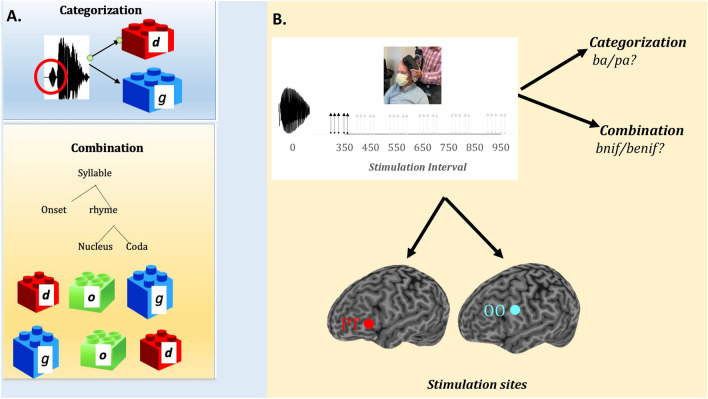
Figure 1
Figure 1
The two core ingredients of language. (A) Illustrates the two computations of interest—speech categorization (e.g., as d or g) and combination of speech sounds into syllables (e.g., as dog or god). (B) Illustrates how these two functions were gauged in our TMS studies. In each experiment, participants were administered a brief 50 Hz TMS train (5 pulses) at seven distinct intervals occurring after the onset of the auditory stimulus. Stimulation, in turn, targeted either the primary motor representation of the orbicularis oris muscle (OO) or the pars triangularis of the left frontal operculum (PT). In Experiment 1, participants categorized the ambiguous auditory stimulus; in Experiments 2, they identified the number of syllables (as a test of the combinatorial function). Note: written informed consent was obtained to use and publish the person’s image (in Fig. 1b).
Figure 2
Figure 2
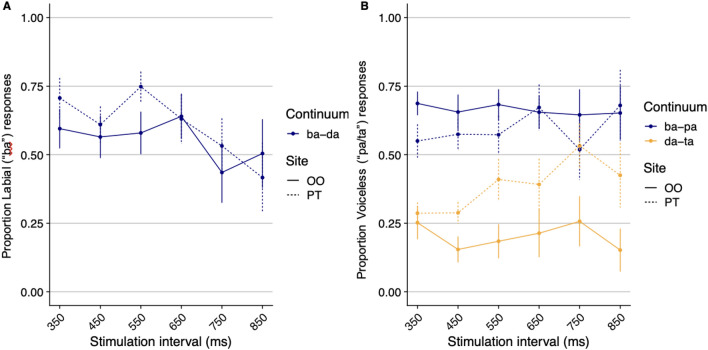
The effect of stimulation site (OO/PT) on the categorization of place of articulation (ba/da; A) and voicing (B). In the ba-pa continuum; ba is the voiced response (pa is voiceless); In the da-ta continuum; da is the voiced response (and ta is voiceless). Error bars are SEM.
Figure 3
Figure 3
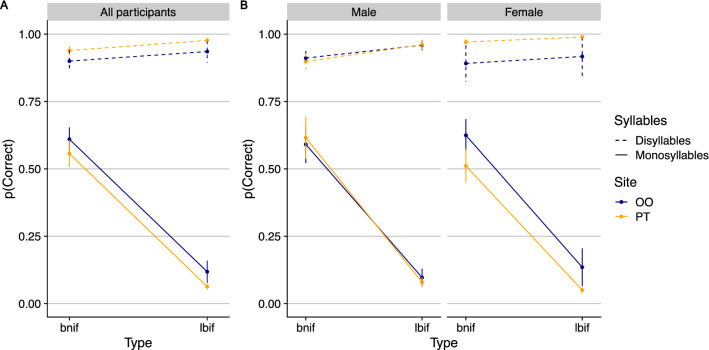
The effect of stimulation on syllable count across participants (A) and by gender (B). Error bars are SEM. P(Correct) is the proportion of correct responses.
Figure 4
Figure 4
Graphical summary. Our results suggest that the categorization of speech sounds engages the motor, whereas the combinatorial computation of syllable structure engages the PT.

References

    1. Hauser MD, Chomsky N, Fitch WT. The faculty of language: What is it, who has it, and how did it evolve? Science. 2002;298:1569–1579. doi: 10.1126/science.298.5598.1569. - DOI - PubMed
    1. Chomsky N. Aspects of the Theory of Syntax. MIT Press; 1965.
    1. Pinker S. The Language Instinct. Morrow; 1994.
    1. Liberman AM, Cooper FS, Shankweiler DP, Studdert-Kennedy M. Perception of the speech code. Psychol. Rev. 1967;74:431–461. doi: 10.1037/h0020279. - DOI - PubMed
    1. Glenberg AM, Witt JK, Metcalfe J. From the revolution to embodiment: 25 years of cognitive psychology. Perspect. Psychol. Sci. J. Assoc. Psychol. Sci. 2013;8:573–585. doi: 10.1177/1745691613498098. - DOI - PubMed

Publication types