. 2023 Jan 17;13(1):898.
doi: 10.1038/s41598-023-28227-6.

Blood leukocyte transcriptional modules and differentially expressed genes associated with disease severity and age in COVID-19 patients

Affiliations

Blood leukocyte transcriptional modules and differentially expressed genes associated with disease severity and age in COVID-19 patients

Silvia Y Bando et al. Sci Rep. .

Abstract

Since the molecular mechanisms determining COVID-19 severity are not yet well understood, there is a demand for biomarkers derived from comparative transcriptome analyses of mild and severe cases, combined with patients' clinico-demographic and laboratory data. Here the transcriptomic response of human leukocytes to SARS-CoV-2 infection was investigated by focusing on the differences between mild and severe cases and between age subgroups (younger and older adults). Three transcriptional modules correlated with these traits were functionally characterized, as well as 23 differentially expressed genes (DEGs) associated to disease severity. One module, correlated with severe cases and older patients, had an overrepresentation of genes involved in innate immune response and in neutrophil activation, whereas two other modules, correlated with disease severity and younger patients, harbored genes involved in the innate immune response to viral infections, and in the regulation of this response. This transcriptomic mechanism could be related to the better outcome observed in younger COVID-19 patients. The DEGs, all hyper-expressed in the group of severe cases, were mostly involved in neutrophil activation and in the p53 pathway, therefore related to inflammation and lymphopenia. These biomarkers may be useful for getting a better stratification of risk factors in COVID-19.


Conflict of interest statement

The authors declare no competing interests.

Figures

Figure 1
Figure 1
Exploratory multivariate analysis. Factor analysis of mixed data (FAMD) with grouping variables identified four dissimilar groups: the two main groups (Severe and Mild), and the two age-related subgroups (10–40 years old; 41–85 years old).
Figure 2
Figure 2
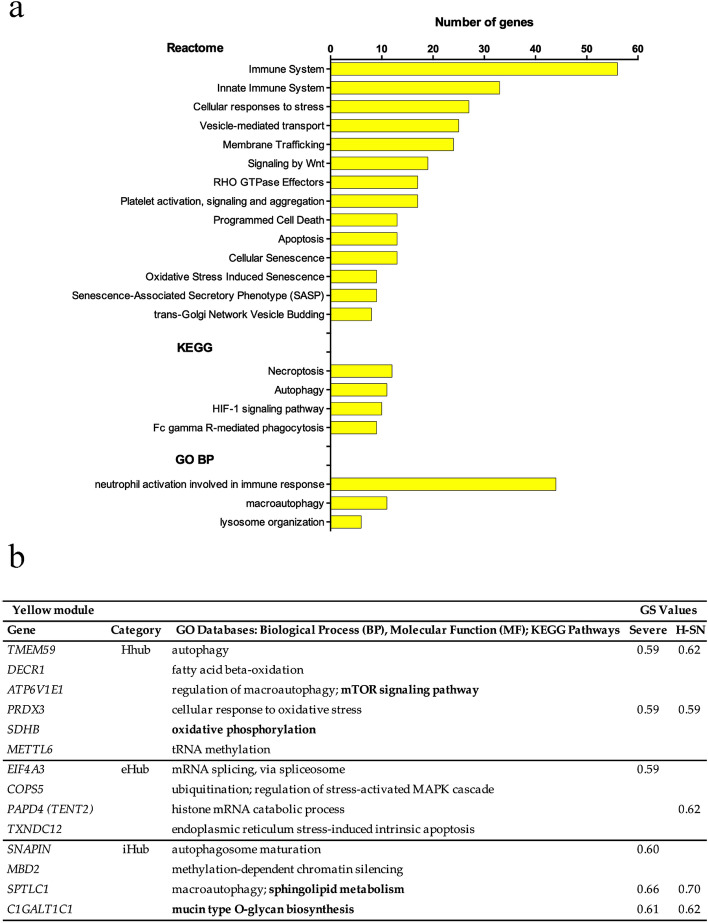
Enrichment analysis and high hierarchy genes (HH genes) for the yellow module. (a) Histogram of enriched Reactome, KEGG pathways, and GO BP terms. The terms with adjusted p < 0.05 were considered significant. (b) HH genes (Hhubs, iHubs, and eHubs) of this module, which is significantly and positively correlated with Severe group, subgroup B, H-SN, and L-Lymphs traits. Each HH gene is identified by its hierarchical categorization, GO biological process or molecular function, and KEGG Pathways-related terms (in bold letters). Only positive (i.e., hyper-expressed) or negative (i.e, hypo-expressed) significant GS values for the specific trait (p < 0.01) are shown. H-SN high percentage of segmented neutrophils in the hemogram, GS gene Significance.
Figure 3
Figure 3
Enrichment analysis and high hierarchy genes (HH genes) for the magenta module. (a) Histogram of enriched Reactome, KEGG pathways, and GO BP terms. The terms with adjusted p < 0.05 were considered significant. (b) HH genes (Hhubs, iHubs, and eHubs) of this module, which is significantly and positively correlated with Severe group, subgroup A, and with H-SN traits. Each HH gene is identified by its hierarchical categorization, GO biological process or molecular function, and KEGG Pathways-related terms (in bold letters). This module did not present significant Gene Significance (GS) values for any specific trait (p < 0.01).
Figure 4
Figure 4
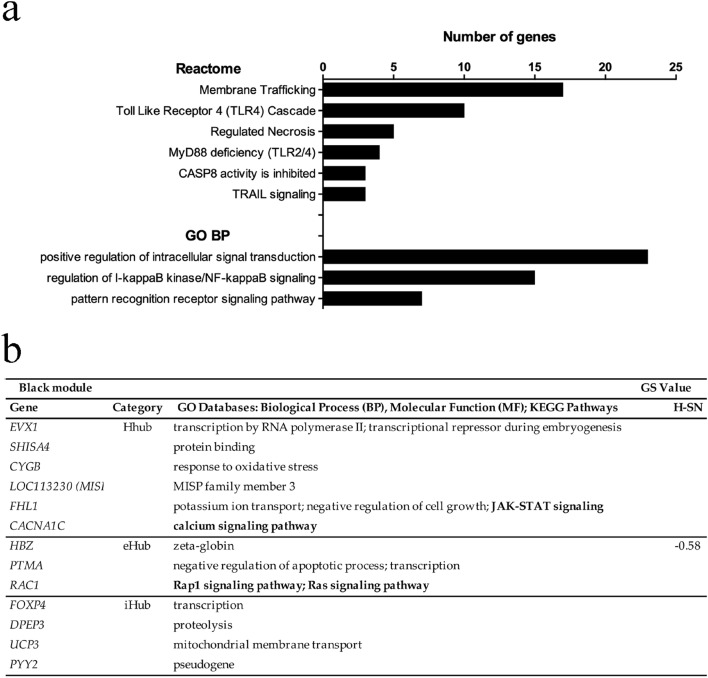
Enrichment analysis and high hierarchy genes (HH genes) for the black module. (a) Histogram of enriched Reactome and GO BP terms. The terms with adjusted p < 0.05 were considered significant. (b) HH genes (Hhubs, iHubs, and eHubs) of this module, which is significantly and positively correlated with subgroup A and with H-SN traits. Each HH gene is identified by its hierarchical categorization, GO biological process or molecular function, and KEGG Pathways-related terms (in bold letters). Only positive (i.e., hyper-expressed) or negative (i.e, hypo-expressed) significant GS values for the specific trait (p < 0.01) are shown. H-SN high per-centage of segmented neutrophils in the hemogram, GS gene significance.
Figure 5
Figure 5
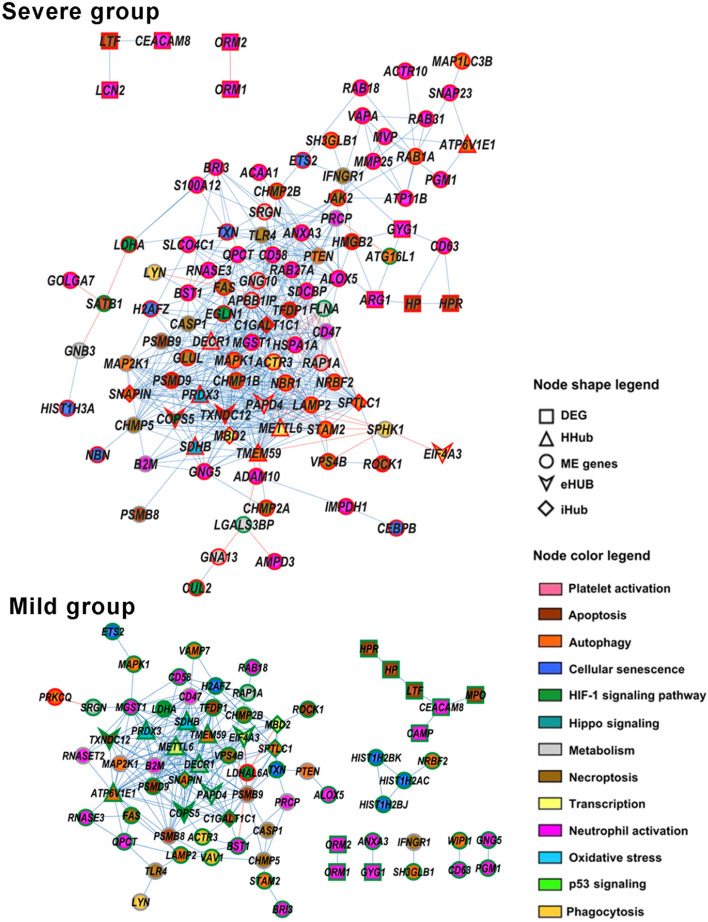
Subnetworks for the yellow module containing ME genes (non-HH module genes), hub genes, and DEGs for the Severe and Mild groups. Red or blue links indicate positive or negative expression correlation values, respectively. Red or green border colors account for hyper-expressed or hypo-expressed genes, respectively.
Figure 6
Figure 6
Subnetworks for the black module containing ME genes (non-HH module genes), hubs, and DEGs for the subgroups A and B. Red or blue links indicate positive or negative expression correlation values, respectively. Red or green border colors account for hyper-expressed or hypo-expressed genes, respectively.

References

    1. Arunachalam PS, et al. Systems biological assessment of immunity to mild versus severe COVID-19 infection in humans. Science. 2020;369:1210–1220. doi: 10.1126/science.abc6261. - DOI - PMC - PubMed
    1. Jackson H, et al. Characterisation of the blood RNA host response underpinning severity in COVID-19 patients. Sci. Rep. 2022;12:12216. doi: 10.1038/s41598-022-15547-2. - DOI - PMC - PubMed
    1. Xiong Y, et al. Transcriptomic characteristics of bronchoalveolar lavage fluid and peripheral blood mononuclear cells in COVID-19 patients. Emerg. Microbes Infect. 2020;9:761–770. doi: 10.1080/22221751.2020.1747363. - DOI - PMC - PubMed
    1. Daamen AR, et al. Comprehensive transcriptomic analysis of COVID-19 blood, lung, and airway. Sci. Rep. 2021;11:7052. doi: 10.1038/s41598-021-86002-x. - DOI - PMC - PubMed
    1. Prokop JW, et al. High-density blood transcriptomics reveals precision immune signatures of SARS-CoV-2 infection in hospitalized individuals. Front. Immunol. 2021;12:694243. doi: 10.3389/fimmu.2021.694243. - DOI - PMC - PubMed

Publication types