. 2023 Jan 18;18(1):e0279623.
doi: 10.1371/journal.pone.0279623. eCollection 2023.

A framework to quantify flow through coral reefs of varying coral cover and morphology

Affiliations

A framework to quantify flow through coral reefs of varying coral cover and morphology

Andrew W M Pomeroy et al. PLoS One. .

Abstract

Flow velocities within coral reefs are greatly reduced relative to those at the water surface. The in-reef flow controls key processes that flush heat, cycle nutrients and transport sediment from the reef to adjacent beaches, all key considerations in assessments of reef resilience and restoration interventions. An analytical framework is proposed and tested with a suite of high-resolution numerical experiments. We demonstrate a single parameter that describes the total coral frontal area explains variation of horizontally averaged velocity within a reef canopy across morphologies, densities, and flow depths. With the integration of existing data of coral cover and geometry, this framework is a practical step towards the prediction of near-bed flows in diverse reef environments.


Conflict of interest statement

The authors have declared that no competing interests exist.

Figures

Fig 1
Fig 1. The global distribution of the three archetypal benthos colony forms analyzed here (“table”, “massive” and “branching”).
Recorded observations [18] of the representative species (A) Acropora hyacinthus [15], (B) Porites lobata [15] and (C) Pocillopora edyouxi [16] are indicated by colored dots in (D) with grey shading indicating ecoregions [19] where these broad morphology types are likely to be found [17]. Panels A-C compare example morphologies of each representative species with the model forms embedded within numerical and experimental simulations (derived from reef colonies digitized in the field, kindly provided by The Hydrous, http://www.thehydro.us). The three coral archetypes are broadly representative of a reef benthos observed globally.
Fig 2
Fig 2. Conceptual model of the flow above and within benthos on a coral reef.
For a given water depth (H), the near-surface flow velocity (U) is greater than that within the reef region (Uc), which is defined by the height of the benthos (h) above the seabed. The plan area (Ap) and frontal area (Af) are shown for the three archetypal coral forms in Fig 1 (“Table”, “Massive” and “Branching”). Note that Af is not simply the total coral area projected into the flow; rather, it is the sum of the projected areas of all coral surfaces.
Fig 3
Fig 3
(A) Example of an experimental setup of the branching morphology used for directly measuring velocities in reefs comprised of 3-D printed coral specimens. (B) Comparison of within- and above-reef velocities predicted by the model with those observed in the laboratory. There is excellent agreement between model and experimental velocity values (RMSE = 0.008).
Fig 4
Fig 4
(A) Vertical profiles of the temporally- and horizontally-averaged velocity (<u>) for the archetypal coral forms. The shading represents the vertical region used to calculate the depth-averaged in-reef velocity (Uc). (B) The significant horizontal variability (at z/h = 0.5) of the instantaneous flow field within a reef consisting of the branched morphology.
Fig 5
Fig 5
The extent of flow attenuation β for the three archetypal coral forms is impacted by: (A) the colony coral cover, (B) the water depth H, (C) the angle of the approaching flow to the morphology θ, and (D) the near-surface velocity U. Where particular parameters were not varied, they took the default values in Table 1: coral cover of 20%, a depth of 0.16 m, a depth-averaged velocity of 0.16 m s-1 and θ = 0°. The coral cover and water depth have the greatest influence on β. The grey lines demonstrate general trends, but do not represent a particular functional form.
Fig 6
Fig 6. The performance of the predictive model (Eq 8) in collapsing the effects of reef colony morphology, coral cover, water depth, orientation and flow velocity into a single predictor variable for in-reef flow attenuation.
The solid markers indicate the coral cover cases for the three archetypal coral forms. The open markers indicate cases where depth, orientation or velocity (as indicated in brackets in the legend) were varied systematically for one coral morphology. The equation for the line of best fit is indicated on the plot, with the shading representing the 95% prediction interval.
Fig 7
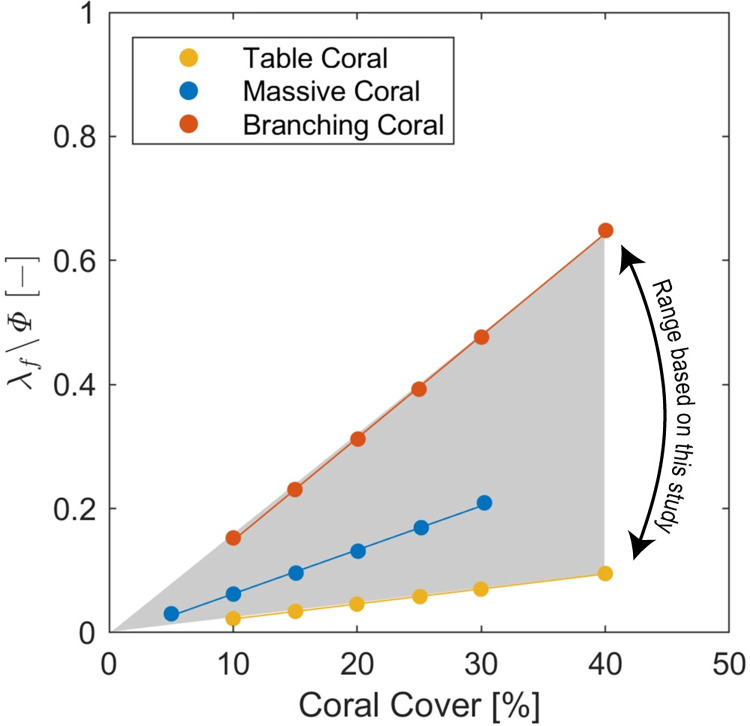
Fig 7. The allometric relationship between coral cover and the resultant value of λf/ϕ for three archetypal benthos colony forms (“table”, “massive” and “branching”) which are based on observations of the representative species Acropora hyacinthus [15], Porites lobata [15] and Pocillopora edyouxi [16], respectively.
The markers indicate data from the numerical simulations. The shaded area roughly represents the range of typical values based on the results of this study.

References

    1. Pomeroy AWM, Lowe RJ, Ghisalberti M, Storlazzi C, Symonds G, Roelvink D. Sediment transport in the presence of large reef bottom roughness. J Geophys Res Oceans. 2017;122: 1347–1368. doi: 10.1002/2016JC011755 - DOI
    1. Monismith SG. Hydrodynamics of Coral Reefs. Annu Rev Fluid Mech. 2007;39: 37–55. doi: 10.1146/annurev.fluid.38.050304.092125 - DOI
    1. Sebens K, Grace S, Helmuth B, Maney E Jr, Miles J. Water flow and prey capture by three scleractinian corals, Madracis mirabilis, Montastrea cavernosa and Porites porites, in a field enclosure. Mar Biol. 1998;131: 347–360.
    1. Thomas FIM, Atkinson MJ. Ammonium uptake by coral reefs: effects of water velocity and surface roughness on mass transfer. Limnol Oceanogr. 1997;42: 81–88.
    1. Todd PA. Morphological plasticity in scleractinian corals. Biol Rev. 2008;83: 315–337. doi: 10.1111/j.1469-185x.2008.00045.x - DOI - PubMed

Publication types