


Factors affecting the quality of life after ischemic stroke in young adults: a scoping review
- PMID: 36653785
- PMCID: PMC9850784
- DOI: 10.1186/s12955-023-02090-5
Factors affecting the quality of life after ischemic stroke in young adults: a scoping review
Abstract
Purpose: To synthesize the body of knowledge on the factors influencing the quality of life (QoL) after ischemic stroke (IS) in young adults.
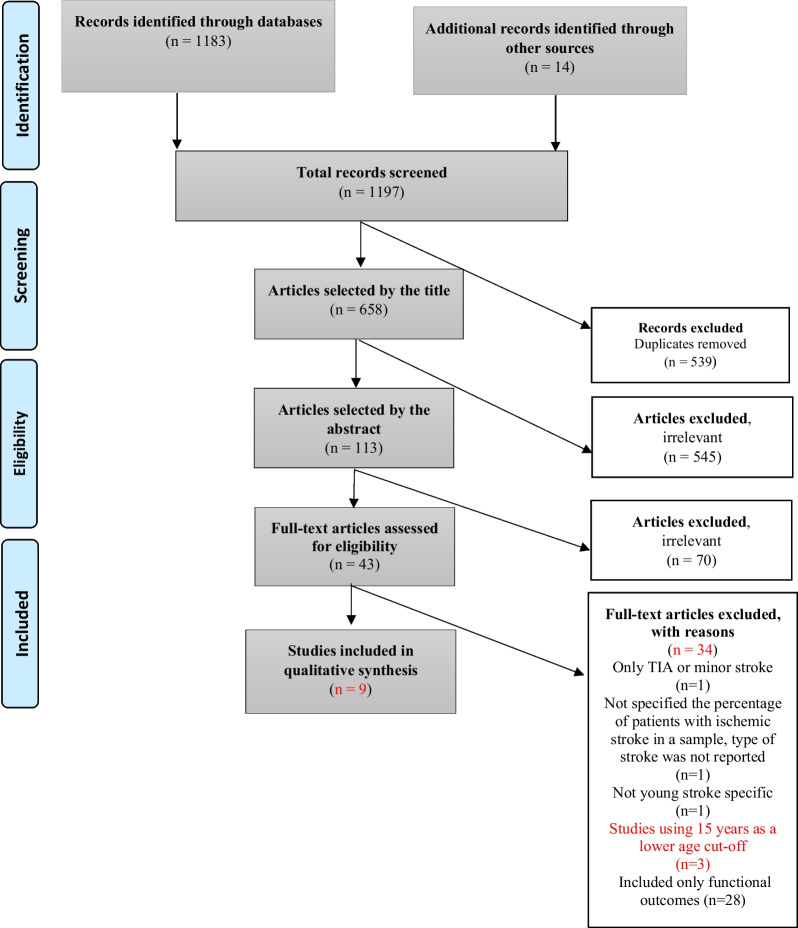
Methods: Guidelines regarding the scoping review methodology developed by the Joanna Briggs Institute, and the PRISMA-ScR checklist for a scoping review was used in this paper. A total of 1197 studies were identified through a bibliographic search in Web of Science, MEDLINE, PsycInfo, ScienceDirect, Scopus, and ProQuest Science Database. Articles published between the years 2000-2021 were included.
Results: A total of nine papers were finally selected to respond to the research question. Three studies were prospective longitudinal studies compared QoL between young stroke and age-matched controls from the general population. Across all the analysed studies, 14 variables potentially associated with QoL were identified. QoL in young patients is mainly affected by clinical outcomes after IS (scored by the modified Rankin scale and the Barthel index-favourable initial functional status and higher independence in ADL leads to higher QoL) and psychological factors (post-stroke fatigue and depression-higher levels of fatigue and depression lead to lower QoL). The reviewed studies emphasized the importance of functional outcomes, post-stroke depression, fatigue and anxiety and early return to work.
Conclusion: Further longitudinal studies are needed to identify the trajectory of post-stroke psychosocial symptoms over time and other potential predictors of unfavourable long-term QoL, thus specific young stroke rehabilitation and stroke self-management support programmes should be developed (address physical, psychological factors which influence the psychosocial adaptation post-stroke and the perception of the QoL).
Keywords: Fatigue; Functional outcome; Health-related quality of life; Post-stroke depression; Quality of life; Young ischemic stroke.
© 2023. The Author(s).
Conflict of interest statement
The authors declare that they have no competing interests.
Figures
References
-
- Ekker MS, Jacob MA, van Dongen MME, Aarnio K, Annamalai AK, Arauz A, Arnold M, Barboza MA, Bolognese M, Brouns R, Chuluun B, Chuluunbaatar E, Dagvajantsan B, Debette S, Don A, Enzinger C, Ekizoglu E, Fandler-Höfler S, Fazekas F, Fromm A, Gattringer T, Gulli G, Hoffmann M, Hora TF, Jern C, Jood K, Kamouchi M, Kim YS, Kitazono T, Kittner SJ, Kleinig TJ, Klijn CJM, Korv J, Lee TH, Leys D, Maaijwee NAM, Martinez-Majander N, Marto JP, Mehndiratta MM, Mifsud V, Montanaro VV, Owolabi MO, Patel VB, Phillips MC, Piechowski-Jozwiak B, Pikula A, Ruiz-Sandoval JL, Sarnowski B, Schreuder FHBM, Swartz RH, Tan KS, Tanne D, Tatlisumak T, Thijs V, Tuladhar AM, Viana-Baptista M, Vibo R, Wu TY, Yesilot N, Waje-Andreassen U, Pezzini A, Putaala J, de Leeuw FE. Global Outcome Assessment Life-long after stroke in young adults initiative-the GOAL initiative: study protocol and rationale of a multicentre retrospective individual patient data meta-analysis. BMJ Open. 2019;9(11):e031144. doi: 10.1136/bmjopen-2019-031144. - DOI - PMC - PubMed
-
- Yahya T, Jilani MH, Khan SU, Mszar R, Hassan SZ, Blaha MJ, Blankstein R, Virani SS, Johansen MC, Vahidy F, Cainzos-Achirica M, Nasir K. Stroke in young adults: current trends, opportunities for prevention and pathways forward. Am J Prevent Cardiol. 2020;3:100085. doi: 10.1016/j.ajpc.2020.100085. - DOI - PMC - PubMed
Publication types
MeSH terms
Grants and funding
LinkOut - more resources
Full Text Sources
Medical
