


Essential medicines for mental disorders: comparison of 121 national lists with WHO recommendations
- PMID: 36653880
- PMCID: PMC9850500
- DOI: 10.1186/s13690-022-01014-x
Essential medicines for mental disorders: comparison of 121 national lists with WHO recommendations
Abstract
Background: To compare the medicines for mental disorders included in national essential medicines lists with the World Health Organization (WHO) essential medicines list and assess the extent to which economic status and WHO Region account for the differences.
Methods: We searched WHO repository and government sites for national essential medicines lists and we abstracted medicines for mental disorders. We calculated the proportion of WHO essential medicines included, the total number of differences (counting both additions and deletions) between national and WHO model list and the proportion of lists including one second-generation oral antipsychotic plus one new-generation antidepressant. Non-parametric statistics was used to investigate whether these indicators were dependent on economic status and WHO Region.
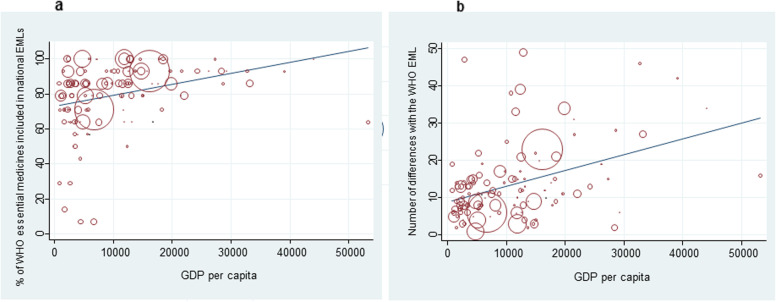
Results: Amongst the 121 identified national lists, the total number of medicines for mental disorders ranged from 2 to 63 (median: 18; IQR: 14 to 25). The median proportion of WHO essential medicines for mental disorders included was 86% (IQR: 71-93%), with 16 countries (13%, 95% CI 7.75-20.5%) including all WHO essential medicines, while the median number of differences with the WHO EML was 11 (IQR: 7 to 15). Country economic level was positively associated with both the proportion of WHO essential medicines included (Spearman's rho = 0.417, p < 0.001) and the number of differences (Spearman's rho = 0.345, p < 0.001), implying that countries with higher income level included more WHO essential medicines, but also more additional medicines. Significant differences were observed in relation to WHO Region, with the African and Western Pacific Region showing the lowest proportions of WHO essential medicines, and the European Region showing the highest median number of differences. Overall, 88 national lists (73%, 95% CI 63-80%) included at least one second-generation oral antipsychotic and new-generation antidepressant, with differences by income level and WHO Region.
Conclusions: The degree of alignment of national lists with the WHO model list is substantial, but there are considerable differences in relation to economic status and WHO Region. These findings may help decision-makers to identify opportunities to improve national lists, aiming to increase access to essential medicines for mental disorders.
Keywords: WHO; antidepressants; antipsychotics; essential medicines list; global health; low-middle income; mental health.
© 2023. The Author(s).
Conflict of interest statement
The authors declare that they have no competing interests.
Figures

References
LinkOut - more resources
Full Text Sources
