


Three-Dimensional Bioprinting of Perfusable Hierarchical Microchannels with Alginate and Silk Fibroin Double Cross-linked Network
- PMID: 36654759
- PMCID: PMC9586224
- DOI: 10.1089/3dp.2019.0115
Three-Dimensional Bioprinting of Perfusable Hierarchical Microchannels with Alginate and Silk Fibroin Double Cross-linked Network
Abstract
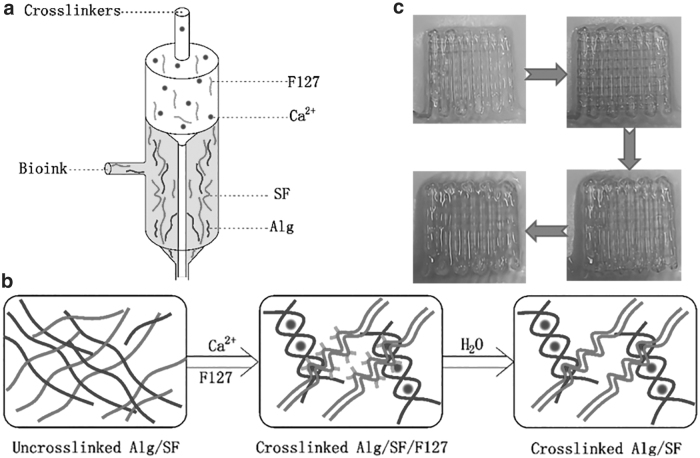
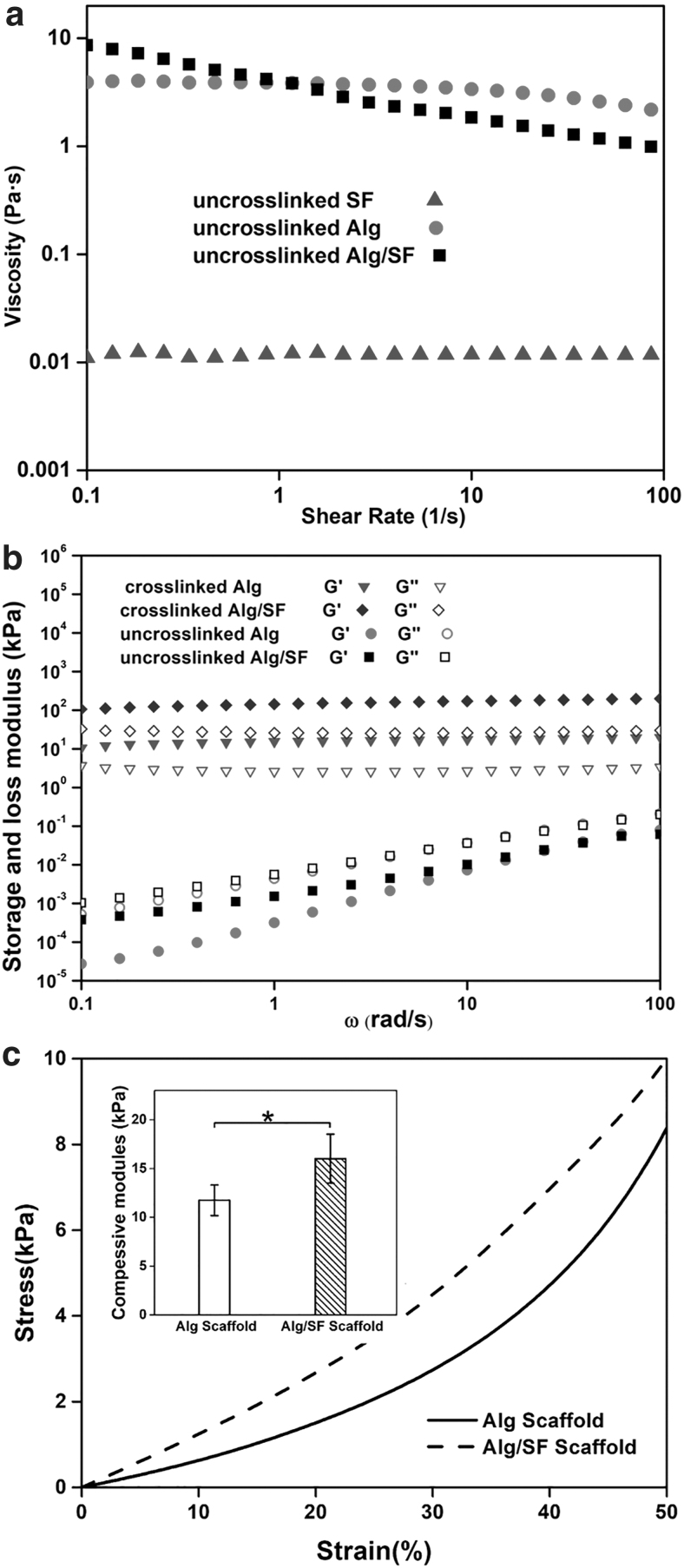
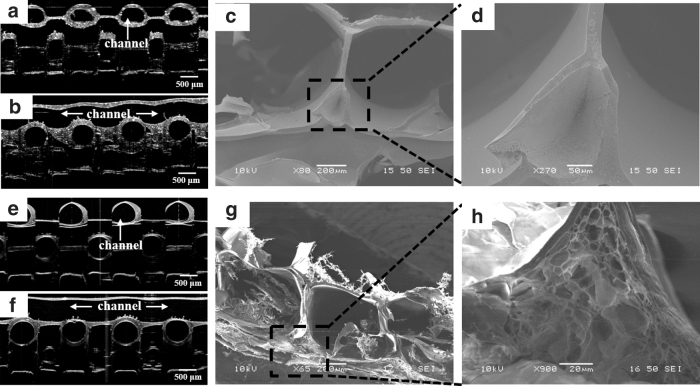
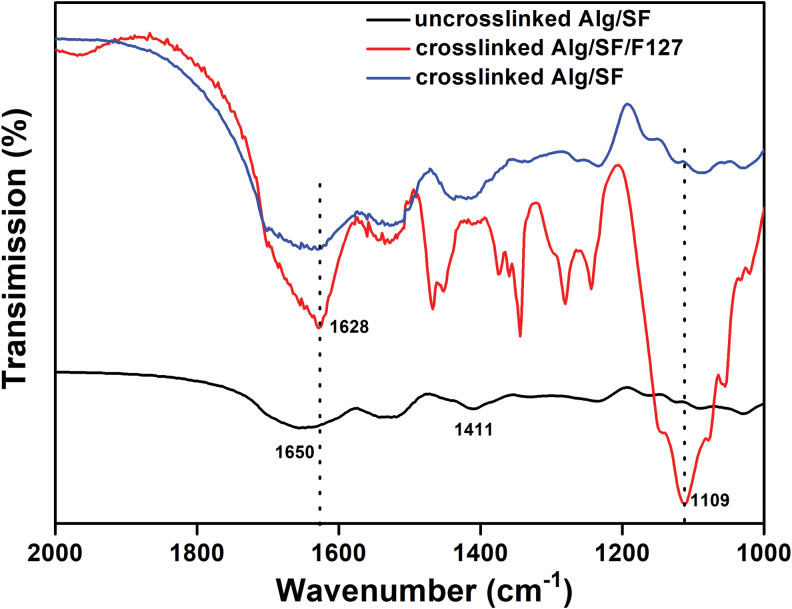
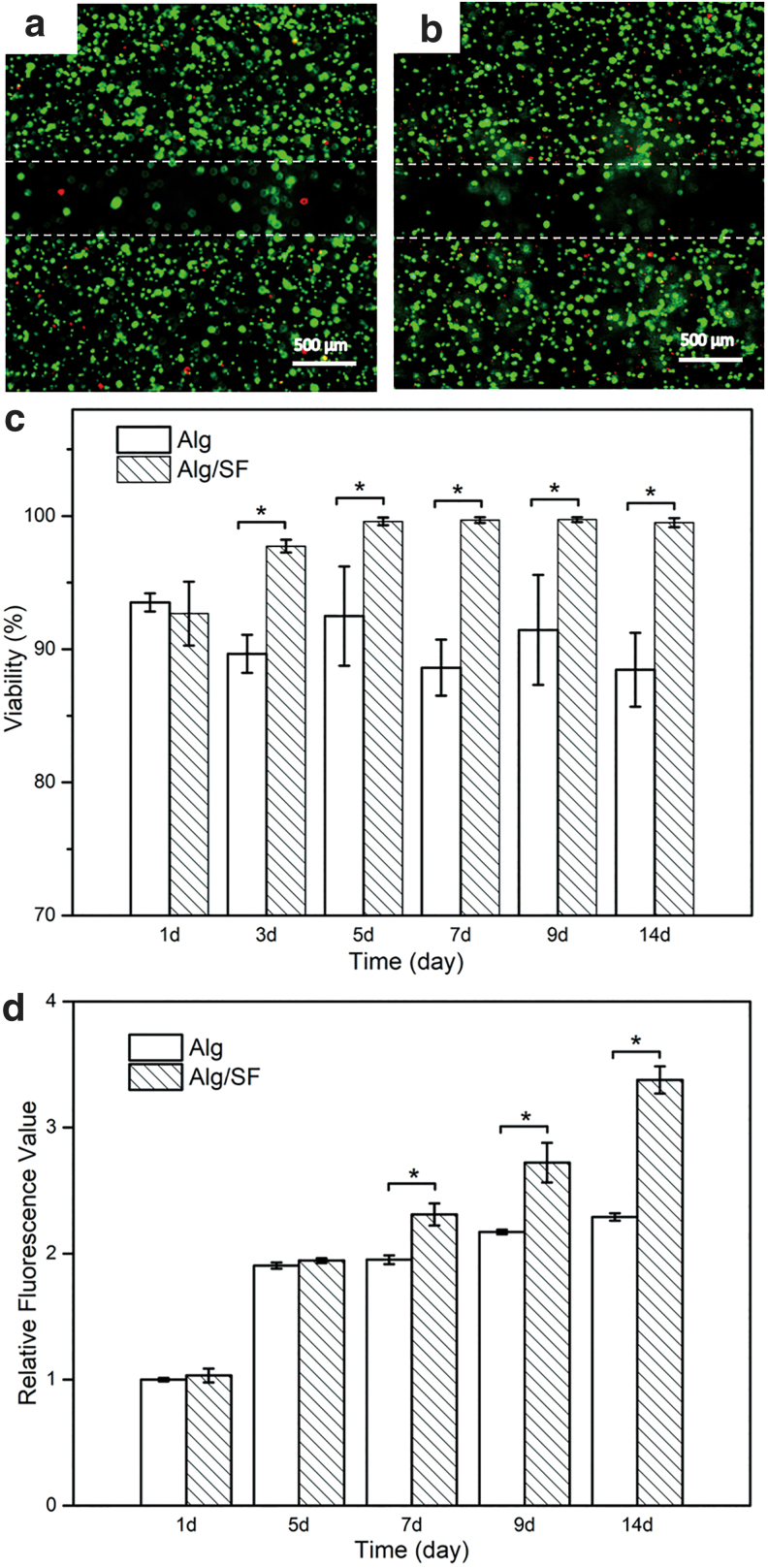
Vascularization is essential for the regeneration of three-dimensional (3D) bioprinting organs. As a general method to produce microfluidic channels in 3D printing constructs, coaxial extrusion has attracted great attention. However, the biocompatible bioinks are very limited for coaxial extrusion to fabricate microchannels with regular structure and enough mechanical properties. Herein, a hybrid bioink composed of alginate (Alg) and silk fibroin (SF) was proposed for 3D bioprinting of microchannel networks based on coaxial extrusion. The rheological properties of the bioink demonstrated that the hybrid Alg/SF bioink exhibited improved viscosity and shear thinning behavior compared with either pure Alg or SF bioink and had similar storage and loss modulus in a wide range of shear frequency, indicating a sound printability. Using a coaxial extrusion system with calcium ions and Pluronic F127 flowing through the core nozzle as cross-linkers, the Alg/SF bioink could be extruded and deposited to form a 3D scaffold with interconnected microchannels. The regular structure and smooth pore wall of microchannels inside the scaffold were demonstrated by optical coherence tomography. Micropores left by the rinse of F127 were observed by scanning electron microscope, constituting a hierarchical structure together with the microchannels and printed macropores. Fourier transform infrared spectroscopy analysis proved the complete rinse of F127 and the formation of β-sheet SF structure. Thus, Alg/SF could form a double cross-linked network, which was much stronger than the pure Alg network. Moreover, cells in the Alg/SF scaffold showed higher viability and proliferation rate than in the Alg scaffold. Therefore, Alg/SF is a promising bioink for coaxial extrusion-based 3D bioprinting, with the printed microchannel network beneficial for complex tissue and organ regeneration.
Keywords: 3D bioprinting; alginate; double cross-linked network; hierarchical microchannel; silk fibroin.
Copyright 2020, Mary Ann Liebert, Inc., publishers.
Conflict of interest statement
No competing financial interests exist.
Figures
References
-
- Murphy SV, Atala A. 3D bioprinting of tissues and organs. Nat Biotechnol 2014;32:773–785. - PubMed
-
- Lee W, Lee V, Polio S, et al. . On-demand three-dimensional freeform fabrication of multi-layered hydrogel scaffold with fluidic channels. Biotechnol Bioeng 2010;105:1178–1186. - PubMed
-
- Luo YX, Lode A, Gelinsky M. Direct plotting of three-dimensional hollow fiber scaffolds based on concentrated alginate pastes for tissue engineering. Adv Healthc Mater 2013;2:777–783. - PubMed
-
- Gao Q, He Y, Fu JZ, et al. . Coaxial nozzle-assisted 3D bioprinting with built-in microchannels for nutrients delivery. Biomaterials 2015;61:203–215. - PubMed
LinkOut - more resources
Full Text Sources
Research Materials