. 2022 Dec 16:28:146-159.
doi: 10.1016/j.omtm.2022.12.009. eCollection 2023 Mar 9.

High-efficiency purification of divergent AAV serotypes using AAVX affinity chromatography

Affiliations

High-efficiency purification of divergent AAV serotypes using AAVX affinity chromatography

Michael Florea et al. Mol Ther Methods Clin Dev. .

Abstract

The adeno-associated viral vector (AAV) provides a safe and efficient gene therapy platform with several approved products that have marked therapeutic impact for patients. However, a major bottleneck in the development and commercialization of AAV remains the efficiency, cost, and scalability of AAV production. Chromatographic methods have the potential to allow purification at increased scales and lower cost but often require optimization specific to each serotype. Here, we demonstrate that the POROS CaptureSelect AAVX affinity resin efficiently captures a panel of 15 divergent AAV serotypes, including the commonly used AAV2, AAV8, AAV9, PHP.B, and Anc80. We also find that AAVX resin can be regenerated repeatedly without loss of efficiency or carry-over contamination. While AAV preps purified with AAVX showed a higher fraction of empty capsids than preps purified using iodixanol ultracentrifugation, the potency of the AAVX purified vectors was comparable with that of iodixanol purified vectors both in vitro and in vivo. Finally, optimization of the purification protocol resulted in a process with an overall efficiency of 65%-80% across all scales and AAV serotypes tested. These data establish AAVX affinity chromatography as a versatile and efficient method for purification of a broad range of AAV serotypes.

Keywords: AAV; AAVX; adeno-associated; affinity chromatography; downstream; gene therapy; manufacturing; purification.


Conflict of interest statement

L.H.V. is an employee of ciendias bio and is a paid advisor to Novartis, Akouos, and Affinia Therapeutics, and serves on the Board of Directors of ciendias bio, Affinia, Addgene, and Odylia Therapeutics. L.H.V. holds equity in ciendias bio, Akouos, and Affinia and receives sponsored research funding from Albamunity Inc., to which he was an unpaid consultant. L.H.V. is an inventor on various patents licensed to multiple biopharmaceutical companies that are relevant to gene therapy including AAV manufacturing. M.F., A.J.W., and L.H.V. are named inventors on a patent covering some methods described in this work. E.A.-M. is an employee and holds equity in Akouos Inc. A.J.W. is a scientific advisor for Kate Therapeutics and Frequency Therapeutics and a co-founder, advisor, and holder of private equity in Elevian, Inc., which also provides sponsored research to the Wagers lab. A.J.W. and M.F. are inventors on various patents that include the use of AAVs for research and therapeutic applications. F.N. is an employee at Takeda Pharmaceutical Company Limited.

Figures
None
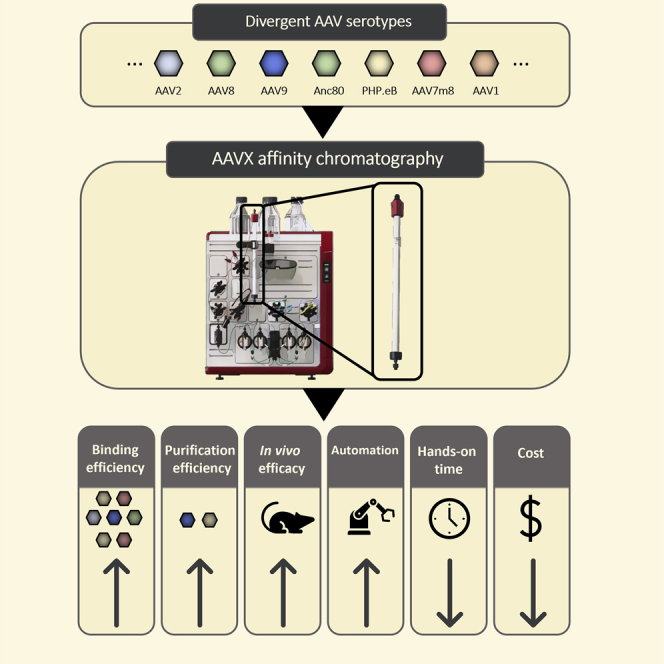
Graphical abstract
Figure 1
Figure 1
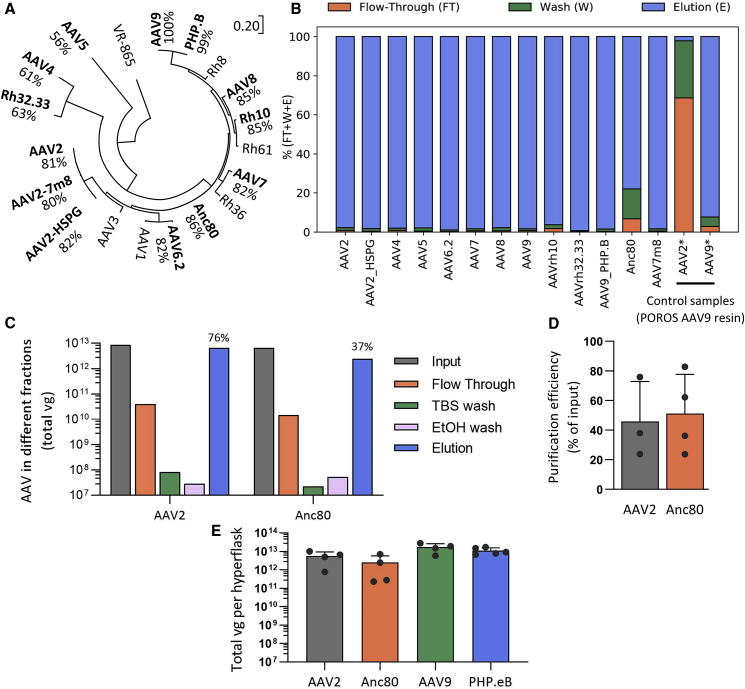
AAV purification using AAVX affinity chromatography (A) Phylogeny depicting the diversity of AAV capsids included in this report (bold) along with the percent identity (by amino acid) compared with AAV9. The tree is drawn to scale with branch lengths depicting substitutions per site. VR-865 is an avian AAV used as an outgroup. (B) Affinity of AAVX to various AAV serotypes tested in a static binding assay. The flow-through (FT), wash (W), and eluted fractions (E) were collected and analyzed by qPCR to quantify their vector genome copies. Data represented as percent vector genomes (vg) of the input. Each serotype was applied to unused AAVX resin. (C) AAV purification of AAV2 and Anc80 using AAVX resin in an HPLC setting. Fractions were taken from input, flow-through, at Tris-buffered saline (TBS) and ethanol wash steps and at elution, and AAV content was quantified using qPCR. Percent recovery for these purifications is shown above elution bars. N = 1 each. (D) Average purification efficiencies of AAV2 and Anc80 (percent recovery of AAV in the elution). (E) Total yields of purified AAV2, Anc80, AAV9, and PHP.eB preps with no optimization of the process. Each dot represents an AAV prep from one HYPERFlask (1,720 cm2 growth area). Error bars denote standard deviation. All purifications were carried out at room temperature, using 1-mL AAVX column at 1 mL/min flow rate. All values estimated are above qPCR limit of detection (approximately 105 vg/mL).
Figure 2
Figure 2
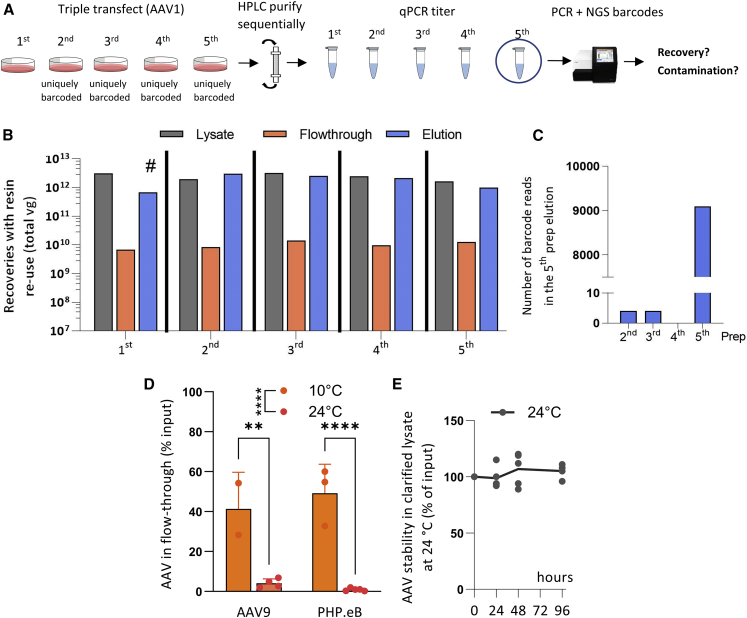
Effect of resin regeneration and temperature on purification efficiency (A) Overview of experimental design of figures (B) and (C). Five small-scale AAV1 preps were produced and purified sequentially on HPLC with AAVX resin without changing the resin between purifications. One prep contained AAV from one and a half 15-cm dishes. Preps 2–5 were identical except for a 100-bp barcode region. Vector genomes were quantified across all purifications. For the fifth prep, the barcode region was PCR amplified and next-generation sequenced, and the unique barcodes corresponding to each prep were quantified to estimate carry-over contamination from preps 2–4. AAV was applied to a column packed with 1 mL of AAVX resin at 1 mL/min flow rate at room temperature. (B) Purification efficiency with repeated resin use. Vector genomes in lysate, flow-through, and elution. Hash mark indicates that some of the sample was lost due to handling error. (C) Estimation of carry-over contamination. Barcode counts from preps 2–5, in the fifth prep estimated via next-generation sequencing. (D) Effect of purification temperature on the percentage of vector genomes found in flow-through for AAV9 and PHP.eB. Difference was assessed using two-way ANOVA with Šídák’s post hoc tests. (E) Stability of AAV (PHP.eB) in clarified lysate at 24°C over 96 h. ∗∗p < 0.01, ∗∗∗p < 0.001, ∗∗∗∗p < 0.0001. Error bars denote standard deviation.
Figure 3
Figure 3
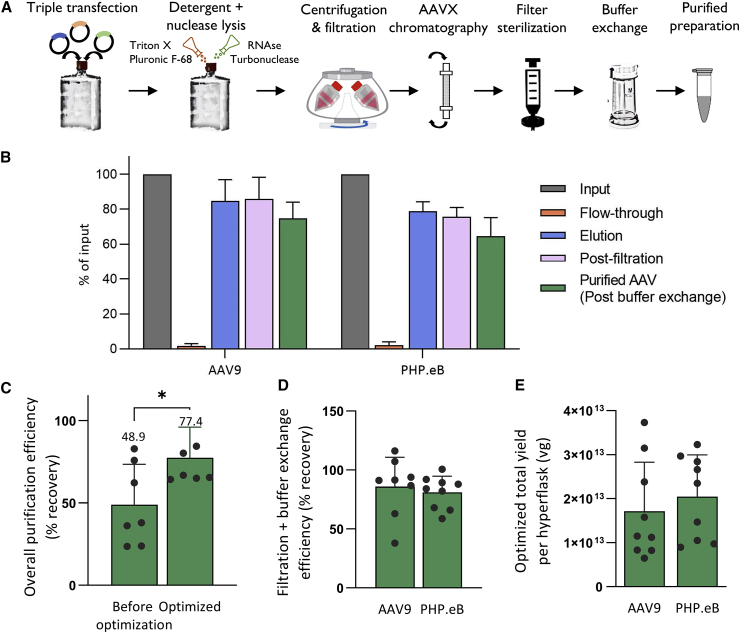
Optimized AAVX affinity purification process (A) Process steps of the protocol. (B) Stepwise recovery at each step of the purification process. Vector genomes were quantified via qPCR from aliquots of the sample at each process step and represented as normalized to the lysate. N = 6 biological replicates for both AAV9 and PHP.eB. (C) Overall purification efficiencies of the non-optimized and optimized protocols for AAV9 and PHP.eB combined. Difference was assessed using a two-tailed t test, with ∗p < 0.05. (D) Recovery after filtration + buffer exchange steps for AAV9 and PHP.eB. Note that the values above 100% fall within the range of the approximately 20% precision limit of qPCR titration, and likely do not represent actual recoveries above 100%. (E) Total yields per HYPERFlask across all vectors produced with scAAV9 and scPHP.eB and purified using this protocol. Error bars denote standard deviation in all panels. Note that this includes some vectors that have lower than average production yields. Detailed steps of the purification process are listed in supplemental protocol.
Figure 4
Figure 4
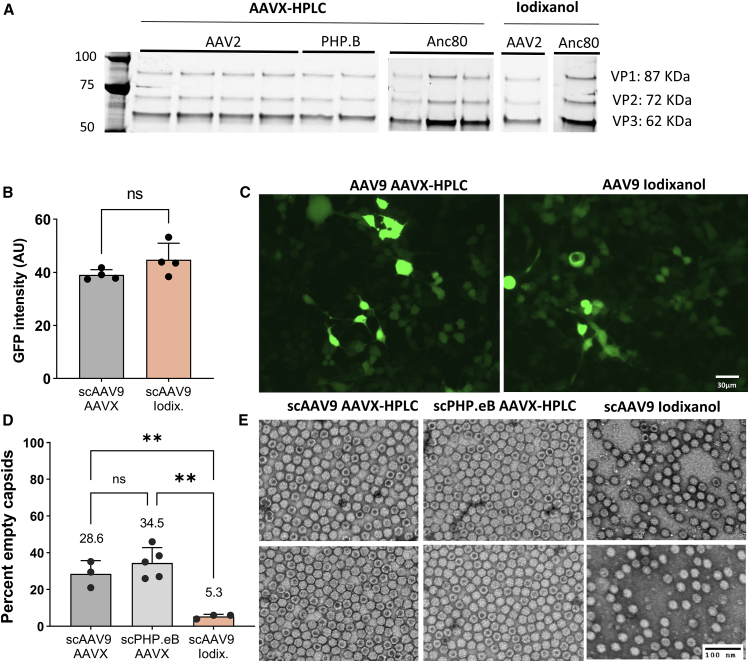
Quality and in vitro bioactivity of AAVX affinity-purified AAV (A) SYPRO Ruby-stained protein gel analysis of AAVX-HPLC versus iodixanol ultracentrifugation purified vectors. Most preps show clear, distinct VP1–VP3 bands, with few non-specific bands present, indicating comparable purity with iodixonal purified virus. (B) Quantification empty capsid content using negative stained TEM. Approximately N = 200 particles were counted for each prep from two separate images by two blinded researchers. Statistical significance was assessed using one-way ANOVA with follow-on Tukey’s multiple comparisons test. (C) Representative micrographs of AAVX and iodixanol purified preps used to perform the quantification, with two representative images shown for each. (D) In vitro infectivity of AAVX and iodixanol ultracentrifugation purified scAAV9 preps on HEK293 cells. Statistical significance was assessed using two-tailed t test. (E) Representative images used to perform the quantification in (D). ∗∗p < 0.01; ns (not significant), p > 0.05. Error bars denote standard deviation in all panels. See also Figures S5–S7 for full images of SYPRO Ruby gels, GFP micrographs, and TEM micrographs, respectively.
Figure 5
Figure 5
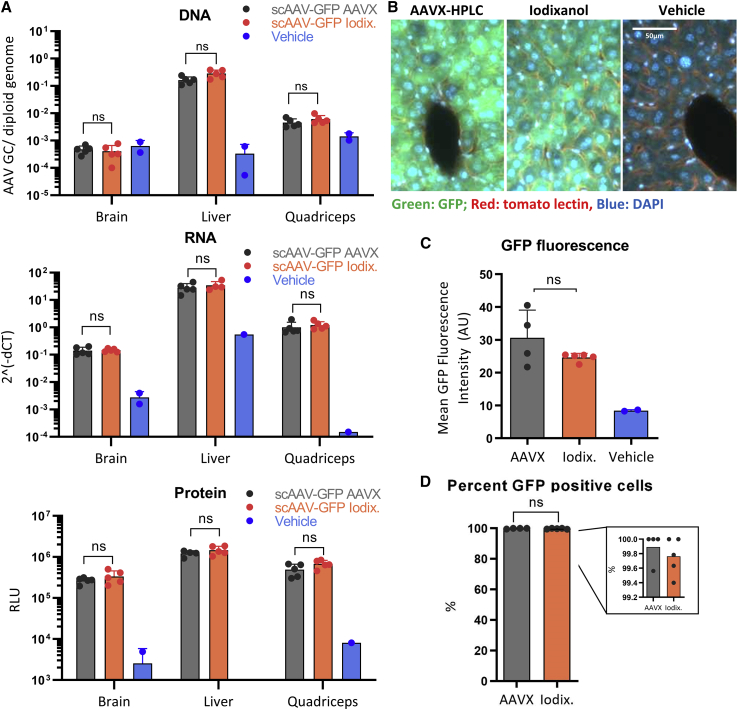
In vivo bioactivity of AAVX-HPLC and iodixanol ultracentrifugation purified AAV (A) Quantification of viral DNA and GFP RNA and protein levels in the liver, brain, and quadriceps of mice injected with a total of 1011 vg/mouse of scAAV9-Cbh-GFP. N = 5 for both scAAV-GFP AAVX and scAAV-GFP iodixinal injected mice, and N = 2 for vehicle-injected mice. DNA and RNA were quantified using qPCR and qRT-PCR, respectively, and protein using Simple Wes. Statistical significance was assessed using two-way ANOVA with Šídák’s post hoc tests. Statistically non-significant differences are not shown on the figure, except for AAVX versus iodixanol groups. Note that the AAV DNA levels in the brain were likely below the limit of quantification in this assay. (B–D) Imaging analysis of livers sectioned, stained for tomato lectin and DAPI, and imaged for native GFP fluorescence, tomato lectin, and DAPI. (C) Comparison of native GFP averaged from 400–700 cells per animal. (D) Percentage of cells that are GFP positive, counted as cells with a higher mean fluorescence intensity than the highest mean fluorescence intensity observed in the vehicle group. Statistical significance was assessed using one-way ANOVA with Tukey’s post hoc test for (C) and two-tailed t test for (D). ns, p > 0.05; ∗p < 0.05, ∗∗p < 0.01, ∗∗∗p < 0.001. Error bars denote standard deviation in all panels.

References

    1. Atchison R.W., Casto B.C., Hammon W.M. Adenovirus-associated defective virus particles. Science. 1965;149:754–756. - PubMed
    1. Hoggan M.D., Blacklow N.R., Rowe W.P. Studies of small DNA viruses found in various adenovirus preparations: physical, biological, and immunological characteristics. Proc. Natl. Acad. Sci. USA. 1966;55:1467–1474. - PMC - PubMed
    1. Samulski R.J., Muzyczka N. AAV-mediated gene therapy for research and therapeutic purposes. Annu. Rev. Virol. 2014;1:427–451. - PubMed
    1. Ginn S.L., Amaya A.K., Alexander I.E., Edelstein M., Abedi M.R. Gene therapy clinical trials worldwide to 2017: an update. J. Gene Med. 2018;20:e3015. - PubMed
    1. Crosson S.M., Dib P., Smith J.K., Zolotukhin S. Helper-free production of laboratory grade AAV and purification by iodixanol density gradient centrifugation. Mol. Ther. Methods Clin. Dev. 2018;10:1–7. - PMC - PubMed