


Prevalence of persons following a vegetarian diet in Germany
- PMID: 36654829
- PMCID: PMC9838578
- DOI: 10.17886/RKI-GBE-2016-039
Prevalence of persons following a vegetarian diet in Germany
Abstract
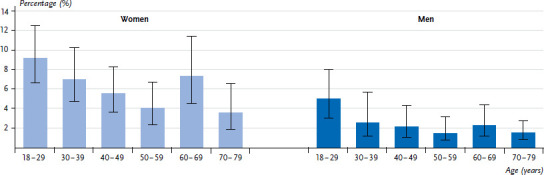
People adopt a vegetarian diet for various reasons. A largely plant-based diet not only has advantages for health, it also has positive social and environmental aspects. The aim of this analysis is to provide a description of the people in Germany who follow a predominantly vegetarian diet and to compare their food consumption with those of non-vegetarians. As part of DEGS1 (2008-2011), a validated questionnaire was used within a representative sample of 6,933 persons aged 18 to 79 to study how often and how much of 53 different food groups was consumed during a four-week period. The questionnaire also included a question about a vegetarian diet. The data were analysed descriptively and with a binary-logistical regression model. In Germany, 4.3% of the population (6.1% of women and 2.5% of men) aged 18 to 79 usually follows a vegetarian diet. The highest proportion of vegetarians is found among 18- to 29-year-olds (women 9.2% and men 5.0%) and among women aged 60 to 69 (7.3%). People with a higher level of education are more likely to usually follow a vegetarian diet. The same applies to people who live in large cities and those who conduct more than four hours of sports per week. In addition, women and men who usually follow a vegetarian diet not only consume significantly less meat compared with non-vegetarians, they also drink less energy-reduced drinks, and less beer and wine; they also drink more tea and eat more fruit and vegetables. A vegetarian lifestyle is often associated with positive socio-political impacts. It can, among others, contribute to a reduction in factory farming, which means it can help preserve the environment. A reduction in meat consumption in Germany would also be beneficial from a public health perspective, since meat consumption is currently considerably higher than the amounts recommended by the German Nutrition Society. The benefits linked to a vegetarian diet would be further strengthened, if, in addition to the relatively small group of people who completely refrain from eating meat, a larger section of the population would reduce their meat consumption.
Keywords: DEGS1; GERMANY; HEALTH SURVEY; NUTRITION; VEGETARIAN.
© Robert Koch Institute. All rights reserved unless explicitly granted.
Conflict of interest statement
Conflicts of interest The authors declared no conflicts of interest.
Figures
References
-
- Wissenschaftlicher Beirat Agrarpolitik, Ernährung und gesundheitlicher Verbraucherschutz und Wissenschaftlicher Beirat Waldpolitik beim Bundesministerium für Ernährung und Landwirtschaft, (2016) Klimaschutz in der Land- und Forstwirtschaft sowie den nachgelagerten Bereichen Ernährung und Holzverwendung. Gutachten. BMEL, Berlin www.bmel.de/DE/Ministerium/Organisation/Beiraete/_Texte/AgrVeroeffentlic... (As at 26.09.2016)
-
- Fields H, Millstine D, Agrwal N. (2014) Just plants? Impact of a vegetarian diet on mortality. J Womens Health (Larchmt) 23(11):987-988 - PubMed
-
- Leitzmann C. (2014) Vegetarian nutrition: past, present, future. Am J Clin Nutr 100 Suppl 1:496s-502s - PubMed
-
- Frentzel-Beyme R, Claude J, Eilber U. (1988) Mortalität und Krebsrisiko bei Vegetariern: 5-Jahresergebnis einer Epidemiologischen Kohortenstudie. Medizinische Informationsverarbeitung und Epidemiologie im Dienste der Gesundheit. Springer, P. 153-155
LinkOut - more resources
Full Text Sources
Research Materials