. 2023 Feb 28;14(1):e0213122.
doi: 10.1128/mbio.02131-22. Epub 2023 Jan 19.

"Failure To Launch": Development of a Reproductive Organ Linked to Symbiotic Bacteria

Affiliations

"Failure To Launch": Development of a Reproductive Organ Linked to Symbiotic Bacteria

Sarah J McAnulty et al. mBio. .

Abstract

Developmental processes in animals are influenced by colonization and/or signaling from microbial symbionts. Here, we show that bacteria from the environment are linked to development of a symbiotic organ that houses a bacterial consortium in female Hawaiian bobtail squid, Euprymna scolopes. In addition to the well-characterized light organ association with the bioluminescent bacterium Vibrio fischeri, female E. scolopes house a simple bacterial community in a reproductive organ, the accessory nidamental gland (ANG). In order to understand the influences of bacteria on ANG development, squid were raised in the laboratory under conditions where exposure to environmental microorganisms was experimentally manipulated. Under conditions where hosts were exposed to depleted environmental bacteria, ANGs were completely absent or stunted, a result independent of the presence of the light organ symbiont V. fischeri. When squid were raised in the laboratory with substrate from the host's natural environment containing the native microbiota, normal ANG development was observed, and the bacterial communities were similar to wild-caught animals. Analysis of the bacterial communities from ANGs and substrates of wild-caught and laboratory-raised animals suggests that certain bacterial groups, namely, the Verrucomicrobia, are linked to ANG development. The ANG community composition was also experimentally manipulated. Squid raised with natural substrate supplemented with a specific ANG bacterial strain, Leisingera sp. JC1, had high proportions of this strain in the ANG, suggesting that once ANG development is initiated, specific strains can be introduced and subsequently colonize the organ. Overall, these data suggest that environmental bacteria are required for development of the ANG in E. scolopes. IMPORTANCE Microbiota have profound effects on animal and plant development. Hosts raised axenically or without symbionts often suffer negative outcomes resulting in developmental defects or reduced organ function. Using defined experimental conditions, we demonstrate that environmental bacteria are required for the formation of a female-specific symbiotic organ in the Hawaiian bobtail squid, Euprymna scolopes. Although nascent tissues from this organ that are involved with bacterial recruitment formed initially, the mature organ failed to develop and was absent or severely reduced in sexually mature animals that were not exposed to microbiota from the host's natural environment. This is the first example of complete organ development relying on exposure to symbiotic bacteria in an animal host. This study broadens the use of E. scolopes as a model organism for studying the influence of beneficial bacteria on animal development.

Keywords: Alphaproteobacteria; Euprymna; Euprymna scolopes; Verrucomicrobia; accessory nidamental gland; bacteria; development; developmental biology; marine bacteria; squid; symbiosis.


Conflict of interest statement

The authors declare no conflict of interest.

Figures
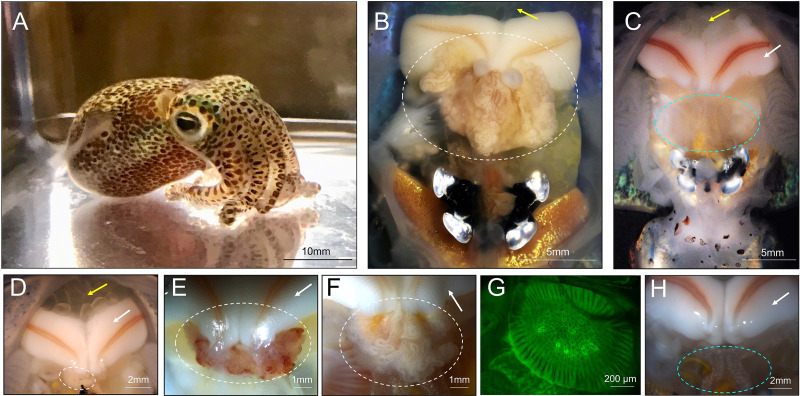
FIG 1
FIG 1
Female Hawaiian bobtail squid develop accessory nidamental glands in response to environmental substrate. (A) Adult Hawaiian bobtail squid. (B) Ventral dissection shows the accessory nidamental gland (ANG, white circle) of a sexually mature wild-caught animal (image modified from Kerwin et al., 2021 [40]). (C) Ventral dissection of a sexually mature lab-raised (lab sand, see Fig. 2) squid, showing where an ANG failed to develop (blue circle). Tissue shown within circle is part of the digestive gland, dorsal to where the ANG would normally be located. (D–H) Representative images depicting the ANGs of animals raised in various conditions, including, (D) lab sand (see Fig. 2) with a stunted ANG (white circle), (E) an ANG from a Wisconsin-raised animal (white circle), (F) an ANG from a Connecticut-raised animal on wet-collected sand (white circle), (G) a confocal micrograph of a nascent ANG from a Connecticut-raised animal on autoclaved wet-collected sand, and (H) an animal raised on dry-collected Hawaiian sand, ANG is absent (blue circle). White arrows indicate fully formed nidamental glands (C–F, H), yellow arrows indicate eggs in mantle cavity (B–D).
FIG 2
FIG 2
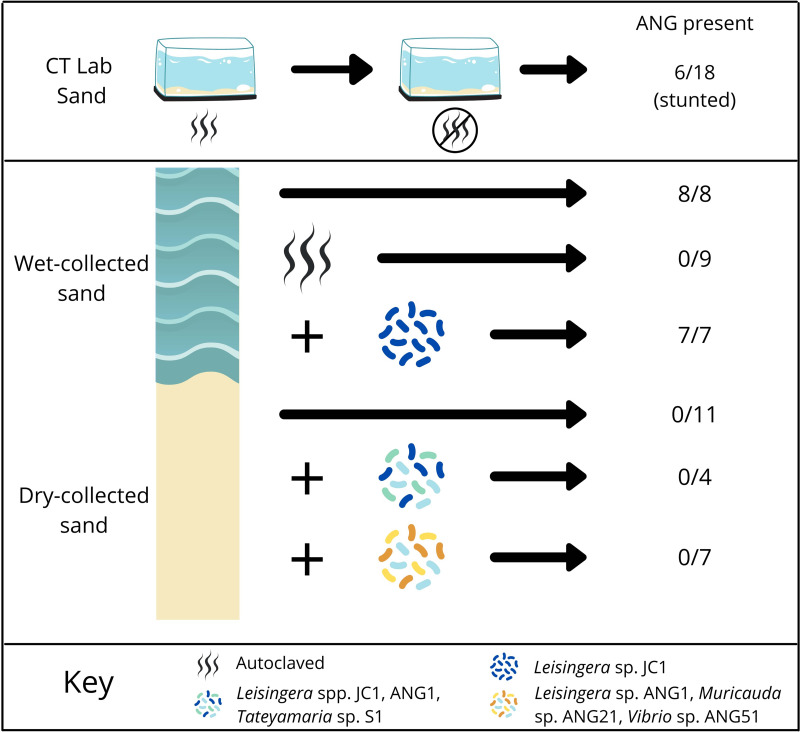
Experimental design and effects of substrate raising conditions on ANG development. Squid raised in Connecticut under “lab sand” conditions: Hatchlings were first raised with autoclaved sand and filter-sterilized artificial seawater until they were approximately 8–10 mm mantle length. They were then transferred to tanks that had previously housed wild-caught squid on unautoclaved sand and raised to sexual maturity. For the “wet-collected conditions,” squid were raised on sand obtained from below the low-tide mark in Maunalua Bay, Oahu, HI. Squid were also raised on wet-collected sand that had been autoclaved prior to rearing. In separate experiments, Leisingera sp. JC1 was added to tanks for squid which were also raised on wet-collected sand. For “dry-collected conditions,” squid were raised on substrate collected from above the high-tide mark (see methods), and specific ANG isolates were added to some conditions as shown. Numbers on the right indicate the number of ANGs that formed in adult animals out of the total number of female animals from that condition.
FIG 3
FIG 3
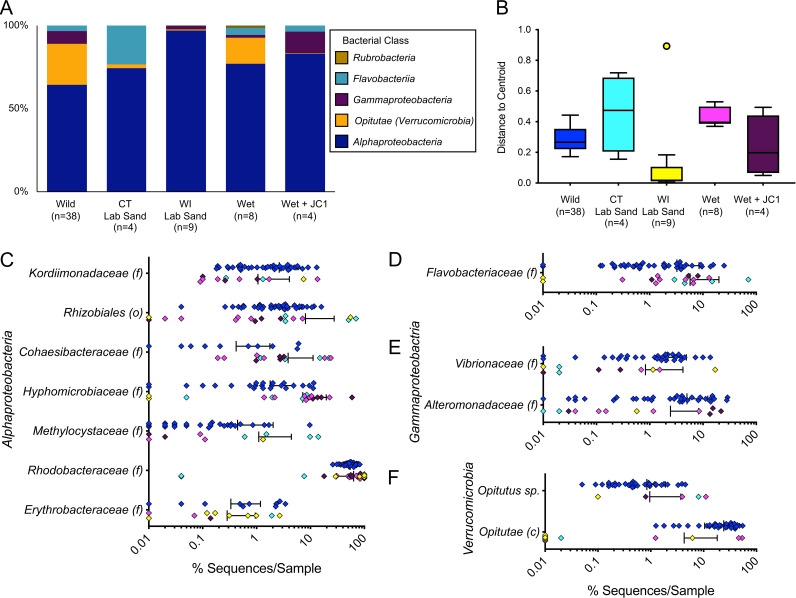
Taxonomic diversity of laboratory-raised E. scolopes ANG communities (class level: A, finer levels: C–F) shows that the ANG communities of raised animals were dominated by Alphaproteobacteria (A, C), but almost completely lacked Opitutae (class of Verrucomicrobia) unless animals were raised on wet-collected sand (A, F). Flavobacteriia were only found in ANGs from CT-raised animals (D). Raised animals showed high levels of variability for all taxa (C–F), also evident from a plot of the average distance from the beta diversity centroid for each condition (B). Finer level plots (C–F) are shown on a log scale and include samples which contained these taxa at >0.1% abundance (c: class, f: family, o: order). Colors of C–F are the same as those in B. “Wet” indicates wet-collected sand throughout. “Lab sand” samples are from stunted ANGs from raising experiments not conducted on wet-collected sand (Fig. 2). Bars in C–F indicate mean +/− standard deviation.
FIG 4
FIG 4
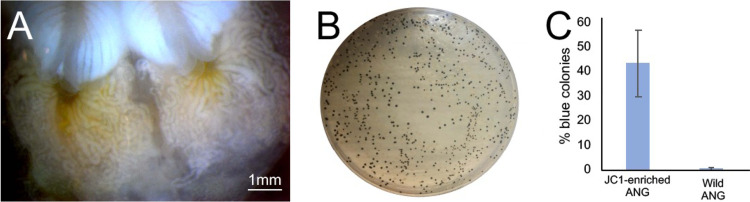
A specific member of the ANG community, Leisingera sp. JC1, was incorporated into ANG tubules. (A) A representative image of the ANG of a squid raised on wet-collected Hawaiian sand with the addition of strain Leisingera sp. JC1 to the tank water. (B) Representative plate of the cultivable ANG community with blue colonies representing Leisingera sp. JC1. (C) On average, 43% +/− 13.5% of colonies plated from ANGs raised on wet-collected sand + JC1 (n = 5) were blue, compared to an average of 0.5% +/− 0.5% of colonies plated from wild-caught ANG homogenate (n = 5). Bars in C indicate mean +/− standard deviation.
FIG 5
FIG 5
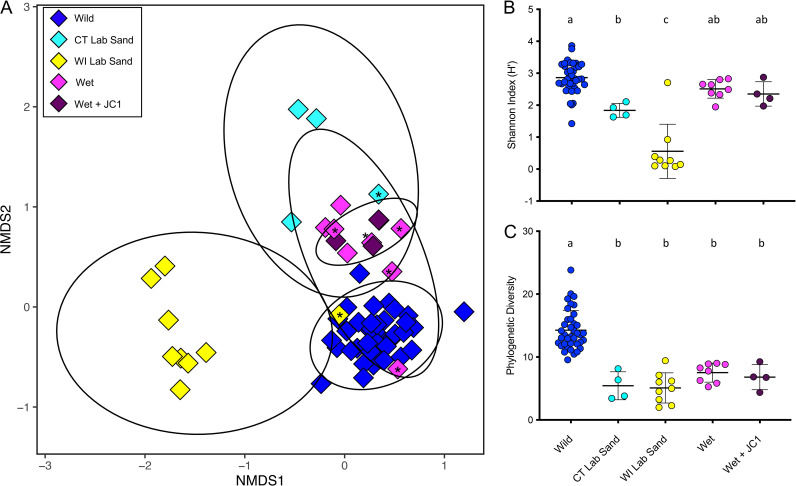
Bray Curtis beta diversity analysis demonstrates that the ANG bacterial composition of lab-raised animals was generally distinct from that of wild-caught E. scolopes, but those animals raised on wet-collected sand had a community that most closely resembled that of wild-caught animals (A). Asterisks indicate raised ANGs with >4% relative abundance of Verrucomicrobia, demonstrating that a higher abundance of Verrucomicrobia appears to shift the overall community composition toward that of the wild-caught animals (A). The richness and evenness of the community was not significantly lower than that of ANGs from wild-caught squid for animals raised on wet-collected sand (B), but the phylogenetic diversity of all ANGs from raised animals was significantly lower than that of wild-caught animals (C). Letter groups denote significantly different alpha diversity levels (B: F4,58 = 36.75, P < 0.0001; C: F4,58 = 32.34, P < 0.0001), based on one-way ANOVA and post hoc Tukey’s test for multiple comparisons. “Wet” indicates wet-collected sand throughout. “Lab sand” samples are from stunted ANGs from raising experiments not conducted on wet-collected sand (Fig. 2).
FIG 6
FIG 6
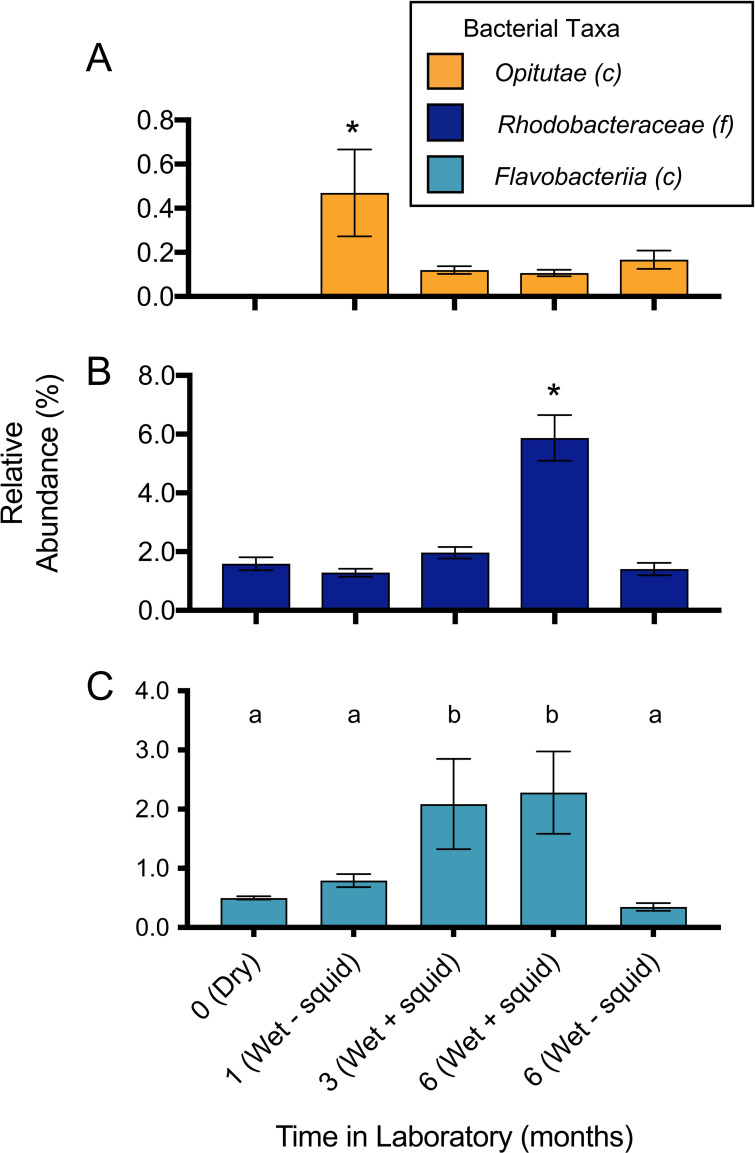
Changes of selected taxa within the sediment bacterial community of lab-raised animals. Sediment (sand) community was profiled (n = 3/time point) 1 month after arrival in lab, 3 months post collection (with squid present in tanks), and 6 months post collection (both with and without squid present in tanks). The community of dry-collected sand was also profiled when it first arrived in the lab. Asterisk denotes significantly different relative abundance levels (A: F4,10 = 11.34, P = 0.001; B: F4,10 = 75.65, P < 0.0001), as do letter groups (C: F4,10 = 11.49, P = 0.001), based on one-way ANOVA and post hoc Tukey’s test for multiple comparisons. Opitutae is a class of Verrucomicrobia; Rhodobacteraceae is a class of Alphaproteobacteria. Note differences in y axes for different taxa on bar graphs. “Wet” indicates wet-collected sand throughout. “Dry” indicates dry-collected sand throughout.
FIG 7
FIG 7
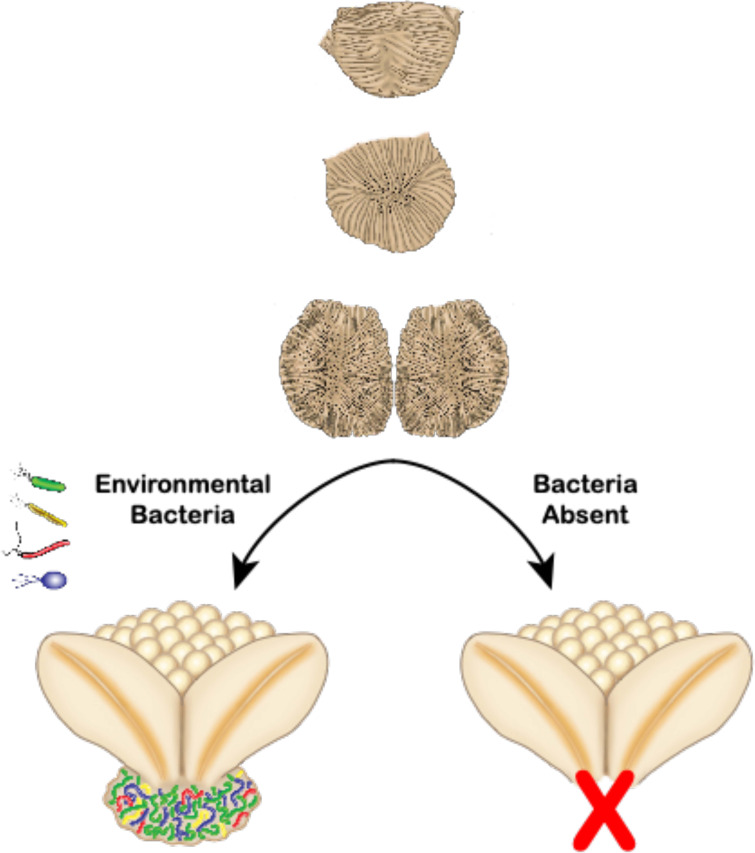
Model for lack of complete ANG development in the absence of environmental bacteria. The nascent ANG primordium forms over the first month after hatching and is poised to recruit environmental bacteria during colonization (40) (upper images). We hypothesize that if specific environmental bacteria are present during a colonization window, the adult ANG fully develops and is present at sexual maturity (lower left). If specific environmental bacteria (possibly Verrucomicrobia) are not present, the ANG primordium regresses, initiation of tubule development fails, and associated tissues do not form. The ANG is then absent in sexually mature adults that are raised in conditions with a reduced or inappropriate bacterial environmental background (lower right). Illustration by Virge Kask.

References

    1. Smith D, Muscatine L, Lewis D. 1969. Carbohydrate movement from autotrophs to heterotrophs in parasitic and mutualistic symbiosis. Biol Rev Camb Philos Soc 44:17–90. doi:10.1111/j.1469-185x.1969.tb00821.x. - DOI - PubMed
    1. Douglas AE. 2009. The microbial dimension in insect nutritional ecology. Funct Ecol 23:38–47. doi:10.1111/j.1365-2435.2008.01442.x. - DOI
    1. Sonnenburg JL, Bäckhed F. 2016. Diet-microbiota interactions as moderators of human metabolism. Nature 535:56–64. doi:10.1038/nature18846. - DOI - PMC - PubMed
    1. Flórez LV, Biedermann PHW, Engl T, Kaltenpoth M. 2015. Defensive symbioses of animals with prokaryotic and eukaryotic microorganisms. Nat Prod Rep 32:904–936. doi:10.1039/c5np00010f. - DOI - PubMed
    1. Miyashiro T, Ruby EG. 2012. Shedding light on bioluminescence regulation in Vibrio fischeri. Mol Microbiol 84:795–806. doi:10.1111/j.1365-2958.2012.08065.x. - DOI - PMC - PubMed

Publication types

LinkOut - more resources