


Seeking Health Care for Perimenopausal Symptoms: Observations from The Women Living Better Survey
- PMID: 36656145
- PMCID: PMC10079240
- DOI: 10.1089/jwh.2022.0230
Seeking Health Care for Perimenopausal Symptoms: Observations from The Women Living Better Survey
Abstract
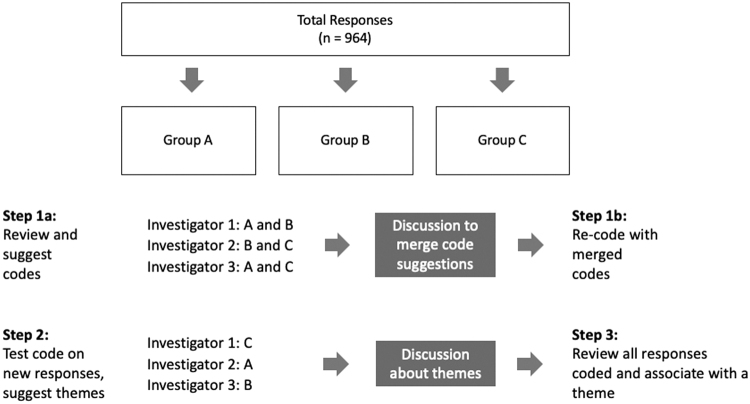
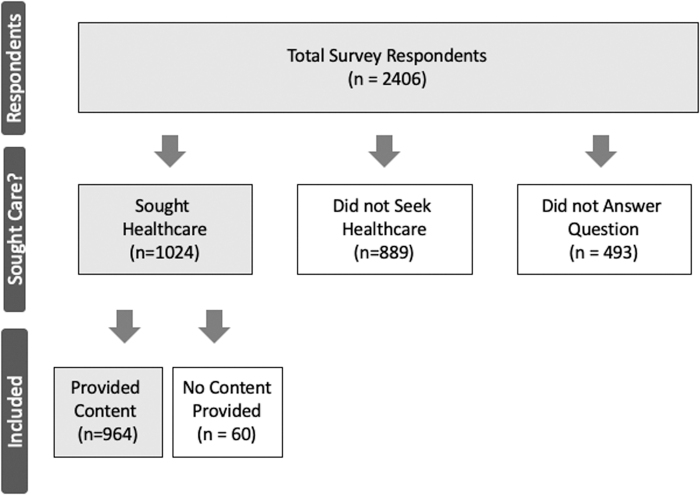
Background: The perimenopausal health care interaction can be challenging both for those seeking care and health care professionals (HCPs). We explore the factors that contribute to making these health care interactions either satisfying or unsatisfying for a midlife person with ovaries who consults an HCP about bothersome symptoms. Materials and Methods: Respondents to the Women Living Better (WLB) survey were asked about 61 symptoms often associated with the menopausal transition. They were then asked whether they sought health care for their most bothersome one. Of the 1024 participants who consulted an HCP, 964 provided a response to the open-ended question "how did that go?" We used conventional content analysis to code the responses and identify themes. Results: We identified six codes reflecting positive health care interactions which we then grouped into five themes suggesting satisfaction with these health care interactions. These included: validating experiences; having matching explanatory models; being supported by a team; engaging in shared decision-making; and having symptoms addressed. We identified 13 codes reflecting negative health care interactions which we then group into 4 themes suggesting dissatisfaction. These included: invalidating experiences, a mismatch in expectations between care recipients and HCP, barriers to treatment, and not feeling helped. Conclusions: Those seeking health care for bothersome symptoms on the path to menopause responded with both positive and negative comments about health care interactions in the WLB survey. Studying these comments identifies opportunities to improve midlife care.
Keywords: Midlife Women's Health Care; anticipatory guidance; health care satisfaction; menopause; perimenopausal health care; perimenopausal health care interactions.
Conflict of interest statement
No competing financial interests exist.
Figures
References
-
- Duggan A, Street RL Jr. Chapter 13. Interpersonal Communication in Health and Illness. In: Health Behavior: Theory, Research and Practice (Glanz K, Rimer BK, & Viswanath K, eds.) Jossey-Bass/Wiley: San Francisco, 2015; pp. 243–267.
-
- Guthrie JR, Dennerstein L, Taffe JR, et al. Health care-seeking for menopausal problems. Climacteric 2003;6(2):112–117. - PubMed
MeSH terms
LinkOut - more resources
Full Text Sources
Medical
Miscellaneous
