


HvNCX, a prime candidate gene for the novel qualitative locus qS7.1 associated with salinity tolerance in barley
- PMID: 36656369
- PMCID: PMC9852152
- DOI: 10.1007/s00122-023-04267-4
HvNCX, a prime candidate gene for the novel qualitative locus qS7.1 associated with salinity tolerance in barley
Erratum in
-
Correction to volume 136 issue 1.Theor Appl Genet. 2023 Mar 23;136(4):84. doi: 10.1007/s00122-023-04323-z. Theor Appl Genet. 2023. PMID: 36952001 Free PMC article. No abstract available.
Abstract
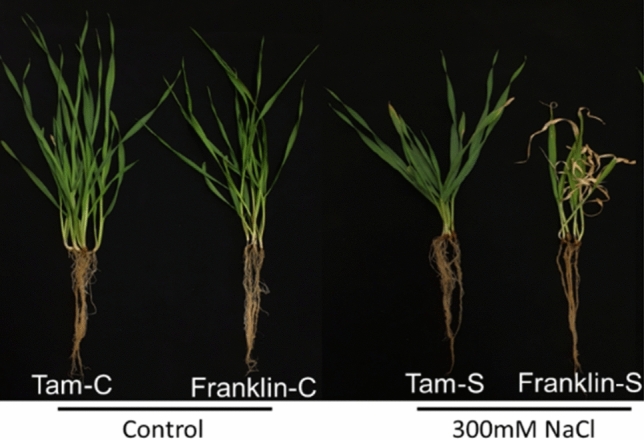
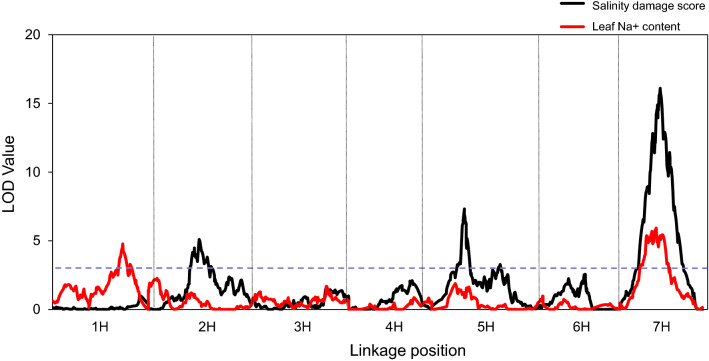
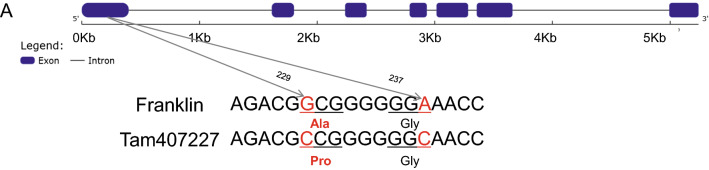
A major QTL (qS7.1) for salinity damage score and Na+ exclusion was identified on chromosome 7H from a barley population derived from a cross between a cultivated variety and a wild accession. qS7.1 was fine-mapped to a 2.46 Mb physical interval and HvNCX encoding a sodium/calcium exchanger is most likely the candidate gene. Soil salinity is one of the major abiotic stresses affecting crop yield. Developing salinity-tolerant varieties is critical for minimizing economic penalties caused by salinity and providing solutions for global food security. Many genes/QTL for salt tolerance have been reported in barley, but only a few of them have been cloned. In this study, a total of 163 doubled haploid lines from a cross between a cultivated barley variety Franklin and a wild barley accession TAM407227 were used to map QTL for salinity tolerance. Four significant QTL were identified for salinity damage scores. One (qS2.1) was located on 2H, determining 7.5% of the phenotypic variation. Two (qS5.1 and qS5.2) were located on 5H, determining 5.3-11.7% of the phenotypic variation. The most significant QTL was found on 7H, explaining 27.8% of the phenotypic variation. Two QTL for Na+ content in leaves under salinity stress were detected on chromosomes 1H (qNa1.1) and 7H(qNa7.1). qS7.1 was fine-mapped to a 2.46 Mb physical interval using F4 recombinant inbred lines. This region contains 23 high-confidence genes, with HvNCX which encodes a sodium/calcium exchanger being most likely the candidate gene. HvNCX was highly induced by salinity stress and showed a greater expression level in the sensitive parent. Multiple nucleotide substitutions and deletions/insertions in the promoter sequence of HvNCX were found between the two parents. cDNA sequencing of the HvNCX revealed that the difference between the two parents is conferred by a single Ala77/Pro77 amino acid substitution, which is located on the transmembrane domain. These findings open new prospects for improving salinity tolerance in barley by targeting a previously unexplored trait.
© 2023. The Author(s).
Conflict of interest statement
The authors declare that they have no conflicts of interest.
Figures


References
-
- Barragán V, Leidi EO, Andrés Z, Rubio L, De Luca A, Fernández JA, Cubero B, Pardo JM. Ion exchangers NHX1 and NHX2 mediate active potassium uptake into vacuoles to regulate cell turgor and stomatal function in Arabidopsis. Plant Cell. 2012;24:1127–1142. doi: 10.1105/tpc.111.095273. - DOI - PMC - PubMed
MeSH terms
Substances
Grants and funding
LinkOut - more resources
Full Text Sources
Miscellaneous
