This is a preprint.
The 2022 RSV surge was driven by multiple viral lineages
- PMID: 36656774
- PMCID: PMC9844019
- DOI: 10.1101/2023.01.04.23284195
The 2022 RSV surge was driven by multiple viral lineages
Update in
-
Viral Lineages in the 2022 RSV Surge in the United States.N Engl J Med. 2023 Apr 6;388(14):1335-1337. doi: 10.1056/NEJMc2216153. Epub 2023 Feb 22. N Engl J Med. 2023. PMID: 36812457 Free PMC article. No abstract available.
Abstract
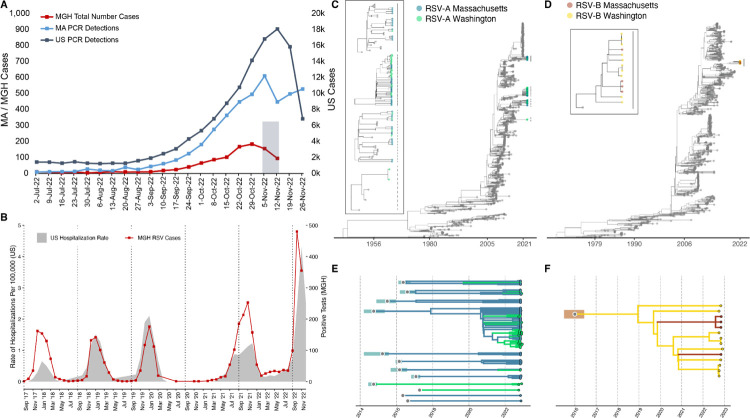
The US experienced an early and severe respiratory syncytial virus (RSV) surge in autumn 2022. Despite the pressure this has put on hospitals and care centers, the factors promoting the surge in cases are unknown. To investigate whether viral characteristics contributed to the extent or severity of the surge, we sequenced 105 RSV-positive specimens from symptomatic patients diagnosed with RSV who presented to the Massachusetts General Hospital (MGH) and its outpatient practices in the Greater Boston Area. Genomic analysis of the resulting 77 genomes (54 with >80% coverage, and 23 with >5% coverage) demonstrated that the surge was driven by multiple lineages of RSV-A (91%; 70/77) and RSV-B (9%; 7/77). Phylogenetic analysis of all US RSV-A revealed 12 clades, 4 of which contained Massachusetts and Washington genomes. These clades individually had times to most recent common ancestor (tMRCA) between 2014 and 2017, and together had a tMRCA of 2009, suggesting that they emerged well before the COVID-19 pandemic. Similarly, the RSV-B genomes had a tMRCA between 2016 and 2019. We found that the RSV-A and RSV-B genomes in our sample did not differ statistically from the estimated clock rate of the larger phylogenetic tree (10.6 and 12.4 substitutions per year, respectively). In summary, the polyphyletic nature of viral genomes sequenced in the US during the autumn 2022 surge is inconsistent with the emergence of a single, highly transmissible causal RSV lineage.
Conflict of interest statement
Conflicts of interest
Dr. Sabeti is a co-founder and consultant at Sherlock Biosciences Inc. and Delve Bio, and is a Board Member of Danaher Corporation; she holds equity in all three companies. She has several patents related to diagnostics, genome sequencing, and informatics, including two patents licensed to Sherlock Biosciences.
Figures
References
-
- HAN Archive - 00479 [Internet]. 2022. [cited 2022 Dec 7];Available from: https://emergency.cdc.gov/han/2022/han00479.asp
-
- Goya S, Sereewit J, Pfalmer D, et al. Genomic characterization of respiratory syncytial virus 2022–2023 outbreak in Washington State, USA [Internet]. medRxiv. 2022;Available from: https://www.medrxiv.org/content/10.1101/2022.12.12.22283375v1 - DOI - PMC - PubMed
Publication types
Grants and funding
LinkOut - more resources
Full Text Sources