


Rating enrichment items by female group-housed laboratory mice in multiple binary choice tests using an RFID-based tracking system
- PMID: 36656912
- PMCID: PMC9851564
- DOI: 10.1371/journal.pone.0278709
Rating enrichment items by female group-housed laboratory mice in multiple binary choice tests using an RFID-based tracking system
Abstract
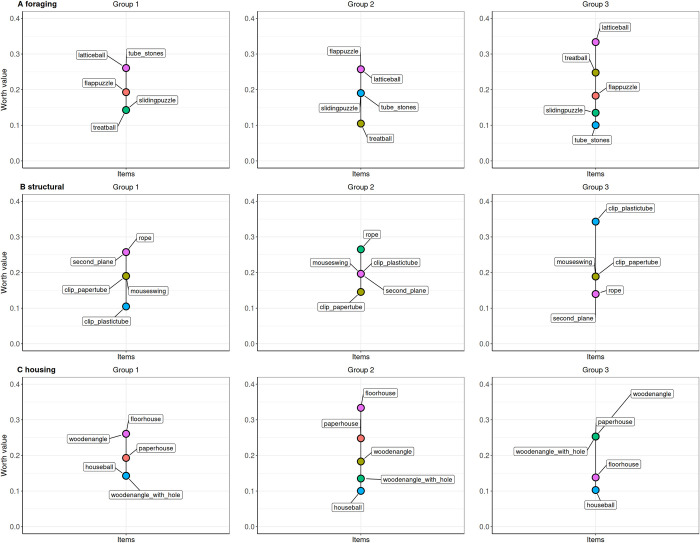
Laboratory mice spend most of their lives in cages, not experiments, so improving housing conditions is a first-choice approach to improving their welfare. Despite the increasing popularity of enrichment, little is known about the benefits from an animal perspective. For a detailed analysis, we categorized enrichment items according to their prospective use into the categories 'structural', 'housing', and 'foraging'. In homecage-based multiple binary choice tests 12 female C57BL/6J mice chose between enrichment items within the respective categories over a 46-hour period. A new analyzing method combined the binary decisions and ranked the enrichment items within each category by calculating worth values and consensus errors. Although there was no unequivocal ranking that was true in its entire rank order for all individual mice, certain elements (e.g. lattice ball, second plane) were always among the top positions. Overall, a high consensus error in ranking positions reflects strong individual differences in preferences which could not be resolved due to the relatively small sample size. However, individual differences in the preference for enrichment items highlights the importance of a varied enrichment approach, as there does not seem to be one item that satisfies the wants and needs of all individuals to the same degree. An enrichment concept, in which the needs of the animals are central, contributes to a more specific refinement of housing conditions.
Copyright: © 2023 Hobbiesiefken et al. This is an open access article distributed under the terms of the Creative Commons Attribution License, which permits unrestricted use, distribution, and reproduction in any medium, provided the original author and source are credited.
Conflict of interest statement
The authors have declared that no competing interests exist.
Figures


References
-
- The European Parliament, The Council of the European Union. Directive 2010/63/EU of the European Parliament and of the Council of 22 September 2010 on the protection of animals used for scientific purposes [Internet]. European Union; 2010. Available from: https://eur-lex.europa.eu/eli/dir/2010/63/oj.
-
- Newberry RC. Environmental enrichment: Increasing the biological relevance of captive environments. Appl Anim Behav Sci. 1995;44(2–4):229–43.
-
- Olsson IAS, Dahlborn K. Improving housing conditions for laboratory mice: A review of “environmental enrichment.” Lab Anim. 2002;36(3):243–70. - PubMed
-
- Lewejohann L, Sachser N. Evaluation of different housing conditions for male laboratory mice by means of preference tests. KTBL SCHRIFT. 2000;170–7.
-
- Duncan IJH, Olsson IAS. Environmental enrichment: from flawed concept to pseudo-science. In: Proceedings International Congress of th e ISAE 2001, Davis, USA. 2001.
MeSH terms
LinkOut - more resources
Full Text Sources
