. 2023 Jan 20;379(6629):253-260.
doi: 10.1126/science.abj4784. Epub 2023 Jan 19.

Heritable defects in telomere and mitotic function selectively predispose to sarcomas

Mandy L Ballinger  1   2 Swetansu Pattnaik  1   2 Piyushkumar A Mundra  1   2 Milita Zaheed  3 Emma Rath  1 Peter Priestley  4   5 Jonathan Baber  4   5 Isabelle Ray-Coquard  6 Nicholas Isambert  7 Sylvain Causeret  7 Winette T A van der Graaf  8 Ajay Puri  9 Florence Duffaud  10 Axel Le Cesne  11 Beatrice Seddon  12 Coonoor Chandrasekar  13 Joshua D Schiffman  14 Andrew S Brohl  15 Paul A James  16   17 Jean-Emmanuel Kurtz  18 Nicolas Penel  19 Ola Myklebost  20   21   22 Leonardo A Meza-Zepeda  22 Hilda Pickett  23 Maya Kansara  1   2 Nicola Waddell  24 Olga Kondrashova  24 John V Pearson  24 Andrew P Barbour  25 Shuai Li  26   27   28   29 Tuong L Nguyen  26 Diane Fatkin  2   30   31 Robert M Graham  2   30 Eleni Giannoulatou  2   32 Melissa J Green  33   34 Warren Kaplan  1   2 Shyamsundar Ravishankar  1 Joseph Copty  1 Joseph E Powell  1   35 Edwin Cuppen  4 Kristel van Eijk  36 Jan Veldink  36 Jin-Hee Ahn  37 Jeong Eun Kim  37 R Lor Randall  38 Kathy Tucker  3 Ian Judson  8 Rajiv Sarin  39 Thomas Ludwig  40 Emmanuelle Genin  40 Jean-Francois Deleuze  41 French Exome Project ConsortiumMichelle Haber  42 Glenn Marshall  42   43 Murray J Cairns  44   45 Jean-Yves Blay  6 International Sarcoma Kindred StudyDavid M Thomas  1   2 Martin TattersallSusan NeuhausCraig LewisKathy TuckerRichard Carey-SmithDavid WoodSandro PorcedduIan DickinsonHeather ThornePaul JamesIsabelle Ray-CoquardJean-Yves BlayPhilippe CassierAxel Le CesneFlorence DuffaudNicolas PenelNicolas IsambertJean-Emmanuel KurtzAjay PuriRajiv SarinJin-Hee AhnJeong Eun KimIain WardIan JudsonWinette van der GraafBeatrice SeddonCoonoor ChandrasekarRory RickarIvo HennigJoshua SchiffmanR Lor RandallAudrey SilvestriAnaiis ZaratzianMichael TayaoKelly WalwynEveline NiedermayrDenia MangRichard ClarkTina ThorpeJessica MacDonaldKim RiddellJasmine MarVicki FennellyAllison WichtBelinda ZielonyEmma GalliganGenna GlavichJohanna StoeckertLynda WilliamsLana DjandjgavaIwona BuettnerCarla OsinkiSonya StephensMuriel RogasikLaure BouclierMagali GirodetAmandine CharretonYohan FayetSaniya CrastoBhanupriya SandupatlaYeon YoonNoda JeLiz ThompsonTrent FowlerBella JohnsonGalina PetrikovaThomas HambridgeAngela HutchinsDiego BotteroDeborah ScanlonJo Stokes-DensonEmmanuelle GéninDominique CampionJean-François DartiguesJean-François DeleuzeJean-Charles LambertRichard RedonThomas LudwigBenjamin Grenier-BoleySébastien LetortPierre LindenbaumVincent MeyerOlivier QuenezChristian DinaCéline BellenguezCamille Charbonnier Le ClézioJoanna GiemzaStéphanie ChatelClaude FérecHervé Le MarecLuc LetenneurGaël NicolasKaren Rouault
Affiliations

Heritable defects in telomere and mitotic function selectively predispose to sarcomas

Mandy L Ballinger et al. Science. .

Abstract

Cancer genetics has to date focused on epithelial malignancies, identifying multiple histotype-specific pathways underlying cancer susceptibility. Sarcomas are rare malignancies predominantly derived from embryonic mesoderm. To identify pathways specific to mesenchymal cancers, we performed whole-genome germline sequencing on 1644 sporadic cases and 3205 matched healthy elderly controls. Using an extreme phenotype design, a combined rare-variant burden and ontologic analysis identified two sarcoma-specific pathways involved in mitotic and telomere functions. Variants in centrosome genes are linked to malignant peripheral nerve sheath and gastrointestinal stromal tumors, whereas heritable defects in the shelterin complex link susceptibility to sarcoma, melanoma, and thyroid cancers. These studies indicate a specific role for heritable defects in mitotic and telomere biology in risk of sarcomas.


Figures
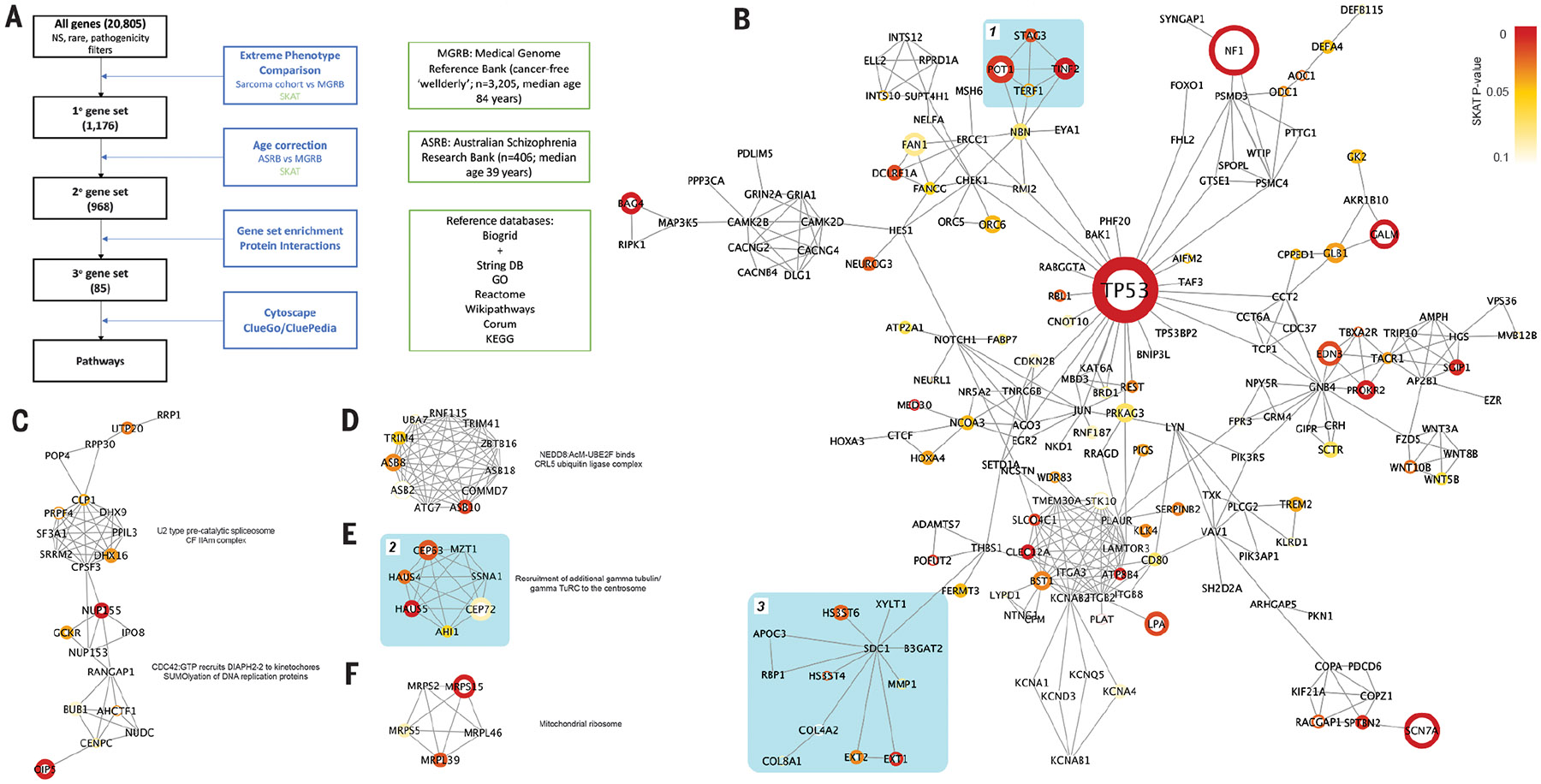
Fig. 1.
Fig. 1.. A systematic analysis of genes and pathways implicated in sarcoma.
(A) A schematic of the analytic approach of progressively enriching for genes and pathways carrying an excess burden of pathogenic variation in sarcoma probands compared to a universal control cohort (MGRB), including correction for age-depletion of nonsarcoma-related genes. Graph representations of the 968 genes (nodes) in the secondary gene set and their interactions (edges). The analysis was performed in Cytoscape. Node color represents the P-value of WRVBT enrichment for each gene in the sarcoma probands relative to the MGRB, the size of the node represents the excess weighted burden of pathogenic variants in the sarcoma probands relative to MGRB, and the width of the node border represents protein interaction and ontologic enrichment by a combined rankscore. Specific groups (1 to 3) relevant to subsequent analyses are highlighted (pale blue boxes). (B to F) Specific clusters are as follows: (B) Graph representation of the super cluster of 187 genes (nodes) in the secondary geneset centered on TP53 and their interactions (edges); (C) A 22-gene cluster representing ontologies linked to RNA processing and activity in the M phase of the cell cycle. (D) Eleven genes implicated in antigen processing, ubiquitination, and neddylation. (E) Seven genes defined by centrosomes, spindle organization, and the G2/M phase of the cell cycle. (F) Five-gene clique with a role in mitochondrial translation and ribosomes.
Fig. 2.
Fig. 2.. Sarcoma-specific enrichment in rare pathogenic variants in the shelterin and centrosome pathways.
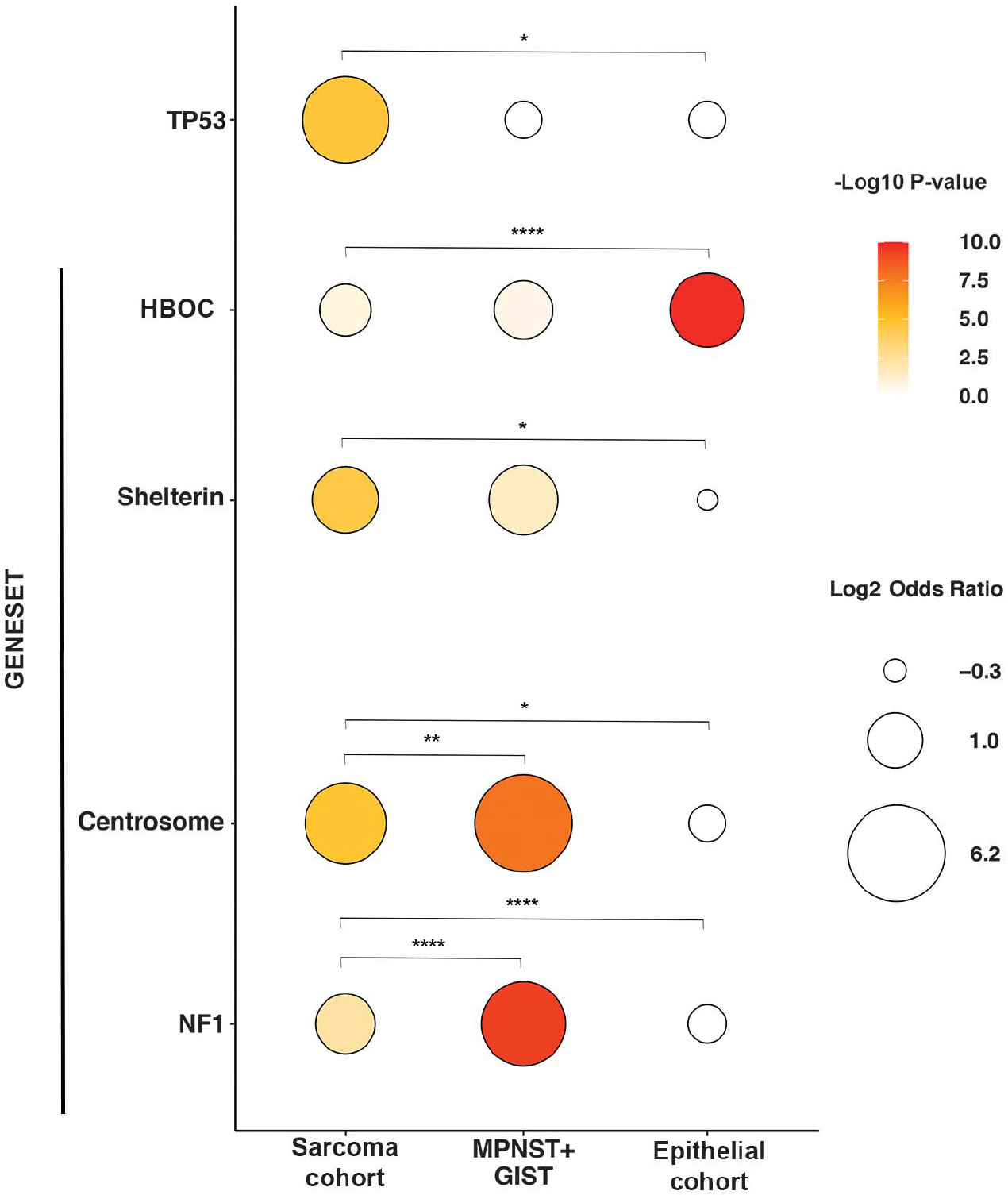
Relative enrichment of pathogenic variants (Log2 Odds Ratio) in sarcoma probands, a subset of 157 cases with GIST or MPNST, and a nonsarcoma cancer population of 632 individuals with epithelial cancers. Gene sets include TP53 alone (TP53); BRCA1, BRCA2, and PALB2 (HBOC); POT1, TINF2, TERF1, TERF2, TERF2IP, STAG3, SMARCAL1, and TIMELESS (shelterin); NF1, SDHA, SDHB, SDHC, SDHD, and LZTR1 (NF1); and CEP63, CEP72, HAUS4, HAUS5, MZT1, and SSNA1 (centrosome). Circle size reflects the odds ratio, and the color represents the P value of the enrichment in each group relative to MGRB. Pairwise comparisons between groups are shown (*P < 0.05; **P < 0.01; ****P < 0.0001).
Fig. 3.
Fig. 3.. Replication of enrichment in centrosome and shelterin-complex genes in sarcomas.
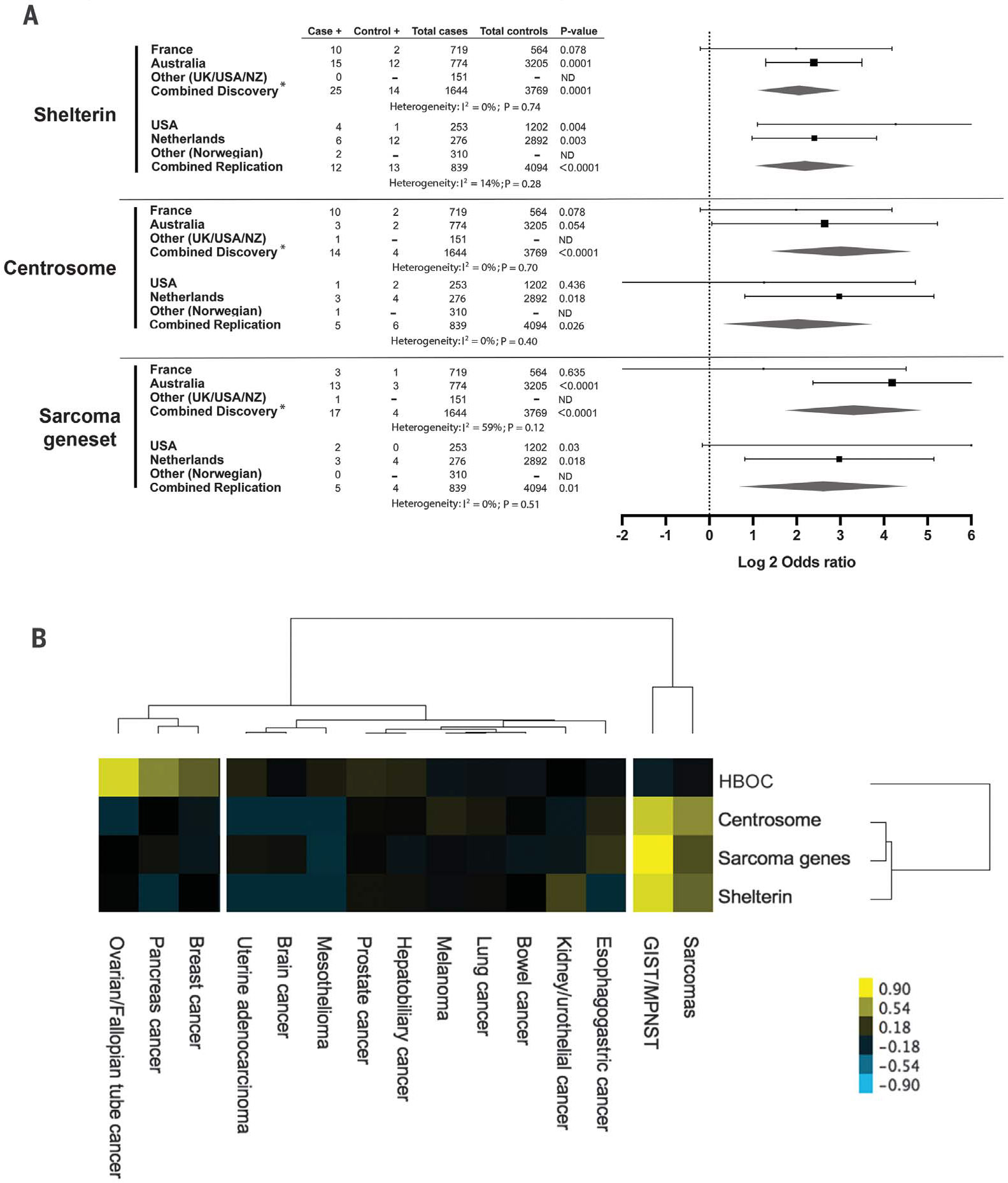
(A) Enrichment of rare C4 or C5 pathogenic variants in sarcoma, shelterin, and centrosome gene sets were estimated for geographically matched discovery (1644 cases and 3769 controls) and replication (839 cases and 4094 controls) datasets. Odds ratios for each geographically matched set are shown with closed squares, and the corresponding horizontal line and whiskers represent 95% confidence intervals (CI). The pooled effect and 95% CI of combined datasets are shown with the diamond. Set heterogeneity was tested using the Cochran-Mantel-Haenszel test without continuity correction and heterogeneity estimates (I2) and P values are presented. Sarcoma cases from the UK, USA, and NZ in the original discovery set and sarcoma cases from Norway in the replication set were excluded from individual analyses due to the lack of geographically matched controls. The combined odds ratio and 95% CI of geographically matched Discovery* and Replication datasets for shelterin, centrosome, and sarcoma gene sets are 5.58 [3.11, 9.64], 4.74 [1.90, 11.83], and 10.59 [4.36, 25.72], respectively. The corresponding I2 values are 0% for all the gene sets. (B) This analysis used the Hartwig Foundation whole-genome germline dataset of 4178 cancers, including sarcomas (276, including 71 GIST or MPNST), breast cancer (801), bowel cancer (650), lung cancer (583), prostate cancer (412), kidney and urothelial cancers (312), melanoma (300), esophagastric cancer (193), ovarian and fallopian tube cancers (174), pancreatic cancer (149), hepatobiliary cancer (138), brain cancer (76), uterine adenocarcinoma (73), and mesothelioma (41). Gene sets were defined as for Fig. 2. Enrichment for each cancer class was determined by normalizing the frequency of variants in that class to the overall frequency in the entire dataset. These data were subject to unsupervised hierarchical clustering for both cancer class and gene sets.
Fig. 4.
Fig. 4.. Leukocyte telomere length in carriers of shelterin-complex variants.
(A) Relative telomere lengths (RTL) were derived from telomere analysis (TelSeq) of whole-genome sequences on peripheral blood DNA for the sarcoma probands. The x axis indicates the age for each individual in years, and the y axis indicates RTL in arbitrary units. (B) Leukocyte RTL is longer in carriers of variants in the shelterin complex. Left panel: RTL in probands with shelterin complex C3 to C5 (n = 35) or C4 or C5 variants (n = 25) compared to the remainder of the sarcoma probands. Right panel: Age distribution for these groups. (C) Representative pedigrees showing autosomal dominant cancer patterns with an excess of melanoma. Top left panel: family with a POT1 pathogenic variant; top right panel: family with a SMARCAL1 pathogenic variant; bottom panels: representative pedigrees of probands with long telomeres and excess of melanoma with no pathogenic variants identified.

References

    1. Bahcall OG, Nat. Genet 45, 343 (2013). - PubMed
    1. Lichtenstein P. et al., N. Engl. J. Med 343, 78–85 (2000). - PubMed
    1. Paul A, Paul S, Front. Biosci. (Landmark Ed.) 19, 605–618 (2014). - PMC - PubMed
    1. Wang C, Wang Y, Hughes KS, Parmigiani G, Braun D, JNCI Cancer Spectr. 4, pkaa027 (2020). - PMC - PubMed
    1. World Health Organisation, WHO Classification of Tumours: Soft Tissue and Bone Tumours. Lokuhetty V. W. Dilani, Ian Cree Ed., WHO Classification of Tumours (International Agency for Research on Cancer, Lyon, France., ed. 5, 2020).

Substances