


Abnormal physiological findings after FFR-based revascularisation deferral are associated with worse prognosis in women
- PMID: 36658168
- PMCID: PMC9852478
- DOI: 10.1038/s41598-023-28146-6
Abnormal physiological findings after FFR-based revascularisation deferral are associated with worse prognosis in women
Abstract
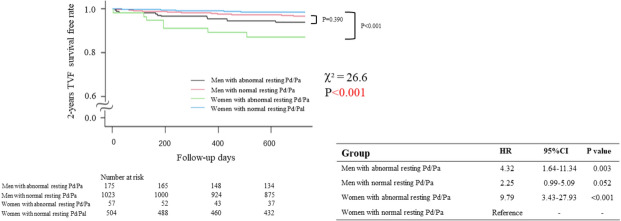
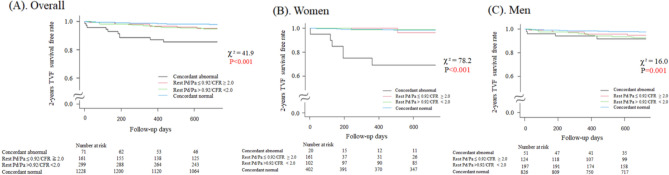
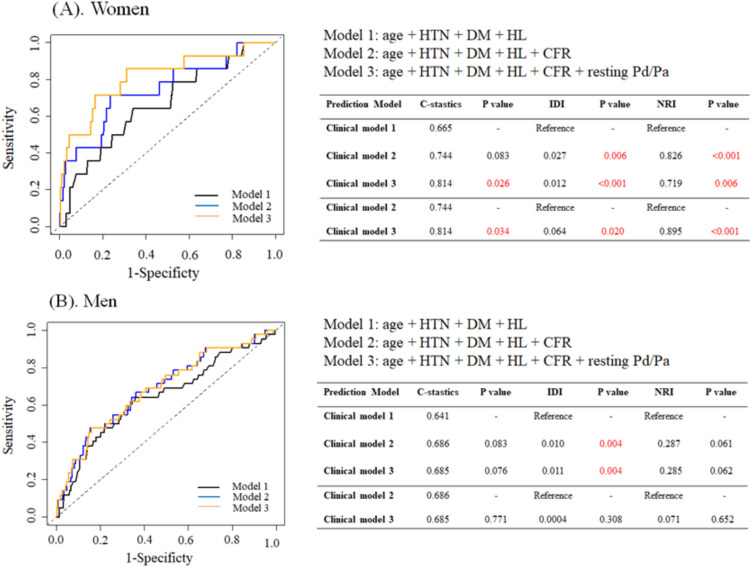
The prognostic value of abnormal resting Pd/Pa and coronary flow reserve (CFR) after fractional flow reserve (FFR)-guided revascularisation deferral according to sex remains unknown. From the ILIAS Registry composed of 20 hospitals globally from 7 countries, patients with deferred lesions following FFR assessment (FFR > 0.8) were included. (NCT04485234) The primary clinical endpoint was target vessel failure (TVF) at 2-years follow-up. We included 1392 patients with 1759 vessels (n = 564 women, 31.9%). Although resting Pd/Pa was similar between the sexes (p = 0.116), women had lower CFR than men (2.5 [2.0-3.2] vs. 2.7 [2.1-3.5]; p = 0.004). During a 2-year follow-up period, TVF events occurred in 56 vessels (3.2%). The risk of 2-year TVF was significantly higher in women with low versus high resting Pd/Pa (HR: 9.79; p < 0.001), whereas this trend was not seen in men. (Sex: P-value for interaction = 0.022) Furthermore, resting Pd/Pa provided an incremental prognostic value for 2-year TVF over CFR assessment only in women. After FFR-based revascularisation deferral, low resting Pd/Pa is associated with higher risk of TVF in women, but not in men. The predictive value of Pd/Pa increases when stratified according to CFR values, with significantly high TVF rates in women in whom both indices are concordantly abnormal.Clinical Trial Registration: Inclusive Invasive Physiological Assessment in Angina Syndromes Registry (ILIAS Registry), NCT04485234.
© 2023. The Author(s).
Conflict of interest statement
TvdH has received speaker fees and institutional research grants from Abbott and Philips. JML received research grants from Abbott and Philips. MEP has received speaker fees from Abbott and Philips. NvR has received speaker fees and institutional research grants from Abbott and Philips. BKK has received institutional research grants from Abbott Vascular and Philips Volcano. JJP has received support as consultant for Philips/Volcano, and has received institutional research grants from Philips. The other authors report no relationship with industry related to this work.
Figures

References
Publication types
MeSH terms
Associated data
LinkOut - more resources
Full Text Sources
Medical
