Review
. 2023 Jan 6:9:100094.
doi: 10.1016/j.tcsw.2023.100094. eCollection 2023 Dec.

The EXTENSIN enigma

Affiliations
Review

The EXTENSIN enigma

Steven Moussu et al. Cell Surf. .

Abstract

EXTENSINS (EXTs) are an abundant and yet enigmatic class of cell wall proteins that are found across multicellular plant lineages, from Bryophytes to Angiosperms. They have been shown to be integrated within the cell wall matrix, and are proposed to play key roles in the dynamic regulation of cell-wall properties. Consistent with this, EXTs are thought to be important for plant growth and development. However, like many other classes of cell wall proteins, EXTs are biochemically complex, highly diverse, and are encoded by multiple genes, making in-depth functional characterization a challenging undertaking. Here we will provide an overview of current knowledge of the biochemistry and properties of EXTs, and of the tools that have been deployed to study their biological functions in plants.

Keywords: Cell wall; EXTENSIN; Glycosylation; Hydroxyproline-rich glycoprotein; Peroxidase.


Conflict of interest statement

The authors declare that they have no known competing financial interests or personal relationships that could have appeared to influence the work reported in this paper.

Figures
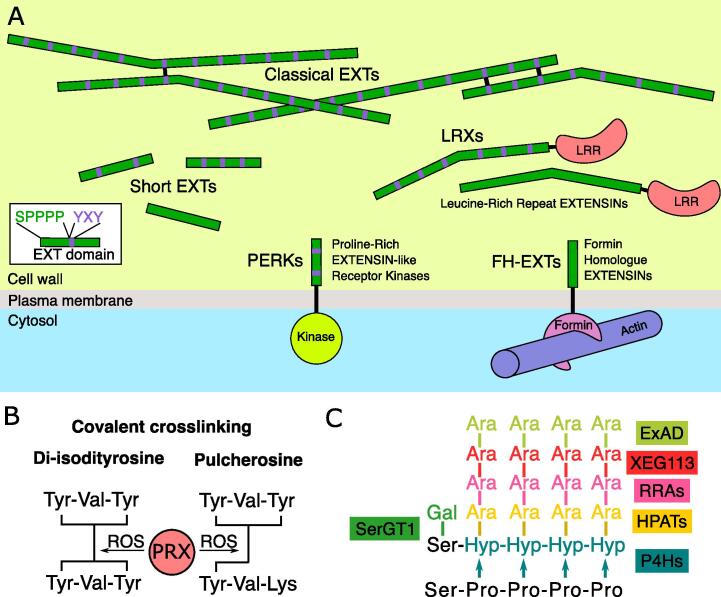
Fig. 1
Fig. 1
EXTENSINs belong to a diverse family of post-translationally modified proteins. A. Overview of different classes of EXT-domain containing proteins in a cellular context. Long classical EXT can form intermolecular bonds (in black) and associate into a network. Short EXTs sometime harbor YXY motifs, potentially allowing crosslinking with other EXTs. Leucine-rich repeat EXTs (LRXs) harbor a N-terminal LRR domain fused to an EXT region and are embedded in the cell wall matrix. Proline-rich Extensin Receptor Kinases (PERKs) are receptors with an intracellular kinase domain, a transmembrane domain, and an ectodomain containing EXT motifs. Formin-homologue EXTs (FH) are composed of an EXT domain extracellular region, a transmembrane domain, and a Formin-like region which is predicted to interact with actin filaments. SPPPP motifs are represented in green and YXY motifs in purple showing the respective alternance of hydrophilic and hydrophobic residues. B. Intermolecular bonds bridging EXTENSINs. YXY motifs can form intramolecular isodityrosine bonds that can then interact in an intermolecular fashion with either a single tyrosine, forming a pulcherosine bond, or with another isodityrosine, leading to the formation of a di-isodityrosine. Formation of pulcherosine and di-isodityosine linkages requires the action of class III peroxidases (PRXs) in the presence of reactive oxygen species (ROS). C. Posttranslational modifications of the proline-rich EXT motif. Proline residues are hydroxylated to hydroxyproline (Hyp) by Prolyl-4-hydroxylases (P4H). Hyp residues are then sequentially glycosylated with 4–5 arabinoses (Ara). Ara residues are added by different glycosyl-transferases. The first Ara is linked by HPATs, the second by RRAs, the third by XEG113 and the final one by ExAD. Galactose is added to the serine before the proline stretch by SerGT1. (For interpretation of the references to colour in this figure legend, the reader is referred to the web version of this article.)

References

    1. Brady J.D., Sadler I.H., Fry S.C. Di-isodityrosine, a novel tetrametric derivative of tyrosine in plant cell wall proteins: a new potential cross-link. Biochem. J. 1996;315(Pt 1):323–327. - PMC - PubMed
    1. Cannon M.C., et al. Self-assembly of the plant cell wall requires an extensin scaffold. Proc. Natl. Acad. Sci. U.S.A. 2008;105:2226–2231. - PMC - PubMed
    1. Dauphin B.G., Ranocha P., Dunand C., Burlat V. Cell-wall microdomain remodeling controls crucial developmental processes. Trends Plant Sci. 2022;27(10):1033–1048. - PubMed
    1. Doll N.M., Berenguer E., Truskina J., Ingram G. AtEXT3 is not essential for early embryogenesis or plant viability in Arabidopsis. New Phytol. 2022 doi: 10.1111/nph.18452. - DOI - PMC - PubMed
    1. Held M.A., Tan L.i., Kamyab A., Hare M., Shpak E., Kieliszewski M.J. Di-Isodityrosine is the intermolecular cross-link of isodityrosine-rich extensin analogs cross-linked in vitro. J. Biol. Chem. 2004;279(53):55474–55482. - PubMed

LinkOut - more resources
