. 2023 Jan 5:13:100113.
doi: 10.1016/j.ynpai.2022.100113. eCollection 2023 Jan-Jul.

HomeCageScan analysis reveals ongoing pain in Fabry rats

Affiliations

HomeCageScan analysis reveals ongoing pain in Fabry rats

Anthony J Burand Jr et al. Neurobiol Pain. .

Abstract

HomeCageScan (HCS) is an automated behavioral scoring system that can be used to classify and quantify rodent behaviors in the home cage. Although HCS has been used for a number of inducible models of severe pain, little has been done to test this system in clinically relevant genetic disease models associated with chronic pain such as Fabry disease. Rats with Fabry disease exhibit mechanical hypersensitivity, however, it is unclear if these rodents also exhibit ongoing non-evoked pain. Therefore, we analyzed HCS data from male and female rats with Fabry disease. Using hierarchical clustering and principal component analysis, we found both sex and genotype differences in several home cage behaviors. Additionally, we used hierarchical clustering to derive behavioral clusters in an unbiased manner. Analysis of these behavioral clusters showed that primarily female Fabry animals moved less, spent less time caring for themselves (e.g., less time spent grooming and drinking), explored less, and slept more; changes that are similar to lifestyle changes observed in patients with long lasting chronic pain. We also show that sniffing, one of the exploratory behaviors that is depressed in Fabry animals, can be partly restored with the analgesic gabapentin, suggesting that depressed sniffing may reflect ongoing pain. Therefore, this approach to HCS data analysis can be used to assess drug efficacy in Fabry disease and potentially other genetic and inducible rodent models associated with persistent pain.

Keywords: Fabry disease; HomeCageScan; Non-evoked behavior; Pain.


Conflict of interest statement

The authors declare that they have no known competing financial interests or personal relationships that could have appeared to influence the work reported in this paper.

Figures
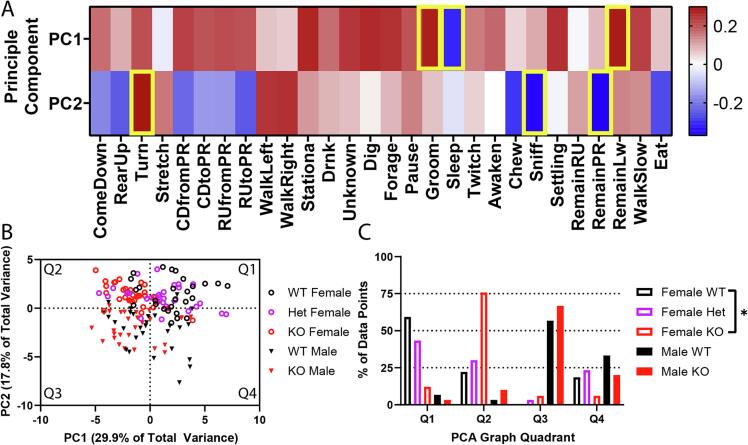
Fig. 1
Fig. 1
PCA reveals inherent differences between Fabry rat genotypes and sexes. A) Contributions of each behavior to principal components PC1 and PC2. Yellow boxes indicate the top 3 highest contributing behaviors to each principal component. C) PCA plot of KO and WT male and female rats. Each point represents one animal on a particular dark cycle. D) Quantification of percentage of each genotype in each of the PCA quadrants. Chi squared test used to test for differences between genotype profiles. N = 10 wt-Male, 10 KO-Male, 11 wt-Female, 10 Het-Female, and 9 KO-Female. *p < 0.05.
Fig. 2
Fig. 2
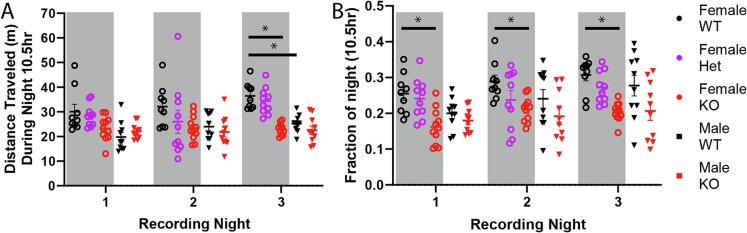
Female but not male Fabry animals show decreases in movement in their home cage. A) Total distance traveled during the dark phase for each of 3 days of recording. Grey boxes indicate female animals. B) Fraction of the dark phase rats were engaged in active movement. Blue text represents the results of the 3-way ANOVA (Het Female rats were not included in the statistical analysis). N = 10 wt-Male, 10 KO-Male, 11 wt-Female, 10 Het-Female, and 9 KO-Female. *p < 0.05.
Fig. 3
Fig. 3
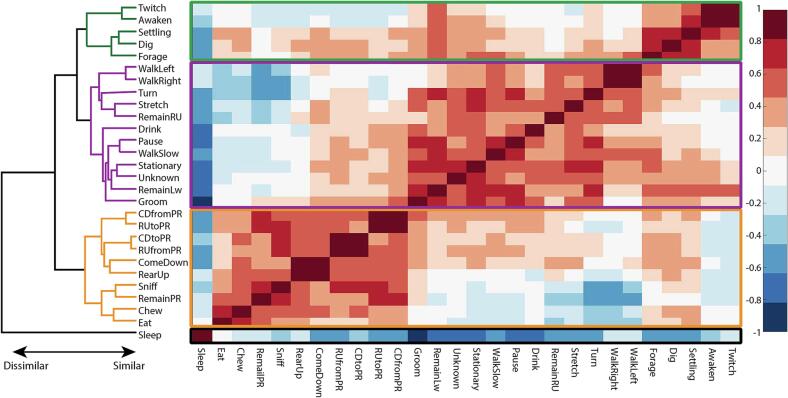
Unbiased behavioral groupings emerge after hierarchacal clustering of behavioral correlations. Correlation matrix showing Spearman correlation coefficent was calculated from all naïve rats measured in HCS. Hierarchacal clustering of correlation coefficents with different behavioral groupings indicated by color in the dendrogram. N = 10 wt-Male, 10 KO-Male, 11 wt-Female, 10 Het-Female, and 9 KO-Female.
Fig. 4
Fig. 4
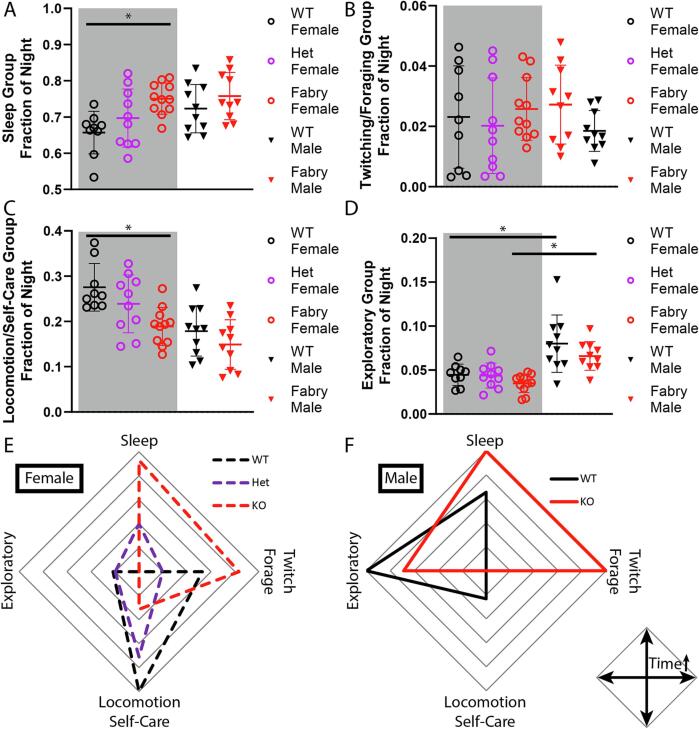
Primarily female Fabry rats display reduced locomotion, self-care, and exploration while increasing time spent sleeping. Sleeping (A), twitching/foraging group (B), locomotion/self-care group (C), and exploratory group (D) defined by hierarchacal clustering. Fraction of time spent for each behavior group (average of days 1–2). Data normalized to the minimum and maximum means for each behavior group is plotted in a radial graph for both female (E) and male (F) rats. Mean behaviors are normalized and plotted. N = 10 wt-Male, 10 KO-Male, 11 wt-Female, 10 Het-Female, and 9 KO-Female. *p < 0.05.
Fig. 5
Fig. 5
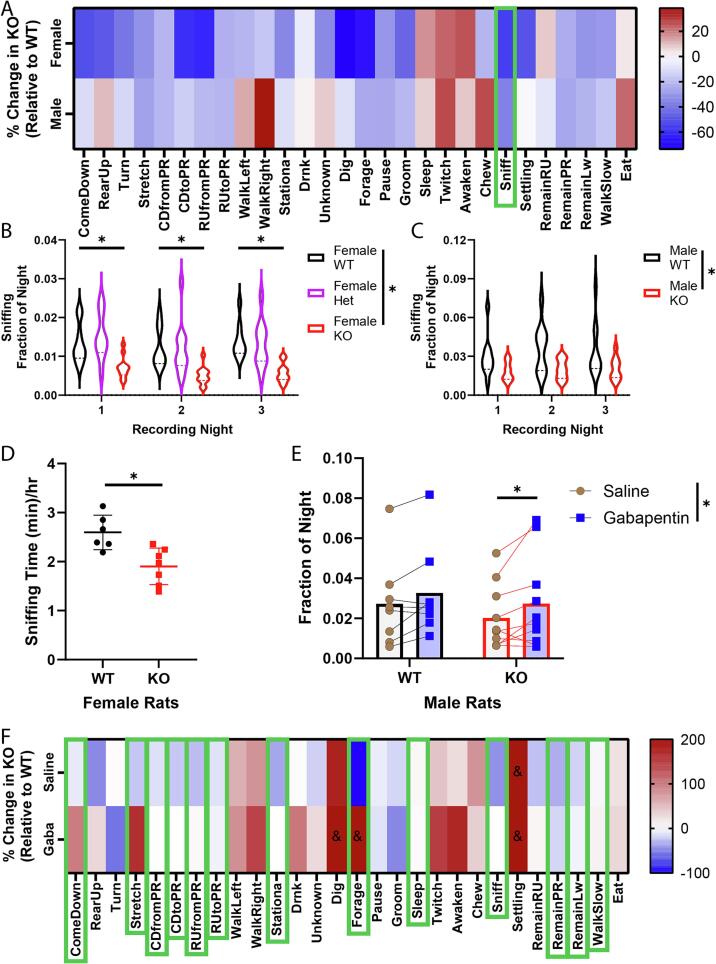
Gabapentin partly reverses decreased sniffing behaviors in Fabry rats. (A) Percentage change in KO animals relative to WT for exploratory, self-care, and locomotion related behaviors. Green box represents the behavior with the greatest consistent change in both male and female rats. Fraction of the dark phase spent sniffing for female (B) or male (C) rats. (D) Whole-body plethysmography of female WT or KO rats. Sniffing (breaths > 250 BPM) were recorded continuously over three days and average sniffing time/hour calculated. (E) Male rats were given i.p. saline injections for 2 days followed by gabapentin (100 mg/kg) injections for 2 days. Fraction of the dark phase spent sniffing was calculated over 4 h following injection. Sniffing data was averaged over 2 days. (F) Heatmap of exploratory, self-care, and locomotion related behaviors after saline or gabapentin injection. Green boxes indicate behaviors that were changed after gabapentin administration towards WT levels. Behaviors marked with “&” are > 200 % increase/decrease due to low WT saline average for that behavior. (A-C): N = 10 wt-Male, 10 KO-Male, 11 wt-Female, 10 Het-Female, and 9 KO-Female. (D): N = 6 wt-Females, 7-KO Females, (E-F): N = 8 wt-Males, 10 KO-Males. *p < 0.05.

References

    1. Allchorne, A.J., Broom, D.C., Woolf, C.J., 2005. Detection of cold pain, cold allodynia and cold hyperalgesia in freely behaving rats. Mol. Pain 1, 1744-8069-1–36. https://doi.org/10.1186/1744-8069-1-36. - PMC - PubMed
    1. Arends M., Hollak C.E.M., Biegstraaten M. Quality of life in patients with Fabry disease: A systematic review of the literature. Orphanet J. Rare Dis. 2015;10:1–10. doi: 10.1186/s13023-015-0296-8. - DOI - PMC - PubMed
    1. Biegstraaten M., Hollak C.E.M., Bakkers M., Faber C.G., Aerts J.M.F.G., van Schaik I.N. Small fiber neuropathy in Fabry disease. Mol. Genet. Metab. 2012;106:135–141. doi: 10.1016/j.ymgme.2012.03.010. - DOI - PubMed
    1. Brenner D.S., Golden J.P., Gereau R.W., Sakakibara M. A novel behavioral assay for measuring cold sensation in mice. PLoS One. 2012;7(6):e39765. - PMC - PubMed
    1. Campbell S.S., Tobler I. Animal sleep: A review of sleep duration across phylogeny. Neurosci. Biobehav. Rev. 1984;8:269–300. doi: 10.1016/0149-7634(84)90054-X. - DOI - PubMed

LinkOut - more resources