Review
. 2022 Dec 5;8(1):321-331.
doi: 10.1021/acsenergylett.2c01885. eCollection 2023 Jan 13.

Zero-Gap Electrochemical CO2 Reduction Cells: Challenges and Operational Strategies for Prevention of Salt Precipitation

Affiliations
Review

Zero-Gap Electrochemical CO2 Reduction Cells: Challenges and Operational Strategies for Prevention of Salt Precipitation

Mark Sassenburg et al. ACS Energy Lett. .

Abstract

Salt precipitation is a problem in electrochemical CO2 reduction electrolyzers that limits their long-term durability and industrial applicability by reducing the active area, causing flooding and hindering gas transport. Salt crystals form when hydroxide generation from electrochemical reactions interacts homogeneously with CO2 to generate substantial quantities of carbonate. In the presence of sufficient electrolyte cations, the solubility limits of these species are reached, resulting in "salting out" conditions in cathode compartments. Detrimental salt precipitation is regularly observed in zero-gap membrane electrode assemblies, especially when operated at high current densities. This Perspective briefly discusses the mechanisms for salt formation, and recently reported strategies for preventing or reversing salt formation in zero-gap CO2 reduction membrane electrode assemblies. We link these approaches to the solubility limit of potassium carbonate within the electrolyzer and describe how each strategy separately manipulates water, potassium, and carbonate concentrations to prevent (or mitigate) salt formation.


Conflict of interest statement

The authors declare no competing financial interest.

Figures
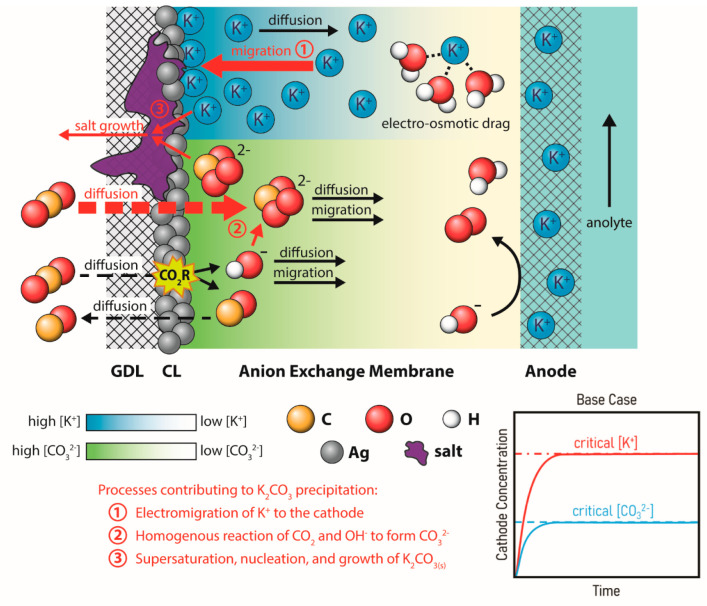
Figure 1
Figure 1
Schematic representation of the cascade of reactions and ion transport in an exchange MEA leading to salt formation on the cathode composed of a catalyst layer (CL) and gas-diffusion layer (GDL). The inserted graph shows the change in ion concentrations occurring near the cathode. After both CO32– and K+ concentrations reach critical levels, the precipitation of K2CO3 starts to occur.
Figure 2
Figure 2
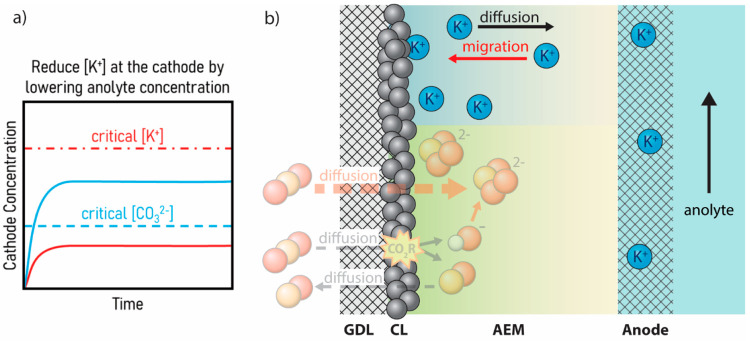
(a) Plot of cathode concentration versus time showing the general trends of K+ and CO32– concentrations at the cathode when the anolyte concentration is reduced. (b) Schematic depiction of a lower concentration of K+ in the anolyte solution resulting in reduced electromigration. This enables the balancing between migration and diffusion of K+, keeping the total concentration below the solubility limit of K2CO3.
Figure 3
Figure 3
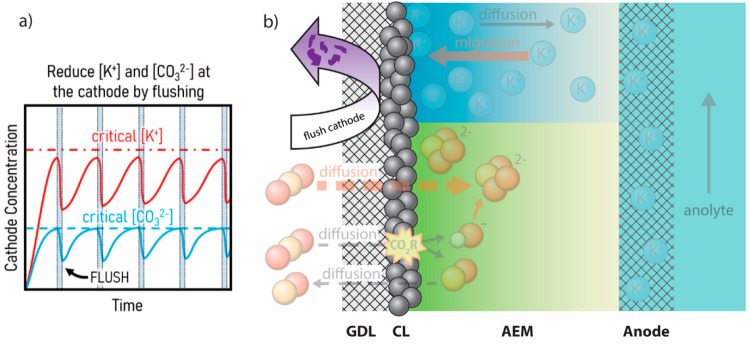
(a) Plot of cathode concentration versus time showing the general trends of K+ and CO32– concentrations at the cathode during active flushing of the cathode compartment with water. (b) Schematic depiction of actively mitigating the buildup of ions and nucleation of crystal seeds on the catalyst by dissolving and removing salt from the cathode with water.
Figure 4
Figure 4
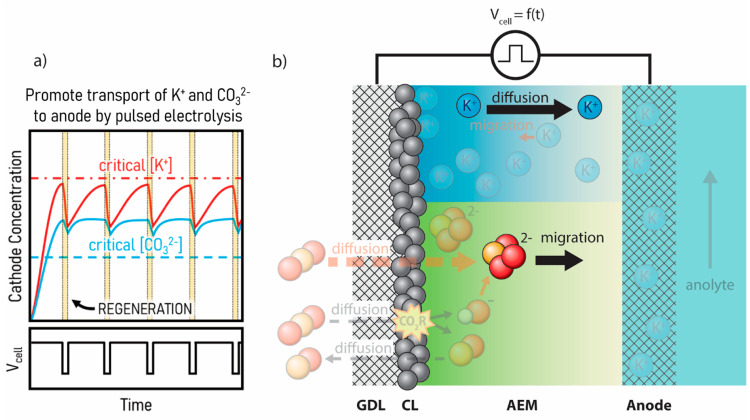
(a) Plots of cathode concentration and cell voltage versus time showing the general trends of K+ and CO32– concentrations at the cathode during pulsed electrolysis. (b) Schematic depiction of ion-transport during a “pulse” of lower voltage. At the lower regeneration voltage, the reaction slows down and migration of carbonates and K+ allow the system to partially homogenize before returning to the operational voltage.
Figure 5
Figure 5
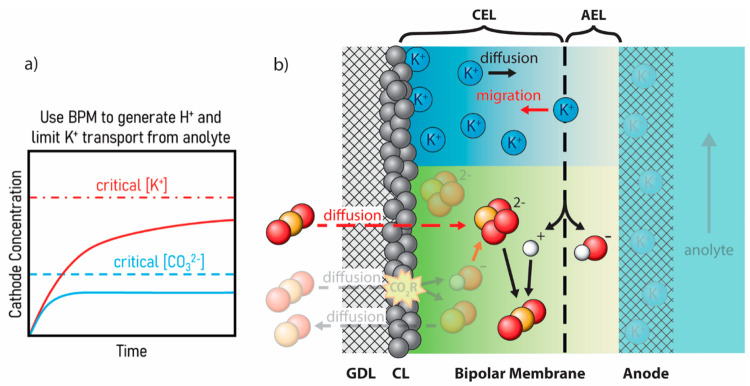
(a) Plot of cathode concentration versus time showing the general trends of K+ and CO32– concentrations at the cathode when a BPM is used. (b) Schematic showing effects of a BPM on K+-comigration past the membrane by limiting free ion transport and electro-osmotic drag. Additionally, CO32– concentrations are reduced by combining with H+ formed at the BPM junction to regenerate CO2. While changing the MEA recipe delays the accumulation of ions, it does not necessarily prevent critical concentrations from being reached.

References

    1. Buttler A.; Spliethoff H. Current Status of Water Electrolysis for Energy Storage, Grid Balancing and Sector Coupling via Power-to-Gas and Power-to-Liquids: A Review. Renew. Sustain. Energy Rev. 2018, 82, 2440–2454. 10.1016/j.rser.2017.09.003. - DOI
    1. Lv J.-J.; Jouny M.; Luc W.; Zhu W.; Zhu J.-J.; Jiao F. A Highly Porous Copper Electrocatalyst for Carbon Dioxide Reduction. Adv. Mater. 2018, 30 (49), 1803111.10.1002/adma.201803111. - DOI - PubMed
    1. Verma S.; Hamasaki Y.; Kim C.; Huang W.; Lu S.; Jhong H.-R. M.; Gewirth A. A.; Fujigaya T.; Nakashima N.; Kenis P. J. A. Insights into the Low Overpotential Electroreduction of CO2 to CO on a Supported Gold Catalyst in an Alkaline Flow Electrolyzer. ACS Energy Lett. 2018, 3 (1), 193–198. 10.1021/acsenergylett.7b01096. - DOI
    1. Cofell E. R.; Nwabara U. O.; Bhargava S. S.; Henckel D. E.; Kenis P. J. A. Investigation of Electrolyte-Dependent Carbonate Formation on Gas Diffusion Electrodes for CO2 Electrolysis. ACS Appl. Mater. Interfaces 2021, 13 (13), 15132–15142. 10.1021/acsami.0c21997. - DOI - PubMed
    1. Nwabara U. O.; Hernandez A. D.; Henckel D. A.; Chen X.; Cofell E. R.; de-Heer M. P.; Verma S.; Gewirth A. A.; Kenis P. J. A. Binder-Focused Approaches to Improve the Stability of Cathodes for CO2 Electroreduction. ACS Appl. Energy Mater. 2021, 4 (5), 5175–5186. 10.1021/acsaem.1c00715. - DOI