. 2023 Jun;165(6):791-808.
doi: 10.1111/jnc.15767. Epub 2023 Jan 31.

Hericerin derivatives activates a pan-neurotrophic pathway in central hippocampal neurons converging to ERK1/2 signaling enhancing spatial memory

Affiliations

Hericerin derivatives activates a pan-neurotrophic pathway in central hippocampal neurons converging to ERK1/2 signaling enhancing spatial memory

Ramón Martínez-Mármol et al. J Neurochem. 2023 Jun.

Abstract

The traditional medicinal mushroom Hericium erinaceus is known for enhancing peripheral nerve regeneration through targeting nerve growth factor (NGF) neurotrophic activity. Here, we purified and identified biologically new active compounds from H. erinaceus, based on their ability to promote neurite outgrowth in hippocampal neurons. N-de phenylethyl isohericerin (NDPIH), an isoindoline compound from this mushroom, together with its hydrophobic derivative hericene A, were highly potent in promoting extensive axon outgrowth and neurite branching in cultured hippocampal neurons even in the absence of serum, demonstrating potent neurotrophic activity. Pharmacological inhibition of tropomyosin receptor kinase B (TrkB) by ANA-12 only partly prevented the NDPIH-induced neurotrophic activity, suggesting a potential link with BDNF signaling. However, we found that NDPIH activated ERK1/2 signaling in the absence of TrkB in HEK-293T cells, an effect that was not sensitive to ANA-12 in the presence of TrkB. Our results demonstrate that NDPIH acts via a complementary neurotrophic pathway independent of TrkB with converging downstream ERK1/2 activation. Mice fed with H. erinaceus crude extract and hericene A also exhibited increased neurotrophin expression and downstream signaling, resulting in significantly enhanced hippocampal memory. Hericene A therefore acts through a novel pan-neurotrophic signaling pathway, leading to improved cognitive performance.

Keywords: Hericium erinaceus; BDNF; TrkB; hericerin; memory; neurite outgrowth.


Conflict of interest statement

This work was supported by the company CNG‐Bio inc. Frédéric A. Meunier is a former editor of the Journal of Neurochemistry.

Figures

FIGURE 1
FIGURE 1
Lion's mane mushroom (LMM) extracts exert a potent neurotrophic effect in hippocampal neurons. (a) Scheme of the purification procedure to generate tested extracts (A1‐A6). Hippocampal neurons were cultured in the presence of FBS (5%) for 24 h, the starved until treated with indicated extracts at DIV3. (b) Representative images of hippocampal neurons (DIV3) treated for 24 h with control vehicle (DMSO), or indicated extracts (A1‐A6) purified from lion's mane mushroom. Neurons were then fixed and processed for immunofluorescence against β‐tubulin (green) and imaged using confocal microscopy (nuclear DAPI in blue). Scale bar 20 μm. (c) Longest neurite (axon) length and numbers quantification for each indicated treatments. Data in (c) shows mean ± SEM, n = 30–60 neurons in each condition, from 3 neuronal preparations. One‐way ANOVA test with Tukey's correction multiple comparison was performed. p‐value is indicated when significative differences were found.
FIGURE 2
FIGURE 2
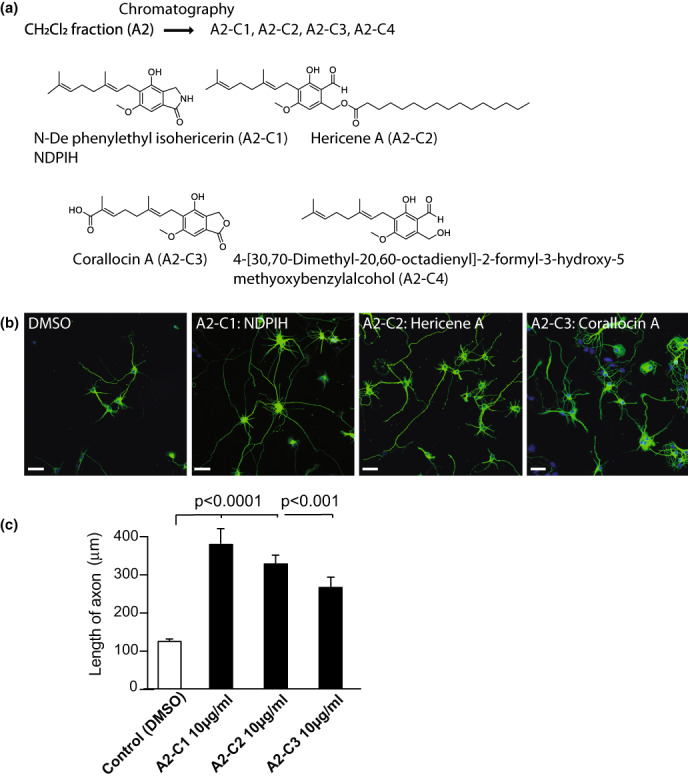
A2‐derived compounds exert a potent neurotrophic effect in hippocampal neurons. (a) Chemical structures of identified A2‐derived compounds. (b) Hippocampal neurons were cultured in the presence of FBS (5%) for 24 h, the starved until treated with indicated extracts at DIV3. (b) Representative images of hippocampal neurons (DIV3) treated for 24 h with control vehicle (DMSO), or indicated extracts (NDPIH, hericene A and Corallocin A). Neurons were then fixed and processed for immunofluorescence against β‐tubulin (green) and imaged using confocal microscopy (nuclear DAPI in blue). Scale bar 20 μm. (c) Longest neurite (axon) length quantification for each indicated treatments. Data in (c) shows mean ± SEM, n = 30–60 neurons in each condition, from 3 neuronal preparations. One‐way ANOVA test with Tukey's correction for multiple comparison was performed. p‐value is indicated when significative differences were found.
FIGURE 3
FIGURE 3
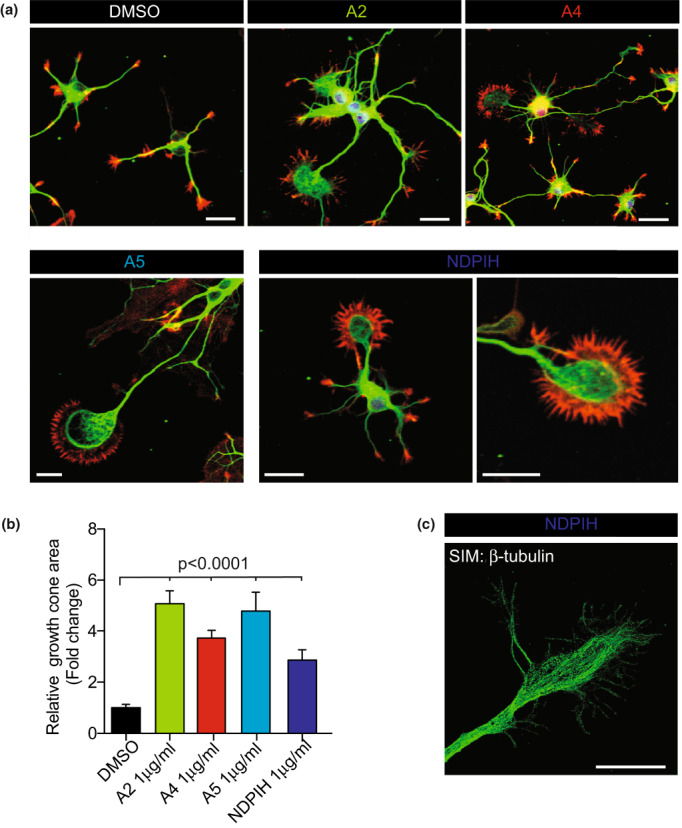
Extracts purified from lion's mane mushroom (LMM) exert a neurotrophic effect on growth cone. Hippocampal neurons were cultured in the presence of FBS (5%) for 24 h, the starved until treated with indicated extracts at DIV3. (a) Representative images of hippocampal neurons (DIV3) treated for 24 h with control vehicle (DMSO), or indicated extracts (A2, A4, A5 and NDPIH) purified from lion's mane mushroom. Neurons were then fixed and processed for immunofluorescence against β‐tubulin (green) and Actin filaments (red) and imaged using confocal microscopy (nuclear DAPI in blue). (b) Growth cone area quantification for each indicated treatments. Scale bar 50 μm. (c) Representative image of a NDPIH‐treated neuron acquired using structure illumination microscopy. Note the classical distribution of microtubules in this enlarged growth cone. Scale bar 50 μm. Data in (b) shows mean ± SEM, n = 15 neurons in each condition, from 4 neuronal preparations. One‐way ANOVA test with Tukey's correction for multiple comparison was performed. p‐value is indicated when significative differences were found.
FIGURE 4
FIGURE 4
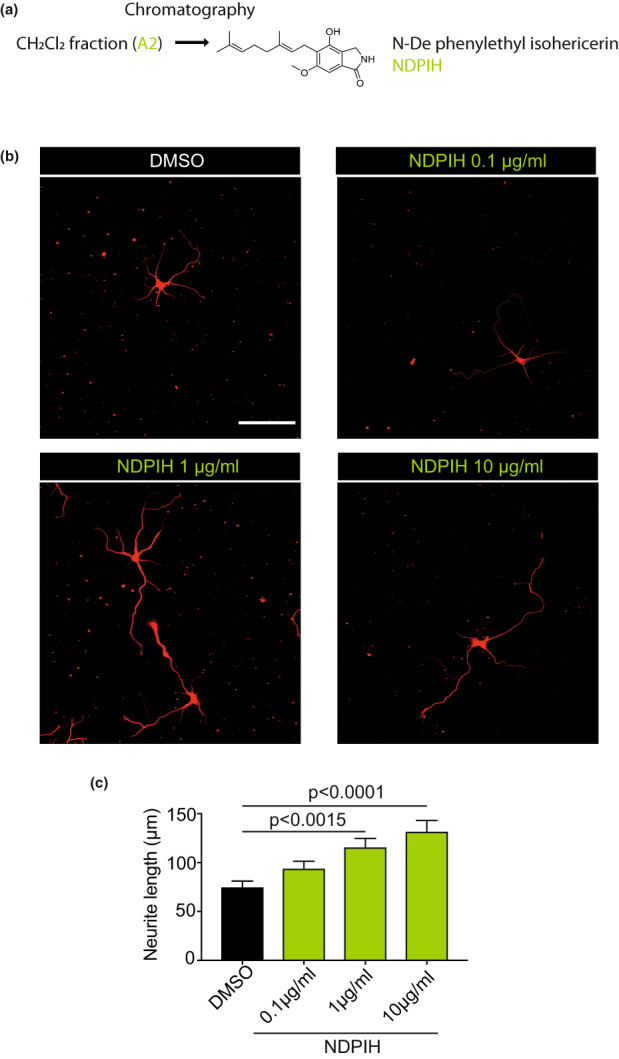
NDPIH purified from lion's mane mushroom exerts a dose‐dependent neurotrophic effect in hippocampal neurons. (a) Chemical structures of identified A2‐derived compound NDPIH. (b) Hippocampal neurons seeded at low density to minimize paracrine effects until DIV2. Cells were then exposed to indicated concentration of purified NDPIH for 24 h, fixed, processed for immunochemistry against β‐tubulin (red) and imaged using confocal microscopy. Representative images of hippocampal neurons, treated with control vehicle (DMSO) or indicated concentrations (0.1, 1 or 10 μg/mL) of NDPIH purified from lion's mane mushroom extract A2. Scale bar 100 μm. (c) Axon length quantification for each treatment. Axon was considered as the longest neurite. Data in (c) shows mean ± SEM. n = 59–102 neurons in each condition, from 3 neuronal preparations. One‐way ANOVA test with Dunnett's correction for multiple comparison was performed. p‐value is indicated when significative differences were found, and “ns” is stated when no significant differences were detected.
FIGURE 5
FIGURE 5
NDPIH purified from lion's mane mushroom A2 exerts a BDNF‐like neurotrophic effect in hippocampal neurons. (a) Hippocampal neurons seeded at low density to minimize paracrine effects until DIV2. Cells were then exposed to purified NDPIH (10 μg/mL) or BDNF (1 nM) for 24 h in the presence or absence of Trk‐B inhibitor ANA‐12 (0.5 μM), fixed, processed for immunochemistry against β‐tubulin (green) and imaged using confocal microscopy. ANA‐12 was added simultaneously to BDNF or NDPIH. Representative images of hippocampal neurons in the indicated conditions. Scale bar 100 μm. (b) Axon length quantification for each treatment. Axon was considered as the longest neurite. (c) Relative inhibition of axon length by ANA‐12 on BDNF or NDPIH. Data in (b) and (c) show mean ± SEM. n = 104–174 neurons in (b), and n = 3 neuronal preparations in (c). One‐way ANOVA test with Tukey's correction for multiple comparison was performed in (b), and two‐tailed, unpaired Mann–Whitney U test was performed in (c). p‐value is indicated when significative differences were found, and “ns” is stated when no significant differences were detected. p‐value = 0.2 in (c).
FIGURE 6
FIGURE 6
NDPIH purified from Lion's mane mushroom A2 potentiates BDNF neurotrophic activity. (a, b) Representative western blot of total protein extracts from HEK‐293 T non‐transfected (a) or transfected with TrkB (b). The cells were serum‐starved for 5 h prior to stimulation with 10 μg/mL of NDPIH mushroom extracts or with a control (unrelated mushroom extract) and/or BDNF (1 ng/mL) for 1 h. ANA‐12 (50 μM) was added at time of serum starvation in indicated conditions. Following stimulation, samples were lysed, resolved by SDS‐PAGE and immunoblotted with indicated primary antibodies. (c) Combined quantification of pERK1/2 activity from non‐transfected or TrkB‐transfected cells. (d) Quantification of pTrkB activation in TrkB‐transfected cells. Total and phospho‐TrkB were immunoblotted following TrkB enrichment from lysates. To quantify densitometry from immunoblots, detected signal was normalized to loading control for each lane (or total TrkB, for phospho‐TrkB), prior to calculation of phospho‐ over total‐signal for each protein, expressed as a fold change relative to DMSO (control) treatment. (e) Representative western blot of total protein extracts from HEK‐293 T transfected with TrkB. The cells were serum starved, stimulated and processed as in (b) except for BDNF concentration, which was saturating (40 ng/mL). (f) Quantification of densitometry analysis from (e) as above. (g) TrkB+p75ICD‐transfected HEK‐293 T cells were treated, stimulated and processed as in (a, b). (h) Quantification of densitometry analysis from (g) as above. (i) ATP conversion by the TrkB kinase in response to mushroom extract treatment was measured using the ADP‐Glo kinase activity assay system with recombinant TrkB kinase domain. TrkB kinase domain was incubated with NDPIH extract, with control or with staurosporine at the indicated concentrations. Activity is expressed as a percentage of the ATP‐conversion by control‐treated kinase domain. Data show mean ± SEM, n = 3 (c, d, h and i) or n = 6 (f) cell culture preparations. One‐way ANOVA test with Tukey's correction for multiple comparison was performed. p‐value is indicated when significant differences were found, and “ns” is stated when no significant differences were detected.
FIGURE 7
FIGURE 7
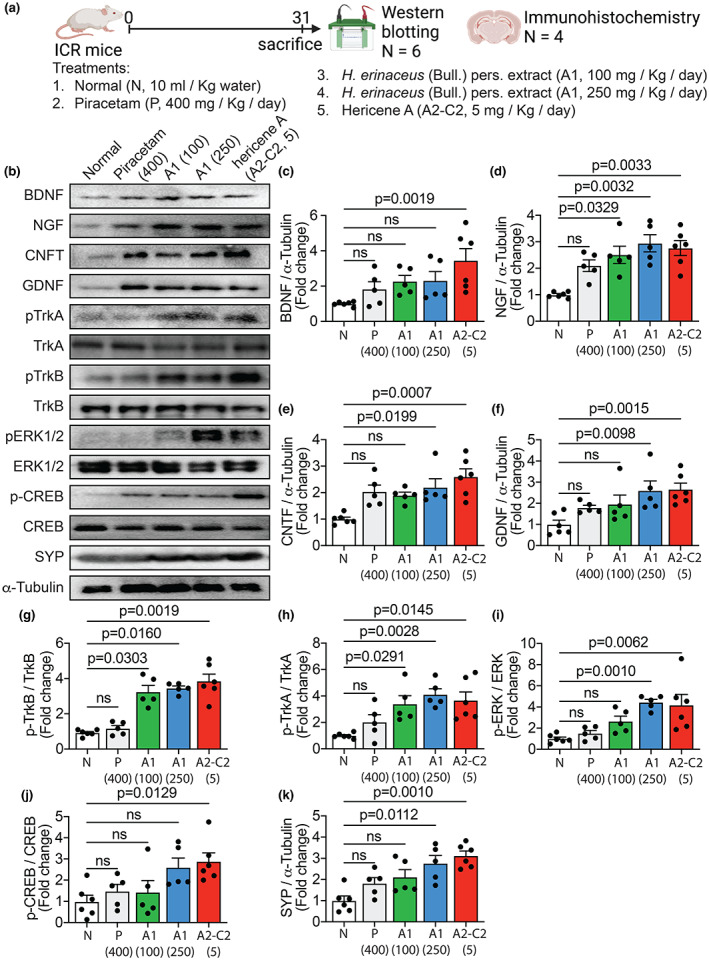
Lion's mane mushroom A1 and A2‐derived hericene dietary treatment increase neurotrophic signaling in vivo. (a) Scheme of the experimental design. Mice were feeded with either A1 (100 or 250 mg/kg), hericene A (A2‐C2, 5 mg/kg), piracetam (PC, 400 mg/kg) or vehicle control during 31 days, before their brains (whole) were collected and the tissue was lysed and prepared for western blot analysis. (b) Representative western blots of anti‐BDNF, NGF, CNTF, p‐TrkA, TrkA, p‐TrkB, TrkB, p‐ERK, ERK, p‐CREB, CREB, SYP and α‐Tubulin. α‐Tubulin was used as loading control. (c–k) Quantification of the relative protein expression levels of BDNF (c), NGF (d), CNTF (e), GDNF (f), p‐TrkB (g), p‐TrkA (h), p‐ERK (i) and p‐CREB (j), SYP (k). All data are expressed as the mean ± SEM, n = 5–6 whole brain lysates. One‐way ANOVA followed by Tukey's post hoc test was performed. p‐value is indicated when significant differences were found, and “ns” is stated when no significant differences were detected.
FIGURE 8
FIGURE 8
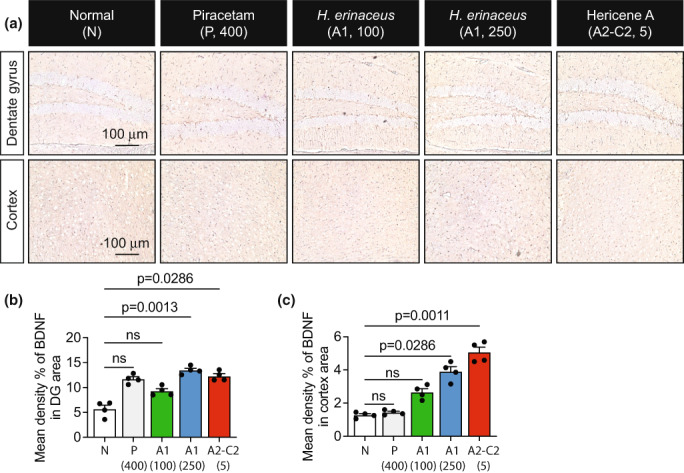
Lion's mane mushroom A1 and A2‐derived hericene A dietary treatment increase BDNF levels in brain. Mice were treated with either A1 (100 or 250 mg/kg), hericene A (A2‐C2, 5 mg/kg), piracetam (PC, 400 mg/kg) or vehicle control during 31 days, before their brains were collected and prepared for immunohistochemistry analysis. (a) The obtained brain sections were immunostained using anti‐BDNF antibody. The images were photographed at 10× magnification. The optical density of BDNF immunoreactivity was analyzed in the dentate gyrus (DG) (b) and in the cortex region (c). All data are expressed as the mean ± SEM, n = 4 brains. One‐way ANOVA followed by Tukey's post hoc test was performed. p‐value is indicated when significant differences were found, and “ns” is stated when no significant differences were detected.
FIGURE 9
FIGURE 9
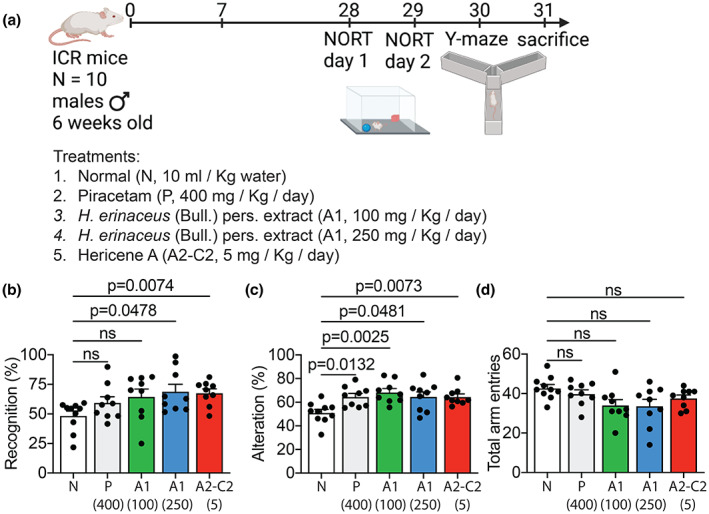
Lion's mane mushroom A1 and A2‐derived hericene dietary treatment improve recognition memory in mice. (a) Scheme of the experimental design. Mice were treated either with A1 (100 or 250 mg/kg), hericene A (A2‐C2, 5 mg/kg), piracetam (PC, 400 mg/kg) or vehicle control (Normal) during 31 days. After testing, mice were sacrificed. (b–d) Quantifications of the behavioral test performed. The NORT test measures the portion of time spent exploring novel object, and expressed as the % of time spent exploring from the total. The NORT test was performed at day 28 and at day 29 (b). The Y‐maze test measures the spontaneous alternation of number of arm entries, and is expressed as the % of alternation (c) and as the total arm entries (d). All data are expressed as the mean ± SEM, n = 9–10 animals. One‐way ANOVA followed by Dunnett's T3 post hoc test was performed. p‐value is indicated when significant differences were found, and “ns” is stated when no significant differences were detected.

References

    1. Allen, S. J. , Watson, J. J. , & Dawbarn, D. (2011). The neurotrophins and their role in Alzheimer's disease. Current Neuropharmacology, 9, 559–573. - PMC - PubMed
    1. Bae, H. J. , Kim, J. , Kim, J. , Goo, N. , Cai, M. , Cho, K. , Jung, S. Y. , Kwon, H. , Kim, D. H. , Jang, D. S. , & Ryu, J. H. (2020). The effect of maslinic acid on cognitive dysfunction induced by cholinergic blockade in mice. Br J Pharmacol, 177, 3197–3209. - PMC - PubMed
    1. Baruch‐Eliyahu, N. , Rud, V. , Braiman, A. , & Priel, E. (2019). Telomerase increasing compound protects hippocampal neurons from amyloid beta toxicity by enhancing the expression of neurotrophins and plasticity related genes. Scientific Reports, 9, 18118. - PMC - PubMed
    1. Bergmann, I. , Reiter, R. , Toyka, K. V. , & Koltzenburg, M. (1998). Nerve growth factor evokes hyperalgesia in mice lacking the low‐affinity neurotrophin receptor p75. Neuroscience Letters, 255, 87–90. - PubMed
    1. Brandalise, F. , Cesaroni, V. , Gregori, A. , Repetti, M. , Romano, C. , Orrù, G. , Botta, L. , Girometta, C. , Guglielminetti, M. L. , Savino, E. , & Rossi, P. (2017). Dietary supplementation of Hericium erinaceus increases mossy fiber‐CA3 hippocampal neurotransmission and recognition memory in wild‐type mice. Evidence‐Based Complementary and Alternative Medicine, 2017, 3864340–3864313. - PMC - PubMed

Publication types