


Simulations of rate of genetic gain in dry bean breeding programs
- PMID: 36662255
- PMCID: PMC9859924
- DOI: 10.1007/s00122-023-04244-x
Simulations of rate of genetic gain in dry bean breeding programs
Erratum in
-
Correction to volume 136 issue 1.Theor Appl Genet. 2023 Mar 23;136(4):84. doi: 10.1007/s00122-023-04323-z. Theor Appl Genet. 2023. PMID: 36952001 Free PMC article. No abstract available.
Abstract
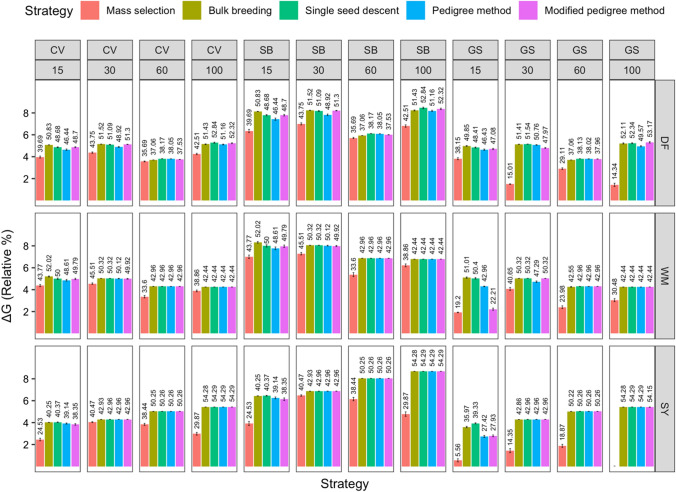
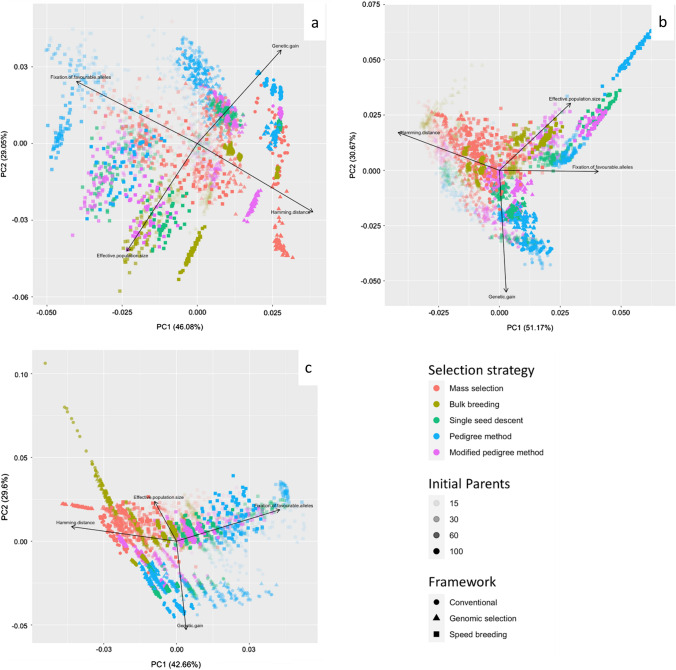
A reference study for breeders aiming at maximizing genetic gain in common bean. Depending on trait heritability and genetic architecture, conventional approaches may provide an advantage over other frameworks. Dry beans (Phaseolus vulgaris L.) are a nutrient dense legume that is consumed by developed and developing nations around the world. The progress to improve this crop has been quite steady. However, with the continued rise in global populations, there are demands to expedite genetic gains. Plant breeders have been at the forefront at increasing yields in the common bean. As breeding programs are both time-consuming and resource intensive, resource allocation must be carefully considered. To assist plant breeders, computer simulations can provide useful information that may then be applied to the real world. This study evaluated multiple breeding scenarios in the common bean and involved five selection strategies, three breeding frameworks, and four different parental population sizes. In addition, the breeding scenarios were implemented in three different traits: days to flowering, white mold tolerance, and seed yield. Results from the study reflect the complexity of breeding programs, with the optimal breeding scenario varying based on trait being selected. Relative genetic gains per cycle of up to 8.69% for seed yield could be obtained under the use of the optimal breeding scenario. Principal component analyses revealed similarity between strategies, where single seed descent and the modified pedigree method would often aggregate. As well, clusters in the direction of the Hamming distance eigenvector are a good indicator of poor performance in a strategy.
© 2023. The Author(s).
Conflict of interest statement
On behalf of all authors, the corresponding author states that there is no conflict of interest.
Figures


References
-
- Acquaah G. Principles of plant genetics and breeding. Wiley; 2009.
-
- Adams M. Basis of yield component compensation in crop plants with special reference to the field bean, Phaseolus vulgaris 1. Crop Sci. 1967;7:505–510. doi: 10.2135/cropsci1967.0011183X000700050030x. - DOI
-
- Ali M, Zhang L, DeLacy I, Arief V, Dieters M, Pfeiffer WH, Wang J, Li H. Modeling and simulation of recurrent phenotypic and genomic selections in plant breeding under the presence of epistasis. The Crop Journal. 2020;8:866–877. doi: 10.1016/j.cj.2020.04.002. - DOI
-
- Atuahene-Amankwa G, Beatie AD, Michaels TE, Falk DE. Cropping system evaluation and selection of common bean genotypes for a maize/bean intercrop. Afr Crop Sci J. 2004;12:105–113. doi: 10.4314/acsj.v12i2.27668. - DOI
-
- Beaver JS, Osorno JM. Achievements and limitations of contemporary common bean breeding using conventional and molecular approaches. Euphytica. 2009;168:145–175. doi: 10.1007/s10681-009-9911-x. - DOI
MeSH terms
Grants and funding
LinkOut - more resources
Full Text Sources
Research Materials
