Health and Economic Outcomes Associated With Musculoskeletal Disorders Attributable to High Body Mass Index in 192 Countries and Territories in 2019
- PMID: 36662529
- PMCID: PMC9860530
- DOI: 10.1001/jamanetworkopen.2022.50674
Health and Economic Outcomes Associated With Musculoskeletal Disorders Attributable to High Body Mass Index in 192 Countries and Territories in 2019
Abstract
Importance: The degree to which health and economic outcomes of musculoskeletal disorders are attributable to high body mass index (BMI) has not been quantified on a global scale.
Objective: To estimate global health and economic outcomes associated with musculoskeletal disorders-low back pain (LBP), gout, and osteoarthritis attributable to high BMI in 2019.
Design, setting, and participants: This cross-sectional study used data of 192 countries and territories from the Global Burden of Diseases, Injuries, and Risk Factors Study, World Health Organization Global Health Expenditure, World Bank, and International Labour Organization databases. Data analyses were conducted from February 24 to June 16, 2022.
Main outcomes and measures: Prevalence, years lived with disability (YLDs), health care costs, and productivity losses due to morbidity from LBP, gout, and osteoarthritis attributable to high BMI by region and country. Prevalence and YLDs were calculated with the population attributable fraction approach. The economic burden, including health care costs and productivity losses due to morbidity, was also quantified. Health care costs borne by the public, private, and out-of-pocket sectors were estimated based on their corresponding payment shares. Productivity losses were estimated based on the output per worker. A sensitivity analysis was conducted to arrive at the base, minimum, and maximum estimates (ie, uncertainty interval [UI]) by using the mean, lower, and upper bounds of all input variables.
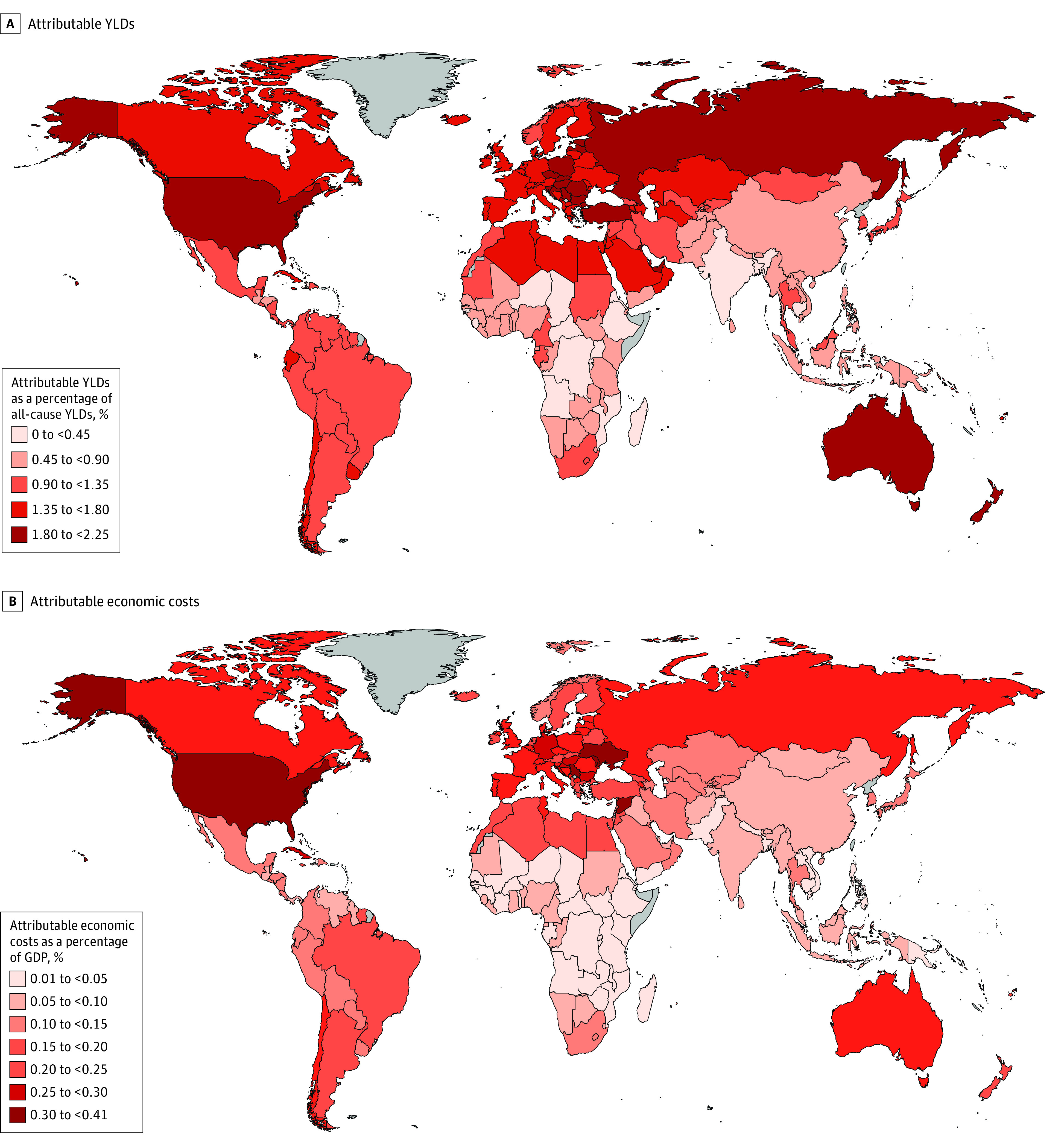
Results: High BMI was estimated to be responsible for 36.3 million (UI, 18.4-61.0 million), 16.9 million (UI, 7.5-32.5 million), and 73.0 million (UI, 32.4-131.1 million) prevalent cases of LBP, gout, and osteoarthritis, respectively, which accounted for 7.3 million (UI, 3.0-15.0 million) YLDs across 192 countries and territories in 2019. Globally, the YLDs of musculoskeletal disorders attributable to high BMI accounted for 1.0% of all-cause YLDs in the working-age population aged 15 to 84 years. The global total costs of musculoskeletal disorders attributable to high BMI reached $180.7 billion (UI, $83.8-$333.1 billion), including $60.5 billion (UI, $30.7-$100.5 billion) in health care costs and $120.2 billion (UI, $53.1-$232.7 billion) in productivity losses. In terms of the global health care costs, 58.9% ($35.6 billion; UI, $17.8-$59.6 billion) was borne by the public sector, 24.0% ($14.5 billion; UI, $7.8-$23.2 billion) by the private sector, and 17.1% ($10.3 billion; UI, $5.1-$17.6 billion) by the out-of-pocket sector. On average, the total costs accounted for 0.2% of global gross domestic product. Great inequalities in the disease and economic burden existed across regions and countries. Nearly 80% of global health care (82.4%) and morbidity-related costs (82.9%) were paid by high-income countries, whereas more than 60% (61.4%) of global YLDs occurred in middle-income countries.
Conclusions and relevance: In this cross-sectional study of 192 countries and territories, a substantial amount of the health and economic impact of musculoskeletal disorders was attributable to high BMI. Developing effective policies and active participation from health professionals to prevent excessive weight gain are needed. More available estimates are also needed to facilitate a global analysis.
Conflict of interest statement
Figures
References
MeSH terms
LinkOut - more resources
Full Text Sources
Medical
Miscellaneous