Effectiveness and Safety of Albuterol Solutions With and Without Benzalkonium Chloride
- PMID: 36669780
- PMCID: PMC10208994
- DOI: 10.4187/respcare.10747
Effectiveness and Safety of Albuterol Solutions With and Without Benzalkonium Chloride
Abstract
Introduction: Continuous aerosolized β2 agonist, namely albuterol, is the most commonly used therapy for critical asthma. Benzalkonium chloride is a preservative present in some formulations of aerosolized albuterol solutions that can induce bronchospasm. Recent studies have shown that inhalation of albuterol containing benzalkonium chloride might induce unintended bronchoconstriction and poor outcomes. This study aimed to investigate whether using albuterol solutions containing benzalkonium chloride results in prolonged hospital length of stay (LOS).
Methods: This was a retrospective cohort study of pediatric subjects admitted to the pediatric ICU (PICU) and treated with continuous albuterol. Data were collected and compared before and after a change to benzalkonium chloride-containing solutions. Subjects who were treated with preservative-free solutions were used as control. The primary outcome was PICU and hospital LOS; secondary outcomes included the duration of continuous albuterol and use of adjunctive therapies.
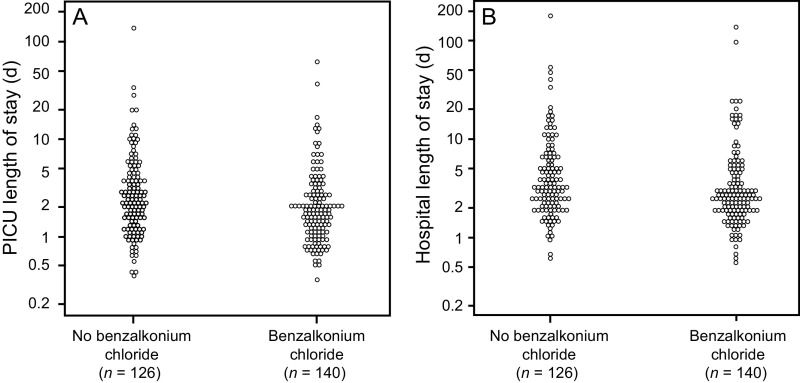
Results: A total of 266 admissions were included in the study. One hundred forty subjects (52.6%) were exposed to benzalkonium chloride. Median age and severity of illness scoring were similar between groups. The initial dose of continuous albuterol was significantly higher in the benzalkonium chloride group (median 15 interquartile range [IQR] 10-20 mg/h) compared to the preservative-free group (median 10 IQR 10-20 mg/h) (P < .001). PICU LOS was longer for the preservative-free group, 2.5 (IQR 1.4-4.6) d vs 1.8 (IQR 1.1-2.9) d for benzalkonium chloride group (P = .002). There was no significant difference in duration of continuous albuterol therapy (P = .16) or need for adjunctive respiratory support (heliox [P = .32], noninvasive ventilation [P = .81], and invasive mechanical ventilation [P = .57]).
Conclusions: In contrast to published literature showing that benzalkonium chloride may be associated with a longer duration of continuous albuterol nebulization and hospital LOS, our study demonstrated that benzalkonium chloride-containing albuterol is safe for continuous nebulization in critically ill children and not associated with worse outcomes.
Keywords: PICU; aerosolized β2 agonist; albuterol; benzalkonium chloride; critical asthma; pediatrics.
Copyright © 2023 by Daedalus Enterprises.
Conflict of interest statement
Dr Al-Subu discloses a relationship with Edwards Lifesciences LLC. The remaining authors have disclosed no conflicts of interest.
Figures
References
-
- Peters SG. Continuous bronchodilator therapy. Chest 2007;131(1):286-289. - PubMed
-
- Kenyon CC, Fieldston ES, Luan X, Keren R, Zorc JJ. Safety and effectiveness of continuous aerosolized albuterol in the non–intensive care setting. Pediatrics 2014;134(4):e976-e982. - PubMed
-
- Lin AT, Moore-Clingenpeel M, Karsies TJ. Comparison of two continuous nebulized albuterol doses in critically ill children with status asthmaticus. J Asthma 2019:1-7. - PubMed
-
- Craig VL, Bigos D, Brilli RJ. Efficacy and safety of continuous albuterol nebulization in children with severe status asthmaticus. Pediatr Emerg Care 1996;12(1):1-5. - PubMed
MeSH terms
Substances
LinkOut - more resources
Full Text Sources