


Synapsid tracks with skin impressions illuminate the terrestrial tetrapod diversity in the earliest Permian of equatorial Pangea
- PMID: 36670191
- PMCID: PMC9860047
- DOI: 10.1038/s41598-023-27939-z
Synapsid tracks with skin impressions illuminate the terrestrial tetrapod diversity in the earliest Permian of equatorial Pangea
Abstract
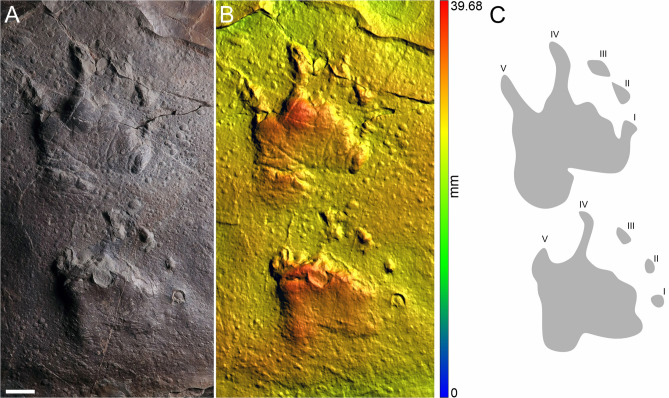
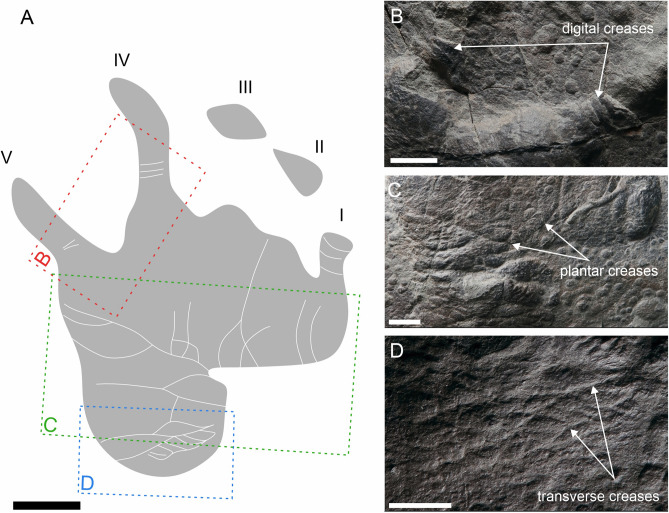
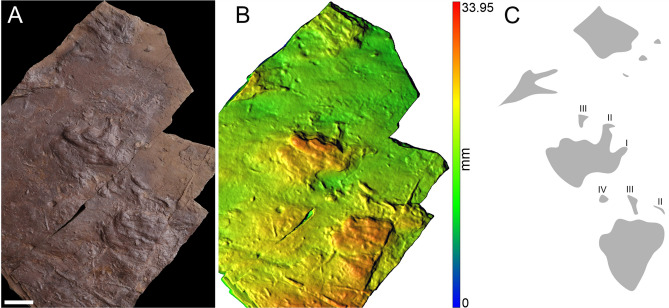
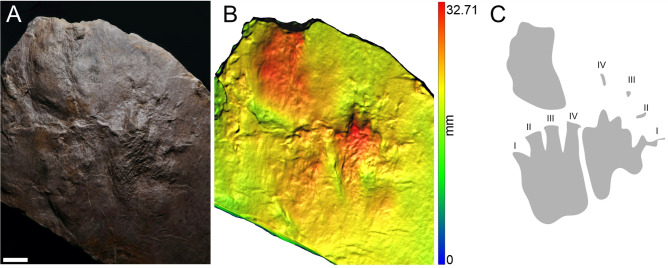
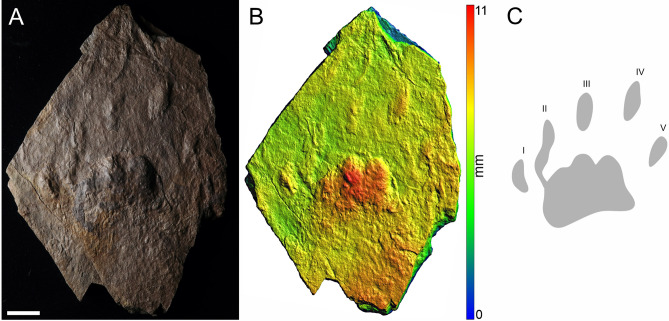
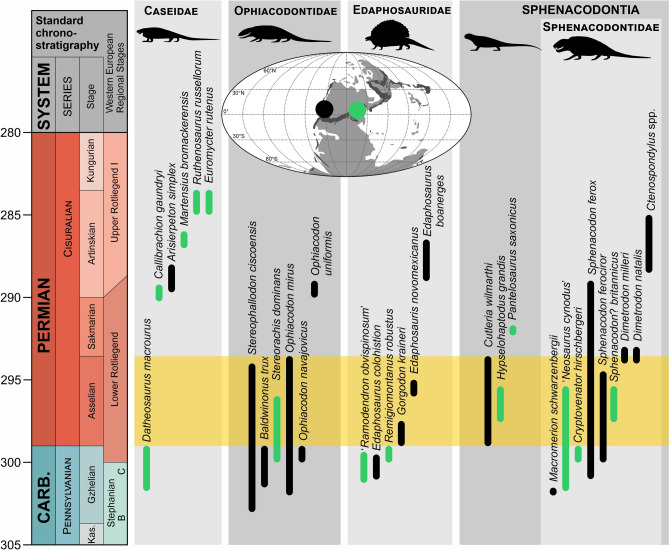
Lower Permian deposits of the Boskovice Basin in the Czech Republic have long been renowned for extraordinarily abundant specimens of discosauriscid seymouriamorphs, some of which showing exceptional preservation, including widespread soft tissues. The only other tetrapods from the strata are represented by rare temnospondyls. However, recent fieldwork in the Asselian (lowermost Permian) of the Boskovice Basin has yielded a diverse assemblage of tetrapod tracks, illuminating a hidden terrestrial tetrapod diversity. Here, we describe well-preserved isolated tracks, manus-pes couples, and a slab with trackways composed of approximately 20 tracks in at least four different directions belonging to early-diverging, or 'pelycosaur-grade', synapsids. The material originates from three localities situated within the Letovice and Padochov formations and is assignable to the ichnotaxon Dimetropus. The best-preserved specimen further shows rare skin impressions, which have not been observed from the hands or feet of early-diverging mammal-line amniotes before. The new material adds to the scarce record of synapsids from the Carboniferous/Permian transitional interval of equatorial Pangea. At the same time, it highlights the significance of the ichnological record of the Boskovice Basin which has long been neglected despite offering evidence for the presence of diverse faunal components that have not been reported from these basinal deposits before.
© 2023. The Author(s).
Conflict of interest statement
The authors declare no competing interests.
Figures


References
-
- Špinar ZV. Revize nĕkterých moravských diskosauriscidů (Labyrinthodontia) Rozpravy Ústředního Ústavu Geologického. 1952;15:1–115.
-
- Klembara J, Meszároš Š. New finds of Discosauriscus austriacus (Makowsky 1876) from the Lower Permian of the Boskovice Furrow (Czecho-Slovakia) Geol. Carpath. 1992;43:305–312.
-
- Klembara J. The external gills and ornamentation of the skull roof bones of the Lower Permian tetrapod Discosauriscus austriacus (Makowsky 1876) with remarks to its ontogeny. Paläontol. Z. 1995;69:265–281. doi: 10.1007/BF02985990. - DOI
-
- Klembara J. The cranial anatomy of Discosauriscus Kuhn, a seymouriamorph tetrapod from the Lower Permian of the Boskovice Furrow (Czech Republic) Philos. Trans. R. Soc. B. 1997;352:257–302. doi: 10.1098/rstb.1997.0021. - DOI
-
- Calábková G, Březina J, Madzia D. Evidence of large terrestrial seymouriamorphs in the lowermost Permian of the Czech Republic. Pap. Palaeontol. 2022 doi: 10.1002/spp2.1428. - DOI
Publication types
MeSH terms
LinkOut - more resources
Full Text Sources
Medical
