. 2022 Dec 22;12(1):15.
doi: 10.3390/antibiotics12010015.

Conjugates of Chloramphenicol Amine and Berberine as Antimicrobial Agents

Affiliations

Conjugates of Chloramphenicol Amine and Berberine as Antimicrobial Agents

Julia A Pavlova et al. Antibiotics (Basel). .

Abstract

In order to obtain antimicrobial compounds with improved properties, new conjugates comprising two different biologically active agents within a single chimeric molecule based on chloramphenicol (CHL) and a hydrophobic cation were synthesized and studied. Chloramphenicol amine (CAM), derived from the ribosome-targeting antibiotic CHL, and the plant isoquinoline alkaloid berberine (BER) are connected by alkyl linkers of different lengths in structures of these conjugates. Using competition binding, double reporter system, and toeprinting assays, we showed that synthesized CAM-Cn-BER compounds bound to the bacterial ribosome and inhibited protein synthesis like the parent CHL. The mechanism of action of CAM-C5-BER and CAM-C8-BER on the process of bacterial translations was similar to CHL. Experiments with bacteria demonstrated that CAM-Cn-BERs suppressed the growth of laboratory strains of CHL and macrolides-resistant bacteria. CAM-C8-BER acted against mycobacteria and more selectively inhibited the growth of Gram-positive bacteria than the parent CHL and the berberine derivative lacking the CAM moiety (CH3-C8-BER). Using a potential-sensitive fluorescent probe, we found that CAM-C8-BER significantly reduced the membrane potential in B. subtilis cells. Crystal violet assays were used to demonstrate the absence of induction of biofilm formation under the action of CAM-C8-BER on E. coli bacteria. Thus, we showed that CAM-C8-BER could act both on the ribosome and on the cell membrane of bacteria, with the alkylated berberine fragment of the compound making a significant contribution to the inhibitory effect on bacterial growth. Moreover, we showed that CAM-Cn-BERs did not inhibit eukaryotic translation in vitro and were non-toxic for eukaryotic cells.

Keywords: C-13 derivatives of berberine; antibiotic activity; bacterial membrane potential; bacterial ribosome; berberine; biofilms; chloramphenicol.


Conflict of interest statement

The authors declare no conflict of interest.

Figures
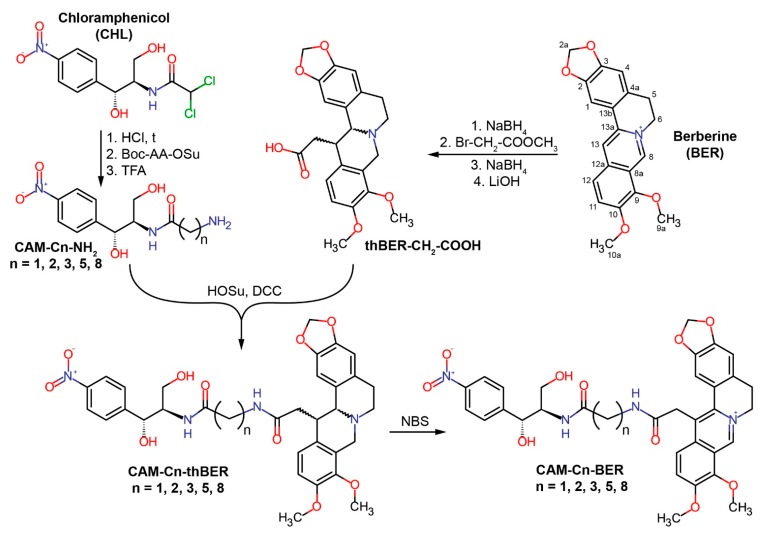
Figure 1
Figure 1
Scheme of the chemical synthesis of conjugates of chloramphenicol amine (CAM) and berberine (BER) containing linkers of different lengths—CAM-Cn-BER, n = 1, 2, 3, 5, 8.
Figure 2
Figure 2
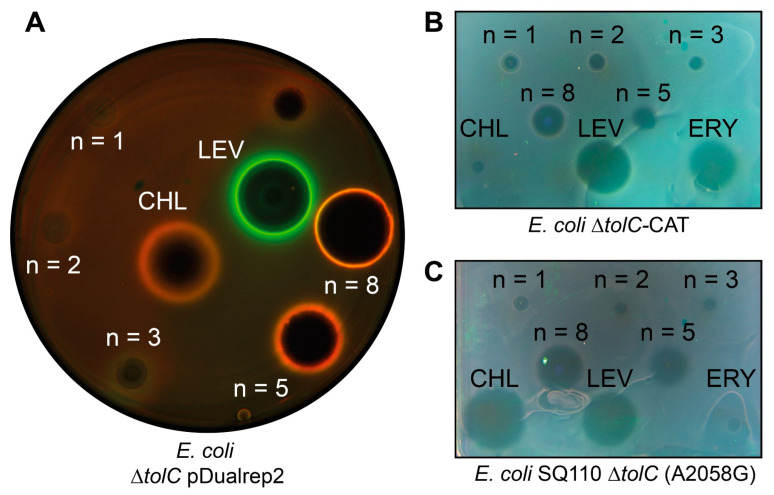
Antibacterial activity of CAM-Cn-BER, n = 1, 2, 3, 5, 8. Levofloxacin (LEV), chloramphenicol (CHL), and erythromycin (ERY) are used as the controls. (A) Testing of the CAM-Cn-BER activity using E. coli ΔtolC pDualrep2 reporter strain. The induction of the red fluorescent protein expression (green halo around the inhibition zone, pseudocolor) is triggered by DNA damage, while the induction of Katushka2S protein (red halo, pseudocolor) occurs in response to ribosome stalling. The unlabeled spot above LEV corresponds to a substance not studied in this work. (B) Testing of the CAM-Cn-BER antibacterial activity on CHL-resistant E. coli strain ΔtolC-CAT harboring pCA24N-LacZ plasmid with the cat gene encoding for chloramphenicol acetyltransferase. (C) Testing of the CAM-Cn-BER antibacterial activity on macrolide-resistant E. coli strain SQ110 ΔtolC (A2058G) in which the A2058 nucleotide is replaced by G2058 in the 23S rRNA.
Figure 3
Figure 3
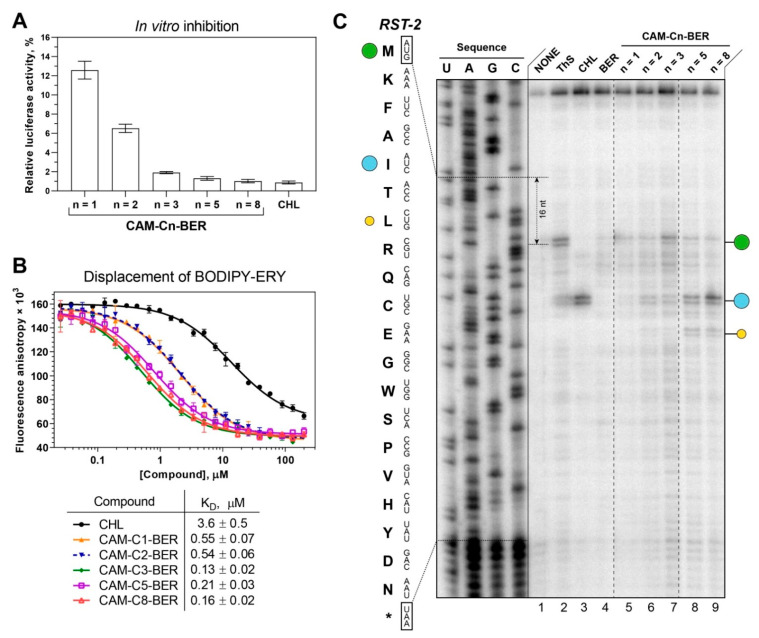
Binding affinity to bacterial ribosomes and the inhibition of protein synthesis by CAM-Cn-BER, n = 1, 2, 3, 5, 8. (A) The inhibition of protein synthesis in vitro by 30 µM of CHL and CAM-Cn-BERs in the cell-free bacterial transcription-translation coupled system. The relative enzymatic activity of in vitro synthesized firefly luciferase is shown. The error bars represent the standard deviations. (B) A competitive binding assay to test the affinity of CHL and CAM-Cn-BERs to E. coli 70S ribosomes measured by fluorescence anisotropy of fluorescently labeled analog of the erythromycin, BODIPY-ERY. All reactions were repeated at least two times. Error bars represent the standard deviation. The resulting mean values for the apparent dissociation constants (KDapp) with confidence intervals (α = 0.05) are shown in the table below the graph. (C) Ribosome stalling by CAM-Cn-BER (n = 1, 2, 3, 5, 8, lanes 5–9) on RST-2 mRNA as detected by a reverse-transcription primer-extension inhibition (toeprinting) assay in a cell-free translation system. DMSO, 0.5% (NONE, lane 1), ThS (inhibits translation at the start codon, lane 2), CHL (lane 3), and BER (lane 4) were used as controls. The nucleotide sequence of RST-2 mRNA and its corresponding amino acid sequence are shown on the left. The green circle marks the translation arrest at the start codon, while the blue and yellow circles denote drug-induced arrest sites within the coding sequence of the mRNA used. Note that due to the large size of the ribosome, the reverse transcriptase used in the toeprinting assay stops 16 nucleotides downstream of the codon located in the P-site. The asterisk (*) indicates a stop codon. Dashed lines mark the places from which parts of the gel were cut out. The full image of the gel is shown in Supplementary Information (Figure S5).
Figure 4
Figure 4
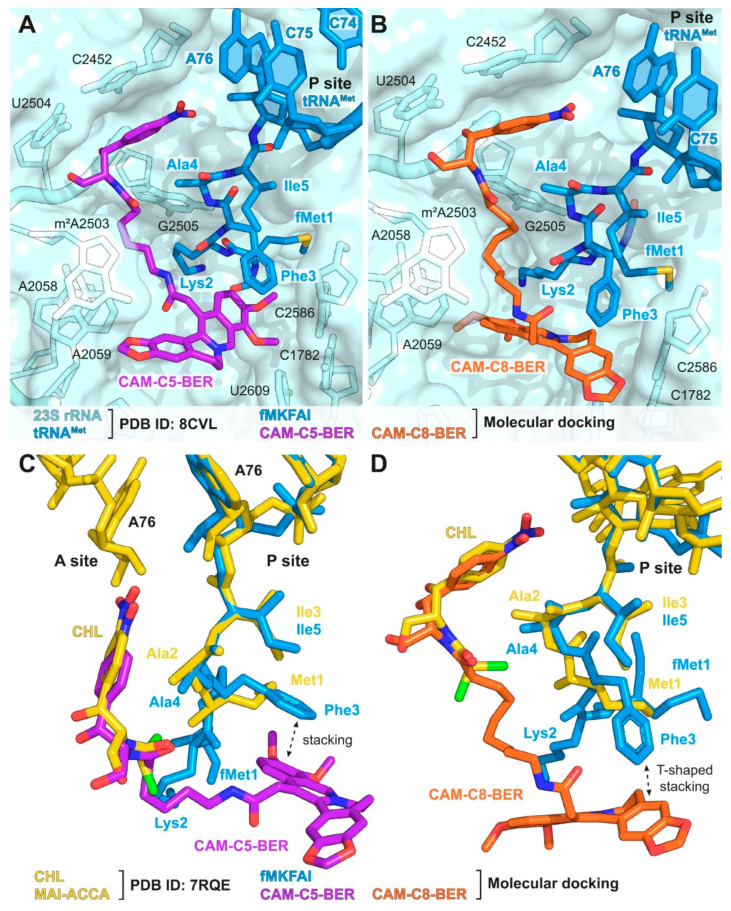
Structures of complexes of CAM-C5-BER and CAM-C8-BER with the T. thermophilus ribosome obtained by molecular docking. (A,B) Structures of CAM-C5-BER ((A), purple), CAM-C8-BER ((B), orange), and fMKFAI-NH-tRNAMet (blue) docked into the crystal structure of T. thermophilus ribosome (PDB ID: 8CVL [76], light blue). (C,D) Superposition of the structures of CAM-C5-BER ((C), purple) and CAM-C8-BER ((D), orange) in complex with T. thermophilus ribosome carrying fMKFAI-NH-tRNAMet (blue) obtained by molecular docking with the previously reported crystal structure of CHL (yellow) and P-site MAI-ACCA (yellow) in complex with T. thermophilus ribosome (PDB ID: 7RQE [16]). E. coli numbering of nucleotides is presented.
Figure 5
Figure 5
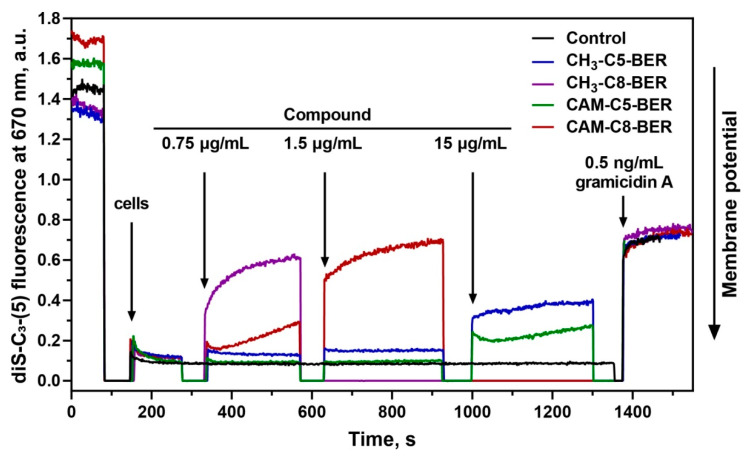
Effect of CAM-Cn-BER (n = 5, 8) and CH3-Cn-BER (n = 5, 8) on the kinetics of the membrane potential of B. subtilis cells measured using the fluorescent probe diS-C3-(5). Arrows mark moments at which appropriate amounts of the compounds were added. Gramicidin A at a concentration of 0.5 ng/mL was used as a control.
Figure 6
Figure 6
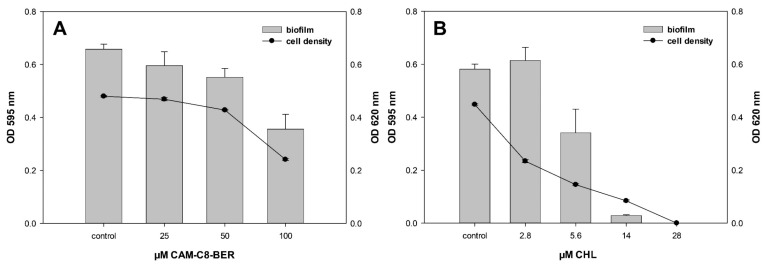
Biofilm formation of E. coli at different concentrations of CAM-C8-BER (A) and CHL (B). E. coli WT cells were exposed 20 h with the test compounds, and their cell density (black curves) and surface attachment (gray bars) were measured. Values for cell density (OD620) are indicated on the right y-axis, and biofilm values (OD595) are indicated on the left y-axis.

References

    1. Wencewicz T.A. Crossroads of Antibiotic Resistance and Biosynthesis. J. Mol. Biol. 2019;431:3370–3399. doi: 10.1016/j.jmb.2019.06.033. - DOI - PMC - PubMed
    1. Schaenzer A.J., Wright G.D. Antibiotic Resistance by Enzymatic Modification of Antibiotic Targets. Trends Mol. Med. 2020;26:768–782. doi: 10.1016/j.molmed.2020.05.001. - DOI - PubMed
    1. Tevyashova A.N., Olsufyeva E.N., Preobrazhenskaya M.N. Design of Dual Action Antibiotics as an Approach to Search for New Promising Drugs. Russ. Chem. Rev. 2015;84:61–97. doi: 10.1070/RCR4448. - DOI
    1. Wilson D.N. Ribosome-Targeting Antibiotics and Mechanisms of Bacterial Resistance. Nat. Rev. Microbiol. 2014;12:35–48. doi: 10.1038/nrmicro3155. - DOI - PubMed
    1. Barbachyn M.R. Recent Advances in the Discovery of Hybrid Antibacterial Agents. Annu. Rep. Med. Chem. 2008;43:281–290. doi: 10.1016/S0065-7743(08)00017-1. - DOI

LinkOut - more resources