Review
. 2023 Jan 12;13(1):159.
doi: 10.3390/biom13010159.

The Challenges and Prospects of p53-Based Therapies in Ovarian Cancer

Affiliations
Review

The Challenges and Prospects of p53-Based Therapies in Ovarian Cancer

Bryce Wallis et al. Biomolecules. .

Abstract

It has been well established that mutations in the tumor suppressor gene, p53, occur readily in a vast majority of cancer tumors, including ovarian cancer. Typically diagnosed in stages three or four, ovarian cancer is the fifth leading cause of death in women, despite accounting for only 2.5% of all female malignancies. The overall 5-year survival rate for ovarian cancer is around 47%; however, this drops to an abysmal 29% for the most common type of ovarian cancer, high-grade serous ovarian carcinoma (HGSOC). HGSOC has upwards of 96% of cases expressing mutations in p53. Therefore, wild-type (WT) p53 and p53-based therapies have been explored as treatment options via a plethora of drug delivery vehicles including nanoparticles, viruses, polymers, and liposomes. However, previous p53 therapeutics have faced many challenges, which have resulted in their limited translational success to date. This review highlights a selection of these historical p53-targeted therapeutics for ovarian cancer, why they failed, and what the future could hold for a new generation of this class of therapies.

Keywords: HGSOC; gene delivery; gene therapy; ovarian cancer; p53 therapies.


Conflict of interest statement

The authors declare no conflict of interest.

Figures
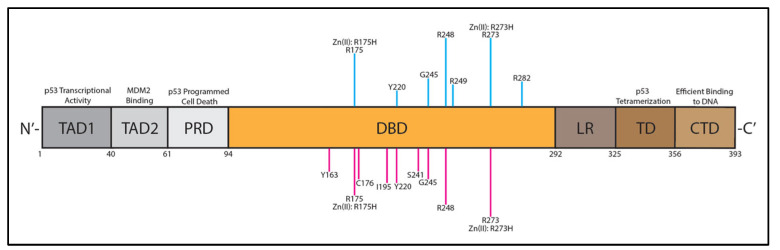
Figure 1
Figure 1
p53 domains (boxes) and cancer-inducing p53 mutations (pink and blue lines). Numbers below domains represent the amino acid number (1–393). Blue lines above DBD represent approximate abundances of all types of cancer-inducing p53 mutations. Pink lines below DBD represent approximate abundances of HGSOC-inducing p53 mutations. Zn(II) binding is inhibited by R175H and R273H mutations. TAD1 and TAD2 are p53 transcriptional activation domains. TAD2 is the MDM2-binding site. PRD (PXXP residues) is associated with p53 programmed cell death. CTD is highly unstructured and assists with efficient binding of p53 to DNA [45,46,49,52,53]. TAD1, TAD2 = transactivation domains 1 and 2; PRD = proline rich domain; DBD = DNA-binding domain; LR = linker region; TD = tetramerization domain; CTD = C-terminal domain.
Figure 2
Figure 2
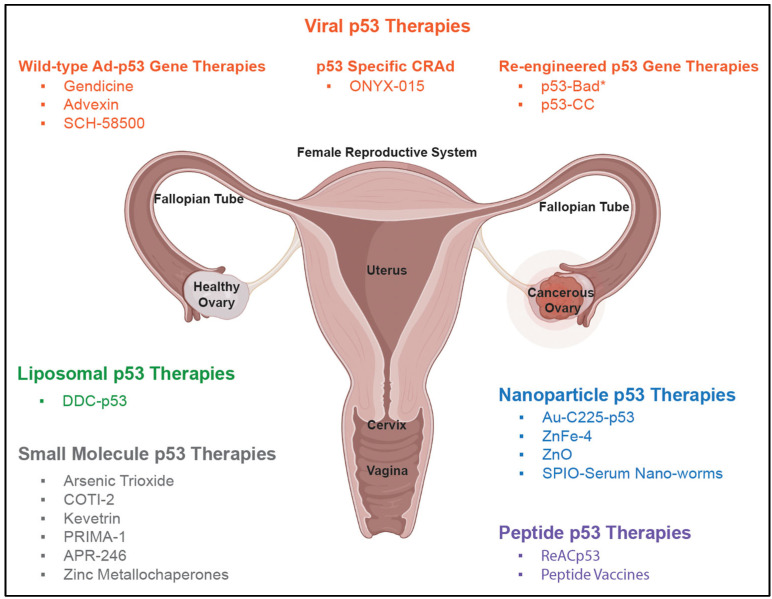
A selection of ovarian cancer p53-based therapies categorized into viral p53 therapies (wild-type Ad-p53 gene therapies, p53-specific CRAd, and re-engineered p53 gene therapies), nanoparticle p53 therapies, liposomal p53 therapies, peptide p53 therapies, and small molecule p53 therapies. Female reproductive system diagram from Bio Render.
Figure 3
Figure 3
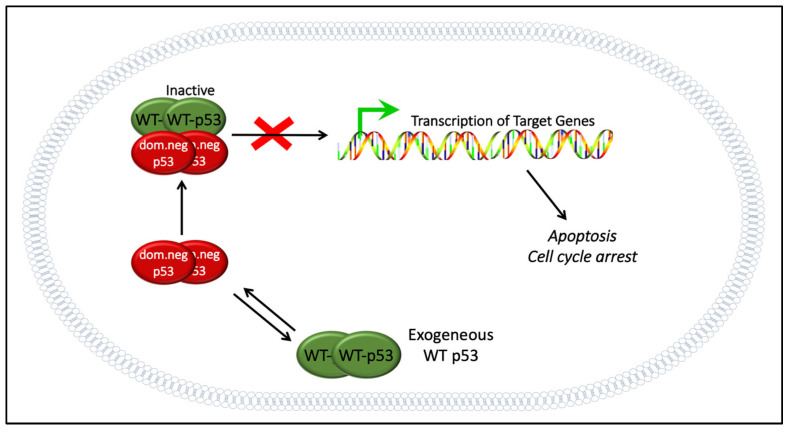
Why wild-type (WT) p53 gene therapy is not effective: dominant negative effect. Endogenous mutant p53 (dominant negative) found in cancer cells can tetramerize and inactivate any exogenously added WT p53. This inactive heterotetramer cannot bind to, nor activate, target genes. The result is that WT p53 cannot execute apoptosis nor cell cycle arrest. Bypassing the dominant negative effect may be possible with re-engineered p53 chimeras that do not bind to dominant negative p53 [52,104,105,106].

References

    1. Torre L.A., Trabert B., Desantis C.E., Miller K.D., Samimi G., Runowicz C.D., Gaudet M.M., Jemal A., Siegel R.L. Ovarian cancer statistics, 2018. CA Cancer J. Clin. 2018;68:284–296. doi: 10.3322/caac.21456. - DOI - PMC - PubMed
    1. Lawrenson K., Gayther S.A. Ovarian Cancer: A Clinical Challenge That Needs Some Basic Answers. PLoS Med. 2009;6:e1000025. doi: 10.1371/journal.pmed.1000025. - DOI - PMC - PubMed
    1. Corney D.C., Flesken-Nikitin A., Choi J., Nikitin A.Y. Role of p53 and Rb in Ovarian Cancer. Springer; New York, NY, USA: 2008. pp. 99–117. - PMC - PubMed
    1. Vinyals A., Peinado M.A., Gonzalez-Garrigues M., Monzó M., Bonfil R.D., Fabra A. Failure of wild-type p53 gene therapy in human cancer cells expressing a mutant p53 protein. Gene Ther. 1999;6:22–33. doi: 10.1038/sj.gt.3300786. - DOI - PubMed
    1. Zeimet A.G., Marth C. Why did p53 gene therapy fail in ovarian cancer? Lancet Oncol. 2003;4:415–422. doi: 10.1016/S1470-2045(03)01139-2. - DOI - PubMed

Publication types

Substances