


Risk Factors for Delirium after Deep Brain Stimulation Surgery under Total Intravenous Anesthesia in Parkinson's Disease Patients
- PMID: 36672007
- PMCID: PMC9856435
- DOI: 10.3390/brainsci13010025
Risk Factors for Delirium after Deep Brain Stimulation Surgery under Total Intravenous Anesthesia in Parkinson's Disease Patients
Abstract
Background: Postoperative delirium (POD) is associated with perioperative complications and mortality. Data on the risk factors for delirium after subthalamic nucleus deep brain stimulation (STN-DBS) surgery is not clarified in Parkinson's disease (PD) patients receiving total intravenous anesthesia. We aimed to investigate the risk factors for delirium after STN-DBS surgery in PD patients.
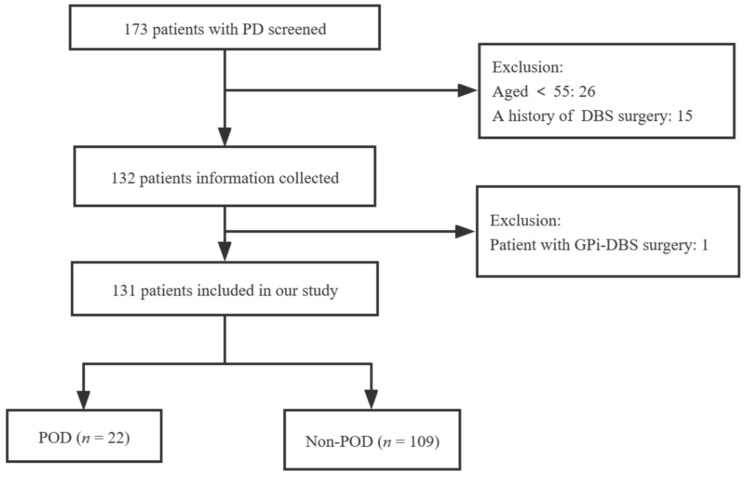
Methods: The retrospective cohort study was conducted, including 131 PD patients who underwent STN-DBS for the first time under total intravenous anesthesia from January to December 2021. Delirium assessments were performed twice daily for 7 days after surgery or until hospital discharge using the confusion assessment method for the intensive care unit. Multivariate logistic regression analysis was used to determine the risk factor of POD.
Results: In total, 22 (16.8%) of 131 patients were in the POD group, while the other 109 patients were in the Non-POD group. Multivariate logistic regression analysis showed that preoperative Mini-mental State Examination score [odds ratio = 0.855, 95% confidence interval = 0.768-0.951, p = 0.004] and unified Parkinson's disease rating scale part 3 (on state) score (odds ratio = 1.061, 95% confidence interval = 1.02-1.104, p = 0.003) were independently associated with delirium after surgery.
Conclusions: In this retrospective cohort study of PD patients, a lower Mini-mental State Examination score and a higher unified Parkinson's disease rating scale part 3 (on state) score were the independent risk factors for delirium after STN-DBS surgery in PD patients under total intravenous anesthesia.
Keywords: Parkinson’s disease; deep brain stimulation; general anesthesia; postoperative delirium; risk factors; total intravenous anesthesia.
Conflict of interest statement
The authors state that the study was conducted without any commercial or financial relationships and potential conflict of interest.
Figures
References
-
- Brown C., Edwards C., Lin C., Jones E., Yanek L., Esmaili M., Gorashi Y., Skelton R., Kaganov D., Curto R., et al. Spinal Anesthesia with Targeted Sedation based on Bispectral Index Values Compared with General Anesthesia with Masked Bispectral Index Values to Reduce Delirium: The SHARP Randomized Controlled Trial. Anesthesiology. 2021;135:992–1003. doi: 10.1097/ALN.0000000000004015. - DOI - PMC - PubMed
-
- Li T., Li J., Yuan L., Wu J., Jiang C., Daniels J., Mehta R., Wang M., Yeung J., Jackson T., et al. Effect of Regional vs General Anesthesia on Incidence of Postoperative Delirium in Older Patients Undergoing Hip Fracture Surgery: The RAGA Randomized Trial. JAMA. 2022;327:50–58. doi: 10.1001/jama.2021.22647. - DOI - PMC - PubMed
Grants and funding
LinkOut - more resources
Full Text Sources
