Review
. 2023 Jan 13;15(2):504.
doi: 10.3390/cancers15020504.

Mechanisms of Acquired Resistance and Tolerance to EGFR Targeted Therapy in Non-Small Cell Lung Cancer

Affiliations
Review

Mechanisms of Acquired Resistance and Tolerance to EGFR Targeted Therapy in Non-Small Cell Lung Cancer

Houssein Chhouri et al. Cancers (Basel). .

Abstract

Non-small cell lung cancers (NSCLC) harboring activating mutations of the epidermal growth factor receptor (EGFR) are treated with specific tyrosine kinase inhibitors (EGFR-TKIs) of this receptor, resulting in clinically responses that can generally last several months. Unfortunately, EGFR-targeted therapy also favors the emergence of drug tolerant or resistant cells, ultimately resulting in tumor relapse. Recently, cellular barcoding strategies have arisen as a powerful tool to investigate the clonal evolution of these subpopulations in response to anti-cancer drugs. In this review, we provide an overview of the currently available treatment options for NSCLC, focusing on EGFR targeted therapy, and discuss the common mechanisms of resistance to EGFR-TKIs. We also review the characteristics of drug-tolerant persister (DTP) cells and the mechanistic basis of drug tolerance in EGFR-mutant NSCLC. Lastly, we address how cellular barcoding can be applied to investigate the response and the behavior of DTP cells upon EGFR-TKI treatment.

Keywords: EGFR-TKI; cellular barcoding; drug resistance; drug tolerant persister cells; non-small cell lung cancer; targeted therapy.


Conflict of interest statement

The authors declare no conflict of interest.

Figures
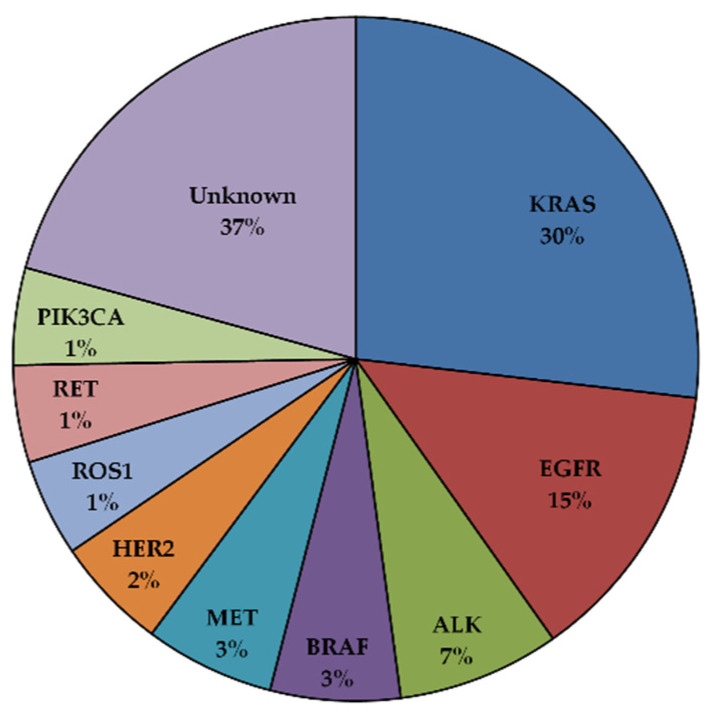
Figure 1
Figure 1
Driver oncogenic mutations in NSCLC [11,12].
Figure 2
Figure 2
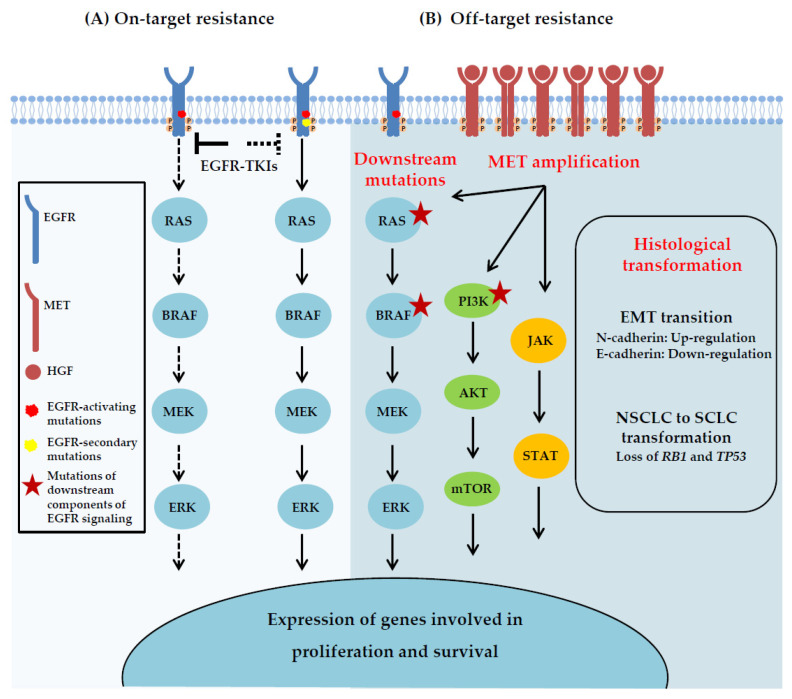
Acquired resistance mechanisms to EGFR-TKIs. (A) On-target resistance is caused by second-site EGFR kinase domain mutations that interfere with the binding of the EGFR-TKIs. (B) Off-target resistance may result from alterations involving downstream components of the EGFR pathway, activation of alternative signaling pathways that bypass the primary drug targets, including MET amplification, or transition to another cell lineage, such as epithelial-to mesenchymal transition (EMT) and SCLC transformation.
Figure 3
Figure 3
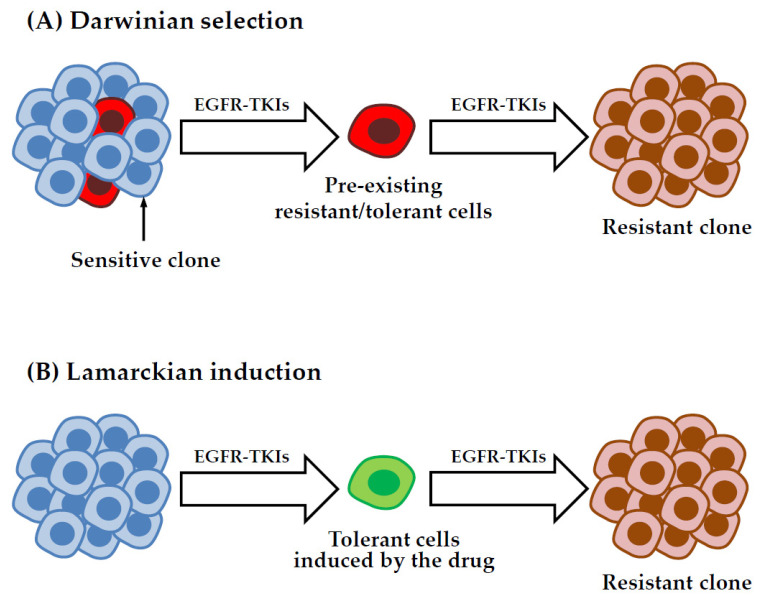
Models for the emergence of drug-tolerant cells. In the pre-existing selection model (A), DTP cells are selected in response to treatment because of some intrinsic properties through non-genetic Darwinian selection. Alternatively, in the drug induced model, also known as Lamarckian induction (B), DTP cells can originate more randomly as a direct effect of the treatment. These cells can evolve over time to acquire various genetic or non-genetic mechanisms of resistance.
Figure 4
Figure 4
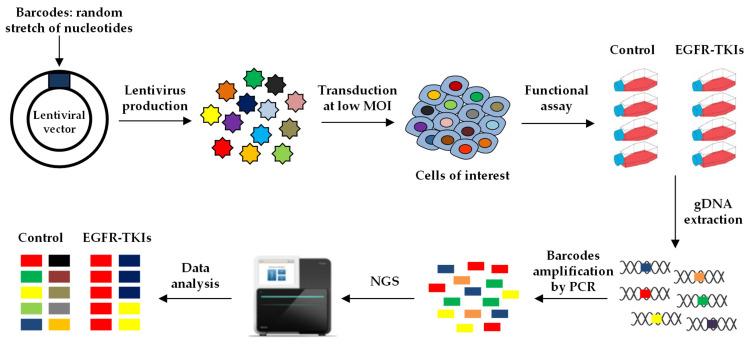
Lentiviral barcoding. A lentiviral barcode library is generated containing a random and highly complex stretch of nucleotides. The virus is produced and used to transduce the cancer cells of interest at low multiplicity of infection to label each cell with one unique barcode. The barcoded cells are treated in the presence or the absence of the compounds of interest, e.g., an EGFR-TKI, and then harvested to extract their genomic DNA (gDNA). The region of the vector containing the barcodes is amplified by PCR and the amplicons are sequenced to assess the relative proportion of each barcode in each sample.

References

    1. Sung H., Ferlay J., Siegel R.L., Laversanne M., Soerjomataram I., Jemal A., Bray F. Global Cancer Statistics 2020: GLOBOCAN Estimates of Incidence and Mortality Worldwide for 36 Cancers in 185 Countries. CA Cancer J. Clin. 2021;71:209–249. doi: 10.3322/caac.21660. - DOI - PubMed
    1. Gazdar A.F., Bunn P.A., Minna J.D. Small-Cell Lung Cancer: What We Know, What We Need to Know and the Path Forward. Nat. Rev. Cancer. 2017;17:725–737. doi: 10.1038/nrc.2017.87. - DOI - PubMed
    1. Herbst R.S., Morgensztern D., Boshoff C. The Biology and Management of Non-Small Cell Lung Cancer. Nature. 2018;553:446–454. doi: 10.1038/nature25183. - DOI - PubMed
    1. Chen Z., Fillmore C.M., Hammerman P.S., Kim C.F., Wong K.-K. Non-Small-Cell Lung Cancers: A Heterogeneous Set of Diseases. Nat. Rev. Cancer. 2014;14:535–546. doi: 10.1038/nrc3775. - DOI - PMC - PubMed
    1. Kenfield S.A., Wei E.K., Stampfer M.J., Rosner B.A., Colditz G.A. Comparison of Aspects of Smoking Among Four Histologic Types of Lung Cancer. Tob. Control. 2008;17:198–204. doi: 10.1136/tc.2007.022582. - DOI - PMC - PubMed