


The Benefits, Challenges, and Strategies toward Establishing a Community-Engaged Knowledge Hub: An Integrative Review
- PMID: 36673915
- PMCID: PMC9858916
- DOI: 10.3390/ijerph20021160
The Benefits, Challenges, and Strategies toward Establishing a Community-Engaged Knowledge Hub: An Integrative Review
Abstract
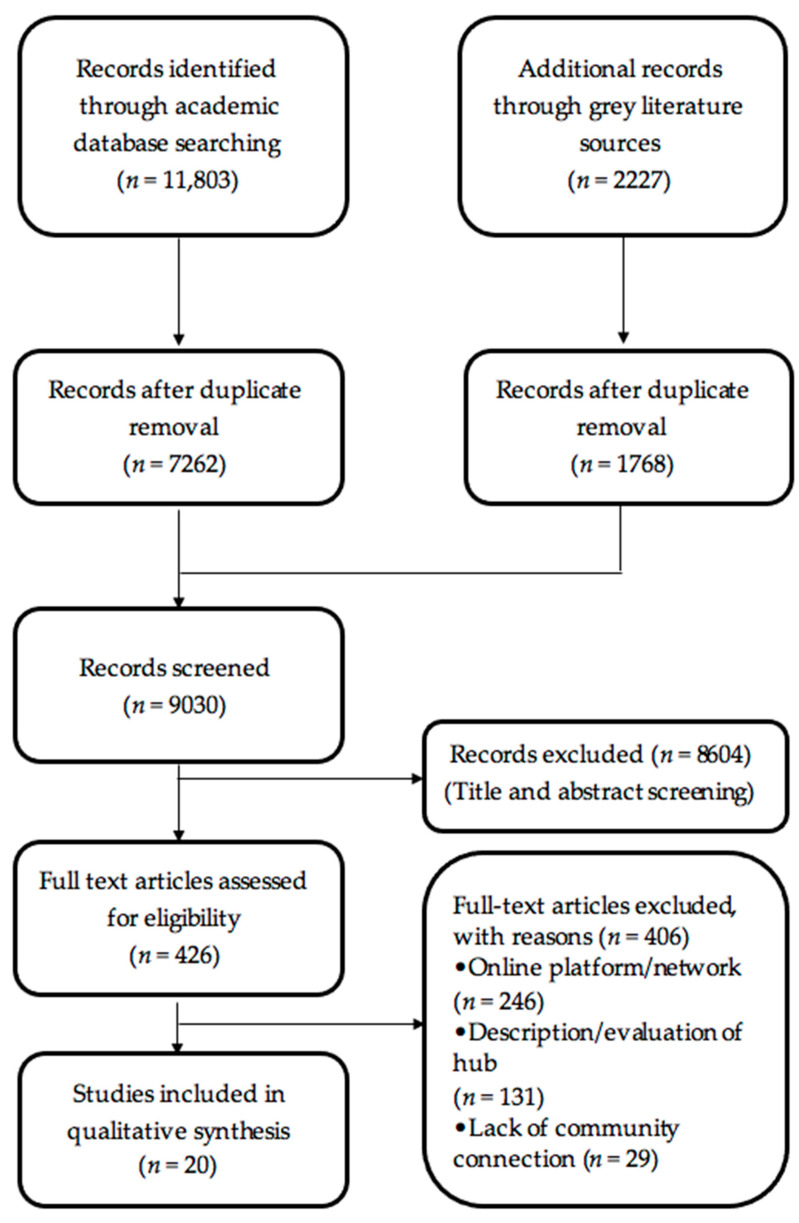
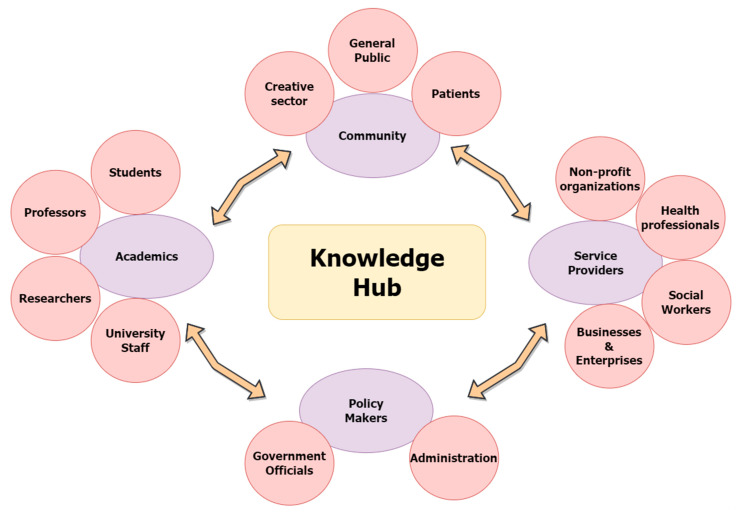
Current knowledge creation and mobilization efforts are concentrated in academic institutions. A community-engaged knowledge hub (CEKH) has the potential for transdisciplinary and cross-sectorial collaboration between knowledge producers, mobilizers, and users to develop more relevant and effective research practices as well as to increase community capacity in terms of knowledge production. Objective: To summarize existing original research articles on knowledge hubs or platforms and to identify the benefits, challenges, and ways to address challenges when developing a CEKH. Methods: This study followed a systematic integrative review design. Following a comprehensive search of academic and grey literature databases, we screened 9030 unique articles using predetermined inclusion criteria and identified 20 studies for the final synthesis. We employed thematic analysis to summarize the results. Results: The focus of the majority of these knowledge mobilization hubs was related to health and wellness. Knowledge hubs have a multitude of benefits for the key stakeholders including academics, communities, service providers, and policymakers, including improving dissemination processes, providing more effective community interventions, ensuring informed care, and creating policy assessment tools. Challenges in creating knowledge hubs are generally consistent for all stakeholders, rather than for individual stakeholders, and typically pertain to funding, resources, and conflicting perspectives. As such, strategies to address challenges are also emphasized and should be executed in unison. Conclusions: This study informs the development of a future CEKH through the identification of the benefits, challenges, and strategies to mitigate challenges when developing knowledge hubs. This study addresses a literature gap regarding the comparisons of knowledge hubs and stakeholder experiences.
Keywords: community engagement; community involvement; cross-sectorial partnership; hub; knowledge creation; knowledge mobilization; transdisciplinary collaboration.
Conflict of interest statement
The authors declare no conflict or competing interests.
Figures
References
-
- Robson E. The Oxford Handbook of Cuneiform Culture. Oxford University Press; Oxford, UK: 2012. The Production and Dissemination of Scholarly Knowledge.
-
- Hong E., Rowell L. Challenging Knowledge Monopoly in Education in the U.S. through Democratizing Knowledge Production and Dissemination. Educ. Action Res. 2019;27:125–143. doi: 10.1080/09650792.2018.1534694. - DOI
-
- Carroll W.K., Sapinski J.P. Embedding Post-Capitalist Alternatives: The Global Network of Alternative Knowledge Production. J. World-Syst. Res. 2013;19:211–240. doi: 10.5195/jwsr.2013.508. - DOI
-
- Bennet D., Bennet A. Knowledge Mobilization in the Social Sciences and Humanities: Moving from Research to Action. Mqi Press; Frost, WV, USA: 2007.
Publication types
MeSH terms
LinkOut - more resources
Full Text Sources
Research Materials
Miscellaneous
