Review
. 2023 Jan 4;24(2):977.
doi: 10.3390/ijms24020977.

The Role of Italy in the Use of Advanced Plant Genomic Techniques on Fruit Trees: State of the Art and Future Perspectives

Affiliations
Review

The Role of Italy in the Use of Advanced Plant Genomic Techniques on Fruit Trees: State of the Art and Future Perspectives

Luca Nerva et al. Int J Mol Sci. .

Abstract

Climate change is deeply impacting the food chain production, lowering quality and yield. In this context, the international scientific community has dedicated many efforts to enhancing resilience and sustainability in agriculture. Italy is among the main European producers of several fruit trees; therefore, national research centers and universities undertook several initiatives to maintain the specificity of the 'Made in Italy' label. Despite their importance, fruit crops are suffering from difficulties associated with the conventional breeding approaches, especially in terms of financial commitment, land resources availability, and long generation times. The 'new genomic techniques' (NGTs), renamed in Italy as 'technologies for assisted evolution' (TEAs), reduce the time required to obtain genetically improved cultivars while precisely targeting specific DNA sequences. This review aims to illustrate the role of the Italian scientific community in the use of NGTs, with a specific focus on Citrus, grapevine, apple, pear, chestnut, strawberry, peach, and kiwifruit. For each crop, the key genes and traits on which the scientific community is working, as well as the technological improvements and advancements on the regeneration of local varieties, are presented. Lastly, a focus is placed on the legal aspects in the European and in Italian contexts.

Keywords: cisgenesis; climate change resilience; genome editing; intragenesis; new genomic techniques; qualitative traits; woody plants.


Conflict of interest statement

The authors declare no conflict of interest.

Figures
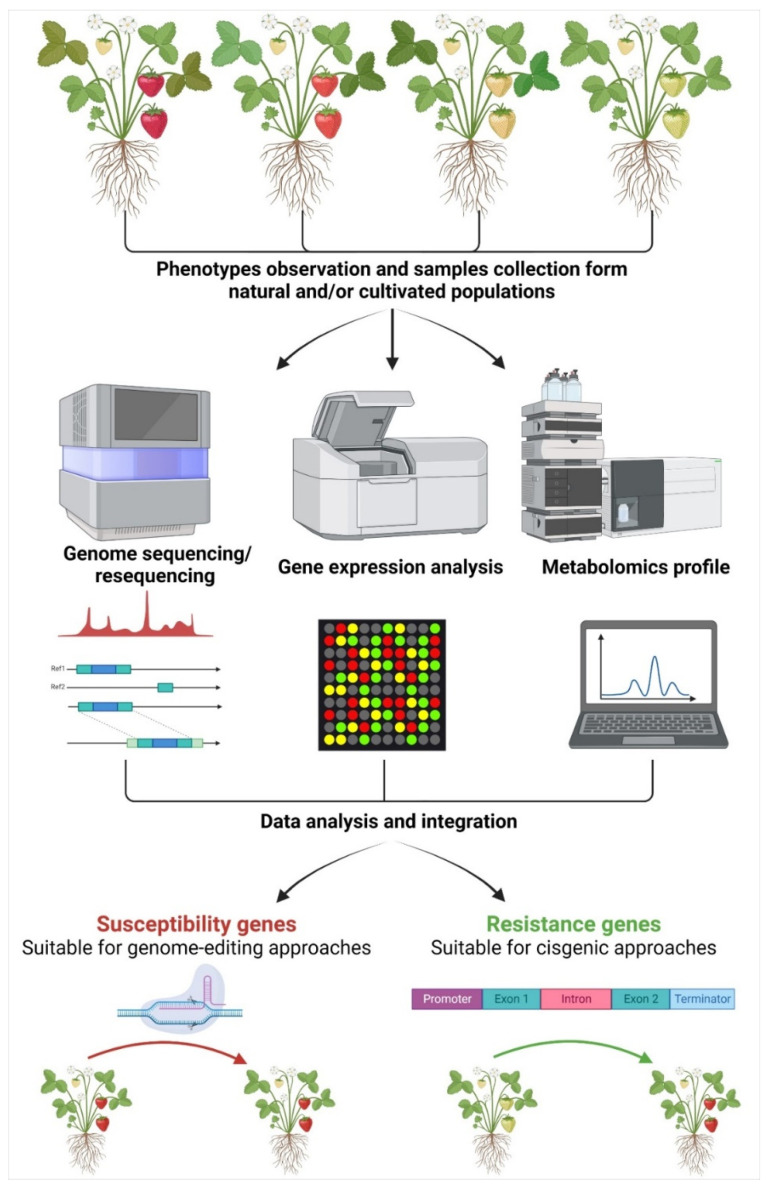
Figure 1
Figure 1
Overview of the multidisciplinary approaches to identify candidate gene(s) exploitable for genome editing or cisgenesis approaches. Starting from the natural occurring phenotypes, including both cultivated and wild genotypes, it is possible to identify genetic sequences involved in the determination of specific traits. More in detail, combining genomic analysis with gene expression and metabolomic data, it is possible to identify pathways and key genes controlling the trait(s) of interest. Once identified, if concerning negative regulator(s), such as stress-related susceptibility genes, it is possible to apply genome editing to obtain an improved genotype where the expression of such gene(s) will be knocked-out. On the contrary, the identification of positive regulator(s) can be exploited in cisgenesis approaches to obtain new genotypes expressing the resistance/tolerance-related gene(s).
Figure 2
Figure 2
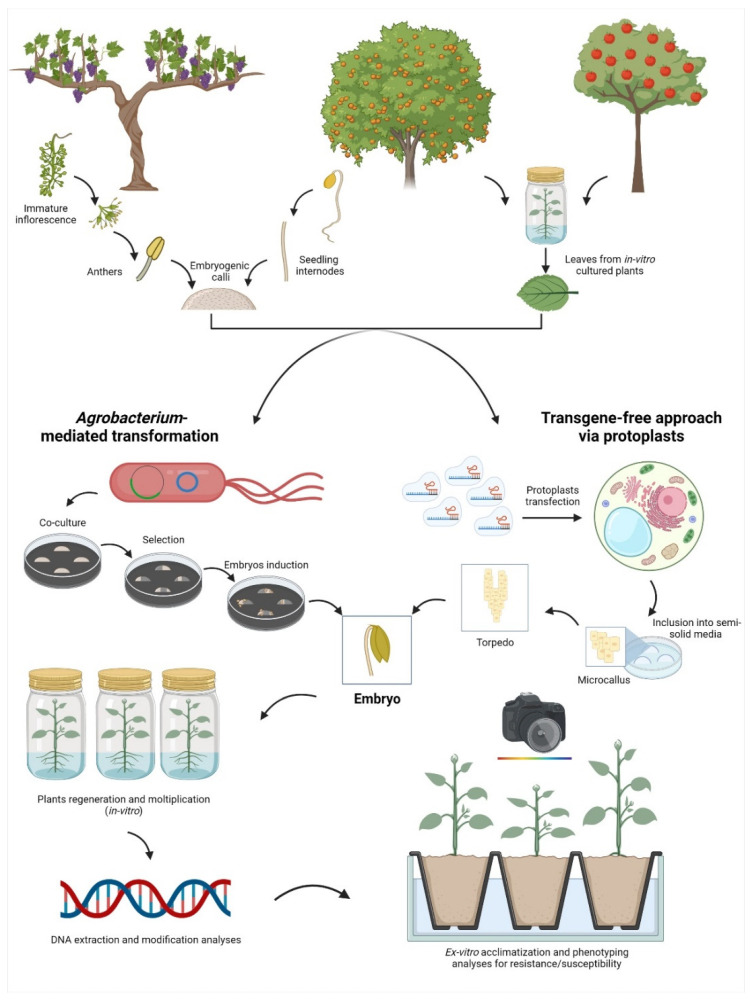
Representation of the main workflows exploited for the application of the new genomic techniques (NGTs) in some fruit crops selected as an example using somatic embryos. From left to right: in grapevine, the most exploited tissues to produce embryogenic calli belong to flowers (e.g., anthers and ovaries); in Citrus, hypocotyls are exploited to obtain embryogenic calli; in apple, there is no need for embryogenic calli since, if cultured in specific conditions, the leaf cells are able to regenerate the entire plant via organogenesis. Once the morphogenic competent tissue is obtained, there are two main approaches to apply NGTs: the classical method through Agrobacterium-mediated transformation or the isolation and transfection of protoplasts (DNA-free approach). Once the transformation/transfection event is completed, embryos are regenerated, and the genetic and phenotypic analyses are then performed.
Figure 3
Figure 3
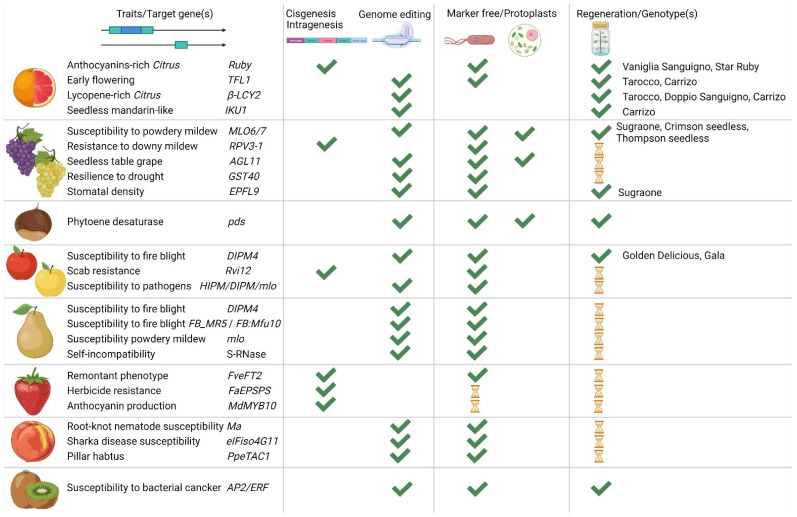
Summary of the main achievements reached by the Italian scientific community over the last years exploiting new genomic techniques (NGTs). From left to right, the species selected for genetic improvement, the gene(s) identified as target (for chestnut the selected gene was chosen as proof of concept), the technique exploited for the selected gene(s) (i.e., genome editing or cisgenesis/intragenesis), and the selected approach (i.e., Agrobacterium-mediated marker free transformation or DNA-free through protoplasts transfection). In the last column, we highlight if improved plants were already regenerated, and which cultivars were regenerated (published data reported in the previous sections). The hourglass represents that work is in progress.

References

    1. Arabska E. From Farm to Fork: Human Health and Well-Being through Sustainable Agri-Food Systems. J. Life Econ. 2021;8:11–27.
    1. Eckert E., Kovalevska O. Sustainability in the European Union: Analyzing the Discourse of the European Green Deal. J. Risk Financ. Manag. 2021;14:80. doi: 10.3390/jrfm14020080. - DOI
    1. Bazzano L.A., Serdula M.K., Liu S. Dietary Intake of Fruits and Vegetables and Risk of Cardiovascular Disease. Curr. Atheroscler. Rep. 2003;5:492–499. doi: 10.1007/s11883-003-0040-z. - DOI - PubMed
    1. Rejman K., Górska-Warsewicz H., Kaczorowska J., Laskowski W. Nutritional Significance of Fruit and Fruit Products in the Average Polish Diet. Nutrients. 2021;13:2079. doi: 10.3390/nu13062079. - DOI - PMC - PubMed
    1. Anderson R., Bayer P.E., Edwards D. Climate Change and the Need for Agricultural Adaptation. Curr. Opin. Plant Biol. 2020;56:197–202. doi: 10.1016/j.pbi.2019.12.006. - DOI - PubMed

LinkOut - more resources