. 2023 Jan 5;24(2):1051.
doi: 10.3390/ijms24021051.

The Histone Chaperone Network Is Highly Conserved in Physarum polycephalum

Affiliations

The Histone Chaperone Network Is Highly Conserved in Physarum polycephalum

Axel Poulet et al. Int J Mol Sci. .

Abstract

The nucleosome is composed of histones and DNA. Prior to their deposition on chromatin, histones are shielded by specialized and diverse proteins known as histone chaperones. They escort histones during their entire cellular life and ensure their proper incorporation in chromatin. Physarum polycephalum is a Mycetozoan, a clade located at the crown of the eukaryotic tree. We previously found that histones, which are highly conserved between plants and animals, are also highly conserved in Physarum. However, histone chaperones differ significantly between animal and plant kingdoms, and this thus probed us to further study the conservation of histone chaperones in Physarum and their evolution relative to animal and plants. Most of the known histone chaperones and their functional domains are conserved as well as key residues required for histone and chaperone interactions. Physarum is divergent from yeast, plants and animals, but PpHIRA, PpCABIN1 and PpSPT6 are similar in structure to plant orthologues. PpFACT is closely related to the yeast complex, and the Physarum genome encodes the animal-specific APFL chaperone. Furthermore, we performed RNA sequencing to monitor chaperone expression during the cell cycle and uncovered two distinct patterns during S-phase. In summary, our study demonstrates the conserved role of histone chaperones in handling histones in an early-branching eukaryote.

Keywords: Physarum; cell cycle; histone chaperones; phylogeny; protein domains.


Conflict of interest statement

The authors declare no conflict of interest.

Figures
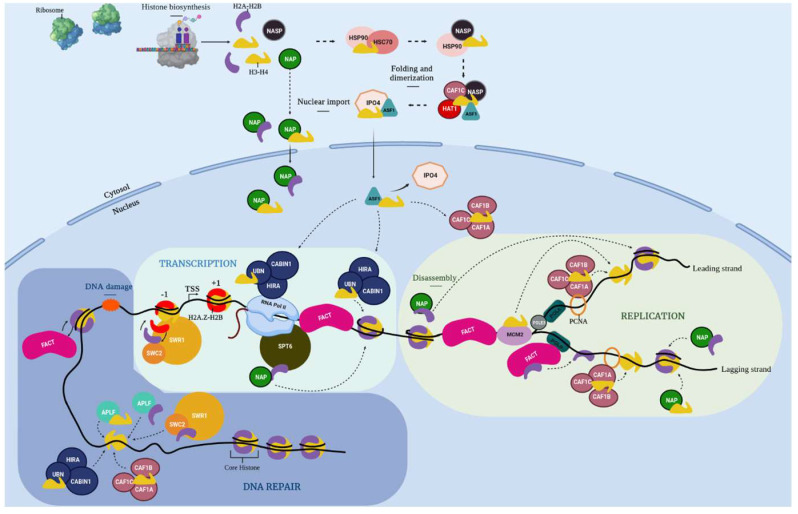
Figure 1
Figure 1
Schema of the histone chaperone network in Physarum polycephalum. Histone proteins are synthetized in the cytoplasm by the ribosome. H3 and H4 are taken in charge by the heat shock proteins HSC70 (Heat Shock Cognate 70) and HSP90 (90-KDa Heat Shock Protein) that assist their folding before H4 get diacetylated at lysines 5 and 12 by HAT1 (Histone Acetyl Transferase 1) in the cytoplasm. Then, the HAT1-NASP (Nuclear Autoantigenic Sperm Protein)-CAF1C (Chromatin Assembly Factor 1C)-ASF1 (Anti-Silencing Factor 1)-IPO4 (ImPortin 4) complex ensures the H3/H4 nuclear import. The NAP (Nucleosome Assembly Protein) family contributes to the nuclear import of H2A/H2B. Once H3/H4 proteins reach the nucleus, ASF1 is the main histone donor that transfers them to the histone deposition complexes CAF-1 (Chromatin Assembly Factor-1) and HIR (HIstone Regulator). The CAF-1 complex deposits H3.1/H4 during replication, while the HIR complex deposits H3.3/H4 during the whole cell cycle in chromatin. The NAP proteins ensure deposition of H2A/H2B in chromatin. The SWR-C (SWR1 Remodeling-Complex, SWi2/snf2-Related 1) complex is involved in the histone exchange reaction to deposit H2A.Z/H2AB in chromatin. It is composed of SWR1 (SWi2/snf2-Related 1) and SWC2 (SWr Complex 2). During replication, MCM2 participates in the unwinding of the dsDNA which seems to disrupt nucleosomes. The H2A/H2B dimers are evicted and escorted by the FACT (FAcilitates Chromatin Transcription) complex. Before eviction of H3/H4 tetramers, ASF1 is recruited to form the MCM2-H3/H4-ASF1 co-chaperone complex. After the passage of the replication fork, parental histones are recycled and deposited along with newly synthetized histones thanks to the CAF-1 and FACT complexes and NAP proteins. Moreover, PolE3 also participate in the deposition of parental and newly synthesized H3/H4 in chromatin on the leading strand of DNA. During transcription, nucleosomes are disassembled to enable the passage of the RNA polymerase II. The SPT6 (SuPpressor of Ty 6) and ASF1 chaperones, the NAP proteins as well as the HIR, FACT and SWR-C participate in the restoration of the chromatin landscape after the RNA polymerase II passage by mediating histone recycling or deposition in the wake of the polymerase. During DNA repair after DNA damage (labelled by an orange cloud), γH2A.X histones are deposited at double strand DNA breaks and then, when repair is complete, they are removed by the SWR-C complex to be replaced by H2A/H2B or unmodified H2AX/H2B by the FACT complex. The HIR and CAF-1 complexes, as well as the APLF chaperone, participate in the re-establishment of histones in chromatin. Since the sub-functionalization of PpNAP1L1 and PpSET remains to be investigated, they were indicated as NAP.
Figure 2
Figure 2
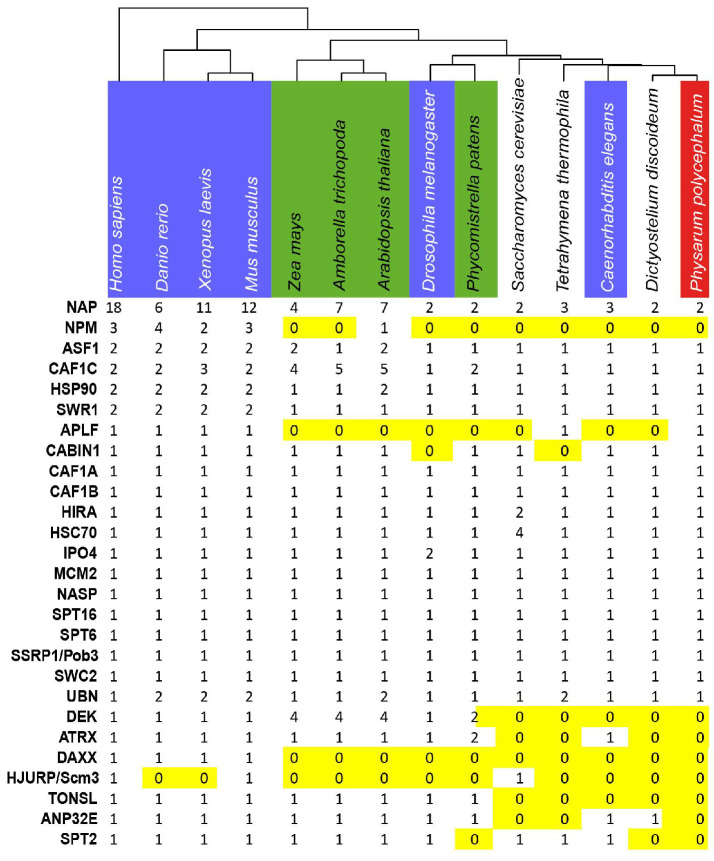
Distribution of histone chaperones in eukaryotes. Selected species used in this study from left to right: animals (blue), plants (green), unicellular and Physarum (red). The distribution of the various histone chaperones (rows) in the 14 species (columns) is displayed. Absence (0) of a given protein is highlighted in yellow. Atr: Amborella trichopoda; At: Arabidopsis thaliana; Ce: Caenorhabditis elegans; Dd: Dictyostellium discoideum; Dr: Danio rerio; Dm: Drosophila melanogaster; Hs: Homo sapiens; Mm: Mus musculus; Pp: Physarum polycephalum; Ppa: Physcomitrella patens, Sc: Saccharomyces cerevisiae; Tt: Tetrahymena thermophila; Zm: Zea mays.
Figure 3
Figure 3
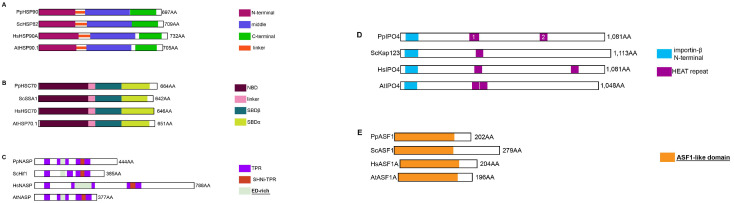
Functional Domains of histone chaperones involved in the cytoplasm. Each diagram displays a scaled representation of the domain structure for HSP90 (A), HSC70 (B), NASP (C), IPO4 (D), ASF1 (E) histone chaperones from Physarum, yeast, human and Arabidopsis. Each domain is depicted at its position by a different color, and the code is indicated at the right. Names of domains involved in histone binding are in bold and underlined. NBD, N-terminal Nucleotide Binding domain; SBD, Substrate-Binding Domain; TPR, tetratricopeptide-like bi-helical repeats; SHNi-TPR, Sim3-Hif1-NASP interrupted TPR; ED-rich, domain rich in glutamic acid and aspartic acid; HEAT, Huntingtin/Elongation factor 3/protein phosphatase 2A/TOR1.
Figure 4
Figure 4
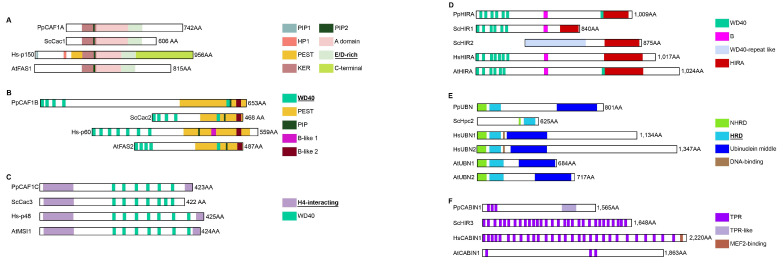
Functional Domains of histone chaperones involved in the H3/H4 incorporation in chromatin. Each diagram displays a scaled representation of the domain structure for CAF1A (A), CAF1B (B), CAF1C (C) HIRA (D), UBN (E), CABIN1 (F) histone chaperones from Physarum, yeast, human and Arabidopsis. Each domain is depicted at its position by a different color and the code is indicated at the right. Names of domains involved in histone binding are in bold and underlined. PIP, PCNA-Interacting Peptide; PEST, domain rich in proline (P), glutamic acid (E), serine (S) and threonine (T); ED-rich, domain rich in glutamic acid (E) and aspartic acid (D); KER, domain rich in lysine (K), glutamic acid (E) and arginine (R); NHRD, N-terminal to the HRD region domain; HRD, Hpc2-related domain; TPR, tetratricopeptide-like bi-helical repeats.
Figure 5
Figure 5
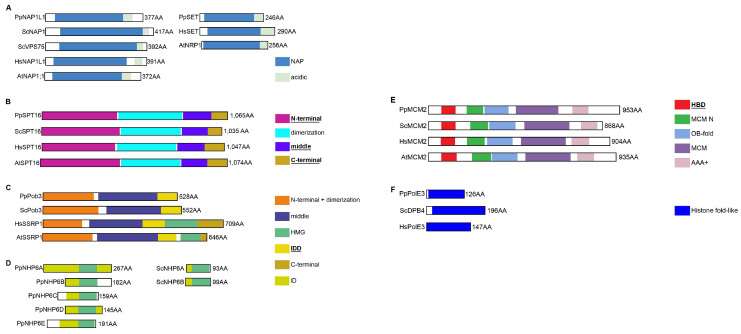
Functional Domains of H2A/H2B histone chaperones and replication-associated chaperones. Each diagram displays a scaled representation of the domain structure for NAP proteins SET and NAP1L1 (A), SPT16 (B), SSRP1/Pob3 (C), NHP6 (D), MCM2 (E), PolE3 (F) from Physarum, yeast, human and Arabidopsis. Each domain is depicted at its position by a different color and the code is indicated at the right. Names of domains involved in histone binding are in bold and underlined. HMG, High-Mobility Group; IDD and ID, Intrinsically DisorDered; HBD, histone binding domain; OB-fold, oligonucleotide/oligosaccharide-fold; AAA+, ATPase activity.
Figure 6
Figure 6
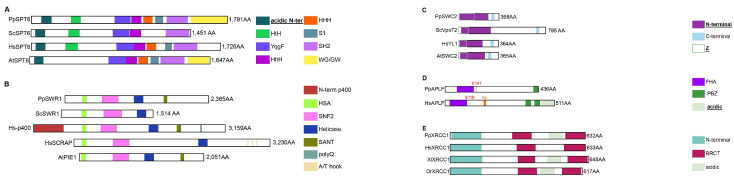
Functional Domains of histone chaperones involved in transcription, replacement and DNA repair. Each diagram displays a scaled representation of the domain structure for SPT6 (A), SWR1 (B), SWC2 (C), APLF (D), histone chaperones from Physarum, yeast, human and Arabidopsis. Diagrams for XRCC1 (E) display a scaled representation of this protein from Physarum, yeast, human, Xenopus, D. rerio and Arabidopsis. Human possesses two SWR1 orthologues named Hs-p400 and HsSCRAP. Each domain is depicted at its position by a different color and the code is indicated at the right. Names of domains involved in histone binding are in bold and underlined. HtH, Helix-turn-Helix; HhH, Helix-hairpin-Helix; HHH, HHH domain 9; S1, S1 RNA-binding domain; SH2, Src-homology 2 domain; WG/GW, domain containing Glycin (G) and Tryptophan (W) repeats; HSA, Helicase/SANT-associated; SANT, Swi3/Ada2/N-Cor/TFIIIB; polyQ, poly-glutamine domain; FHA, ForkHead-Associated; PBZ, PolyADP-ribose-Binding Zinc-finger; BRCT, BRCA1 C-terminal.
Figure 7
Figure 7
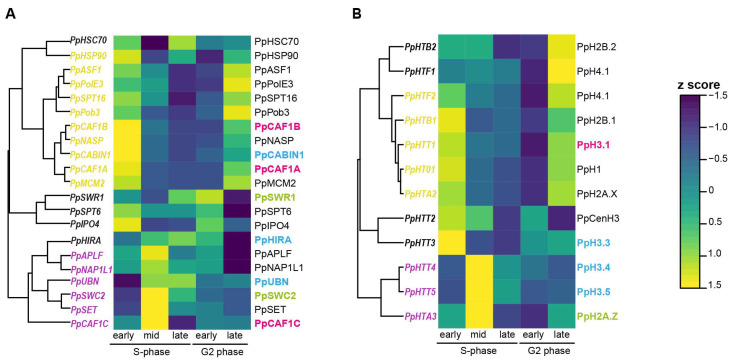
Expression profiles of Physarum histones and chaperones during the cell cycle. The heat map displays the RNA-Seq expression of histone chaperones (A) and histones (B) at five stages of the Physarum cell cycle indicated at the bottom of the map. Each row corresponds to a transcript listed on the right and each column to a cell cycle stage. The color bar at the right depicts the scale for z-score, with blue representing the lowest expression and yellow representing the highest. In Figure 7A, chaperones from group 1, i.e., with elevated mRNA levels in early S-phase and late G2 phase are displayed in yellow on the left of the heat map, while chaperones from group 2, i.e., with an elevated mRNA level in mid S-phase are displayed in magenta. Transcript and protein names are indicated on the left and the right of the heat map, respectively. The CAF-1 complex is associated with H3.1/H4 incorporation during DNA replication, and its subunits are displayed in pink (A) as well as the PpHTT1 transcript coding the Physarum H3.1 protein (B). The HIR complex is associated with H3 variant incorporation throughout the cell cycle and its subunits are displayed in blue (A), as well as the PpHTT3/4/5 transcript coding the Physarum H3 variants (B). The SWR-C complex is involved in H2A.Z/H2B replacement and its subunits are displayed in green (A), as well as the PpHTA3 transcript coding the Physarum H2A.Z variant (B).

References

    1. Luger K., Mäder A.W., Richmond R.K., Sargent D.F., Richmond T.J. Crystal structure of the nucleosome core particle at 2.8 Å resolution. Nature. 1997;389:251–260. doi: 10.1038/38444. - DOI - PubMed
    1. Marzluff W., Duronio R.J. Histone mRNA expression: Multiple levels of cell cycle regulation and important developmental consequences. Curr. Opin. Cell Biol. 2002;14:692–699. doi: 10.1016/S0955-0674(02)00387-3. - DOI - PubMed
    1. Marzluff W.F., Wagner E.J., Duronio R.J. Metabolism and regulation of canonical histone mRNAs: Life without a poly(A) tail. Nat. Rev. Genet. 2008;9:843–854. doi: 10.1038/nrg2438. - DOI - PMC - PubMed
    1. Burgess R.J., Zhang Z. Histone chaperones in nucleosome assembly and human disease. Nat. Struct. Mol. Biol. 2013;20:14–22. doi: 10.1038/nsmb.2461. - DOI - PMC - PubMed
    1. Campos E.I., Fillingham J., Li G., Zheng H., Voigt P., Kuo W.-H.W., Seepany H., Gao Z., Day L.A., Greenblatt J.F., et al. The program for processing newly synthesized histones H3.1 and H4. Nat. Struct. Mol. Biol. 2010;17:1343–1351. doi: 10.1038/nsmb.1911. - DOI - PMC - PubMed

MeSH terms

LinkOut - more resources