Review
. 2023 Jan 15;24(2):1724.
doi: 10.3390/ijms24021724.

Role of Impaired Glycolysis in Perturbations of Amino Acid Metabolism in Diabetes Mellitus

Affiliations
Review

Role of Impaired Glycolysis in Perturbations of Amino Acid Metabolism in Diabetes Mellitus

Milan Holeček. Int J Mol Sci. .

Abstract

The most frequent alterations in plasma amino acid concentrations in type 1 and type 2 diabetes are decreased L-serine and increased branched-chain amino acid (BCAA; valine, leucine, and isoleucine) levels. The likely cause of L-serine deficiency is decreased synthesis of 3-phosphoglycerate, the main endogenous precursor of L-serine, due to impaired glycolysis. The BCAA levels increase due to decreased supply of pyruvate and oxaloacetate from glycolysis, enhanced supply of NADH + H+ from beta-oxidation, and subsequent decrease in the flux through the citric acid cycle in muscles. These alterations decrease the supply of α-ketoglutarate for BCAA transamination and the activity of branched-chain keto acid dehydrogenase, the rate-limiting enzyme in BCAA catabolism. L-serine deficiency contributes to decreased synthesis of phospholipids and increased synthesis of deoxysphinganines, which play a role in diabetic neuropathy, impaired homocysteine disposal, and glycine deficiency. Enhanced BCAA levels contribute to increased levels of aromatic amino acids (phenylalanine, tyrosine, and tryptophan), insulin resistance, and accumulation of various metabolites, whose influence on diabetes progression is not clear. It is concluded that amino acid concentrations should be monitored in patients with diabetes, and systematic investigation is needed to examine the effects of L-serine and glycine supplementation on diabetes progression when these amino acids are decreased.

Keywords: branched-chain amino acids; glycine; insulin resistance; serine.


Conflict of interest statement

The author declares no conflict of interest.

Figures
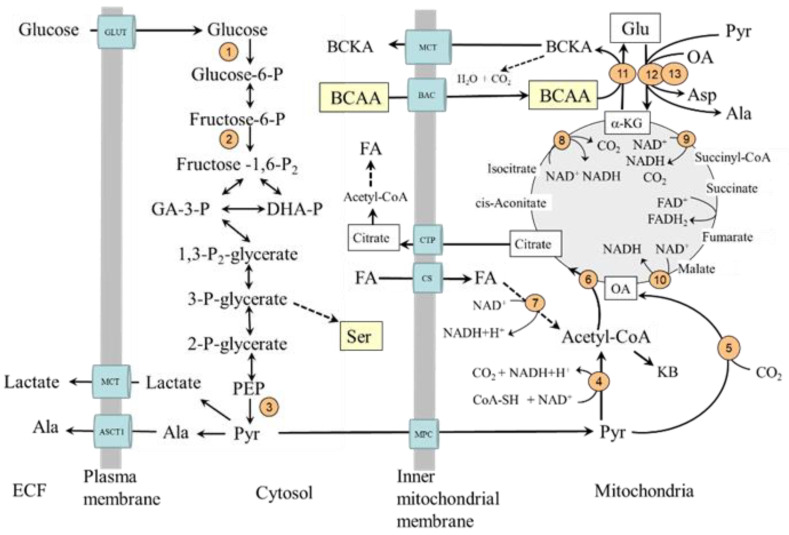
Figure 1
Figure 1
Glycolysis and its relationship to serine synthesis, beta-oxidation, citric acid cycle, and BCAA catabolism. 1, hexokinase; 2, phosphofructokinase; 3, pyruvate kinase; 4, pyruvate dehydrogenase; 5, pyruvate carboxylase; 6, citrate synthase; 7, beta-hydroxyacyl-CoA-dehydrogenase; 8, isocitrate dehydrogenase; 9, α-ketoglutarate dehydrogenase; 10, malate dehydrogenase; 11, BCAA aminotransferase; 12, AST; 13, ALT. BAC, branched-chain amino acid carrier (SLC25A44); BCAA, branched-chain amino acids; BCKA, branched-chain keto acids; CAC, citric acid cycle; CS, carnitine system; CTP citrate (tricarboxylate) transport protein; GLUT, glucose transporter; MCT, monocarboxylate transporter; MPC, mitochondrial pyruvate carrier; OA, oxaloacetate.
Figure 2
Figure 2
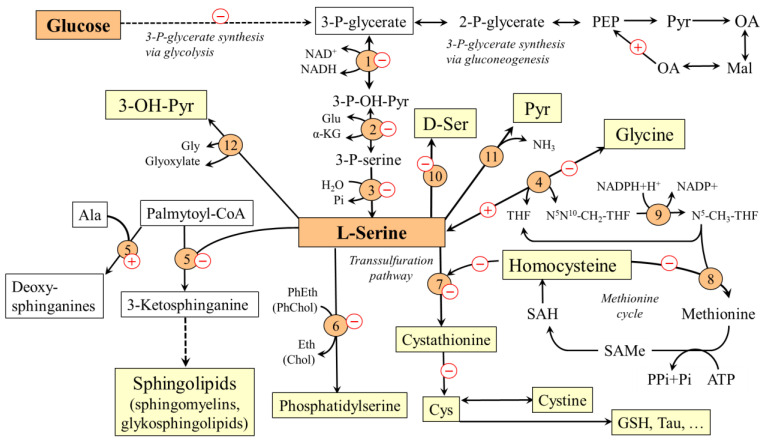
Main pathways of L-serine metabolism and their alterations during diabetes mellitus. The pluses and minuses indicate the predicted changes in diabetes. 1, 3-phosphoglycerate dehydrogenase; 2, phosphoserine aminotransferase; 3, phosphoserine phosphatase; 4, serine hydroxymethyltransferase; 5, serine palmitoyltransferase; 6, phosphatidylserine synthase; 7, cystathionine β-synthase; 8, methionine synthase; 9, methylene tetrahydrofolate reductase; 10, racemase 11, serine dehydratase; 12, serine-glyoxylate transaminase. Chol, choline; Eth, ethanolamine; GSH, glutathione; OA, oxaloacetate; Mal, malate; Pyr, pyruvate; PEP, phosphoenolpyruvate; PhChol, phosphatidylcholine; PhEth, phosphatidylethanolamine; SAH, S-adenosylhomocysteine; SAMe, S-adenosylmethionine; 3-OH-Pyr, 3-hydroxypyruvate.
Figure 3
Figure 3
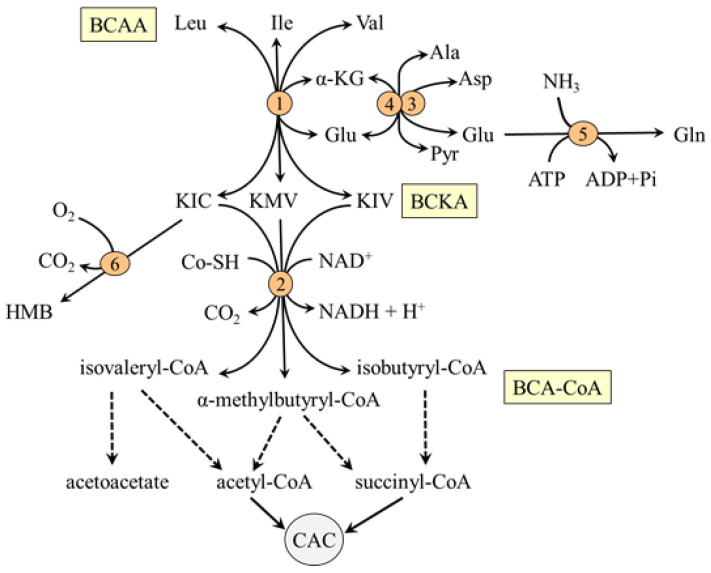
Main pathways of BCAA catabolism. 1, BCAA aminotransferase; 2, BCKA dehydrogenase; 3, AST; 4, ALT; 5, glutamine synthetase; 6, KIC dioxygenase. BCAA, branched-chain amino acids; BCA-CoA, branched-chain acyl-CoA; BCKA, branched-chain keto acids; CAC, citric acid cycle; HMB, β-hydroxy-β-methylbutyric acid; OA, oxaloacetate.
Figure 4
Figure 4
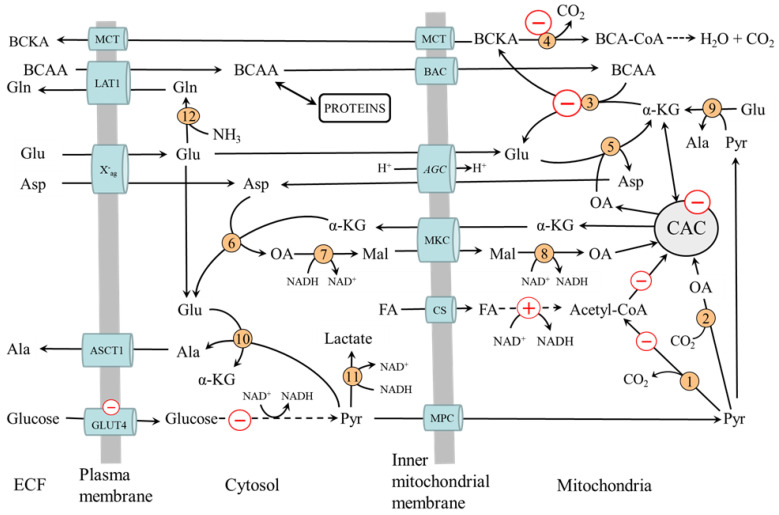
Muscle BCAA metabolism in diabetes. The pluses and minuses indicate the main changes associated with decreased glycolysis and preferential fatty acid oxidation resulting in impaired BCAA catabolism. 1, pyruvate dehydrogenase; 2, pyruvate carboxylase; 3, BCAA aminotransferase; 4, BCKA dehydrogenase; 5, AST mitochondrial; 6, AST cytosolic; 7, cytosolic malate dehydrogenase; 8, mitochondrial malate dehydrogenase 9, ALT mitochondrial; 10, ALT cytosolic; 11, lactate dehydrogenase; 12, glutamine synthetase. AGC, aspartate-glutamate carrier; ASCT1, alanine, serine, cysteine, and threonine carrier 1 (SLC1A4); BCAA, branched-chain amino acids; BAC, branched-chain amino acid carrier (SLC25A44); BCA-CoA, branched-chain acyl-CoA; BCKA, branched-chain keto acids; CAC, citric acid cycle; CS carnitine system; ECF, extracellular fluid; LAT1 (large neutral amino acid transporter 1); Mal, malate; MCT, monocarboxylate transporter; MKC, malate-ketoglutarate carrier; OA, oxaloacetate; MPC, mitochondrial pyruvate carrier; X-ag, a transporter for aspartate and glutamate (SLC1 family).

References

    1. Sinha R., Fisch G., Teague B., Tamborlane W.V., Banyas B., Allen K., Savoye M., Rieger V., Taksali S., Barbetta G., et al. Prevalence of impaired glucose tolerance among children and adolescents with marked obesity. N. Engl. J. Med. 2002;346:802–810. doi: 10.1056/NEJMoa012578. - DOI - PubMed
    1. Gar C., Rottenkolber M., Prehn C., Adamski J., Seissler J., Lechner A. Serum and plasma amino acids as markers of prediabetes, insulin resistance, and incident diabetes. Crit. Rev. Clin. Lab. Sci. 2018;55:21–32. doi: 10.1080/10408363.2017.1414143. - DOI - PubMed
    1. Hosseinkhani S., Arjmand B., Dilmaghani-Marand A., Mohammadi Fateh S., Dehghanbanadaki H., Najjar N., Alavi-Moghadam S., Ghodssi-Ghassemabadi R., Nasli-Esfahani E., Farzadfar F., et al. Targeted metabolomics analysis of amino acids and acylcarnitines as risk markers for diabetes by LC-MS/MS technique. Sci. Rep. 2022;12:8418. doi: 10.1038/s41598-022-11970-7. - DOI - PMC - PubMed
    1. Holeček M., Vodeničarovová M., Fingrová R. Dual effects of beta-hydroxy-beta-methylbutyrate (HMB) on amino acid, energy, and protein metabolism in the liver and muscles of rats with streptozotocin-induced type 1 diabetes. Biomolecules. 2020;10:1475. doi: 10.3390/biom10111475. - DOI - PMC - PubMed
    1. Holm L.J., Buschard K. L-serine: A neglected amino acid with a potential therapeutic role in diabetes. APMIS. 2019;127:655–659. doi: 10.1111/apm.12987. - DOI - PMC - PubMed