. 2022 Dec 31;13(1):62.
doi: 10.3390/metabo13010062.

Neurobiological Basis of Aversion-Resistant Ethanol Seeking in C. elegans

Affiliations

Neurobiological Basis of Aversion-Resistant Ethanol Seeking in C. elegans

Changhoon Jee et al. Metabolites. .

Abstract

Persistent alcohol seeking despite the risk of aversive consequences is a crucial characteristic of alcohol use disorders (AUDs). Therefore, an improved understanding of the molecular basis of alcohol seeking despite aversive stimuli or punishment in animal models is an important strategy to understand the mechanism that underpins the pathology of AUDs. Aversion-resistant seeking (ARS) is characterized by disruption in control of alcohol use featured by an imbalance between the urge for alcohol and the mediation of aversive stimuli. We exploited C. elegans, a genetically tractable invertebrate, as a model to elucidate genetic components related to this behavior. We assessed the seb-3 neuropeptide system and its transcriptional regulation to progress aversion-resistant ethanol seeking at the system level. Our functional genomic approach preferentially selected molecular components thought to be involved in cholesterol metabolism, and an orthogonal test defined functional roles in ARS through behavioral elucidation. Our findings suggest that fmo-2 (flavin-containing monooxygenase-2) plays a role in the progression of aversion-resistant ethanol seeking in C. elegans.

Keywords: C. elegans; aversion-resistant seeking; ethanol preference; fmo-2; seb-3.


Conflict of interest statement

The authors declare no conflict of interest.

Figures
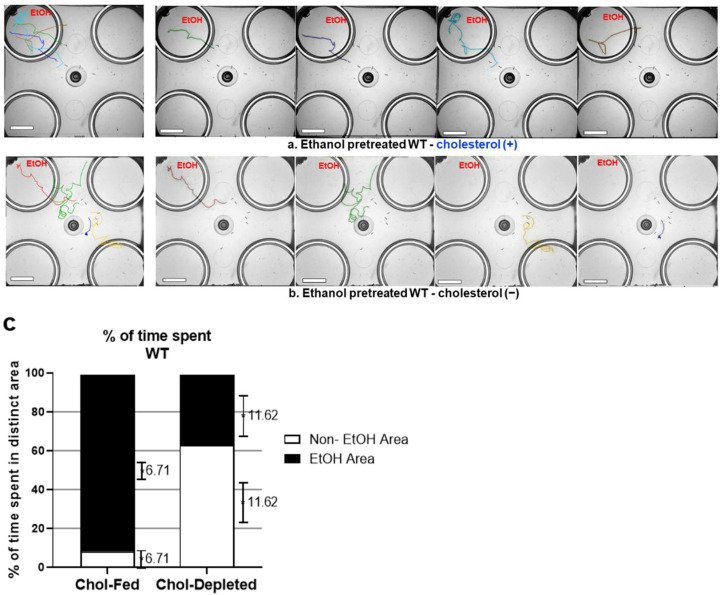
Figure 1
Figure 1
Cholesterol-depleted WT animals explored the nonethanol area even after ethanol pretreatment while cholesterol-fed animals headed straight to and remained in the ethanol area. (a) Trajectories of individual WT animals, cholesterol-fed (ethanol-pretreated for 4 h on 300 mM of ethanol). (b) Trajectories of individual WT animals, cholesterol-depleted (ethanol-pretreated for 4 h on 300 mM of ethanol). Ethanol-pretreated animals were placed in the middle of the assay plate, which contained ethanol (300 mM) only in the top left well (red EtOH). All wells were marginally covered by media that allowed free motion between the areas. Scale bar = 10 mm. (c) Behavioral quantification of (a,b). Ethanol-pretreated WT animals (cholesterol-fed) spent more time in the ethanol area, whereas cholesterol-depleted WT animals explored the nonethanol area more, even when ethanol-pretreated under the same conditions. These data were analyzed employing a chi-square test, which indicated df 66.42 and 1 z 8.150, p < 0.0001. Error bars shown to the right of each section (ethanol area or non-ethanol area) of the bar graph is SEM (N = 6, cholesterol-fed; N = 14, cholesterol-depleted).
Figure 2
Figure 2
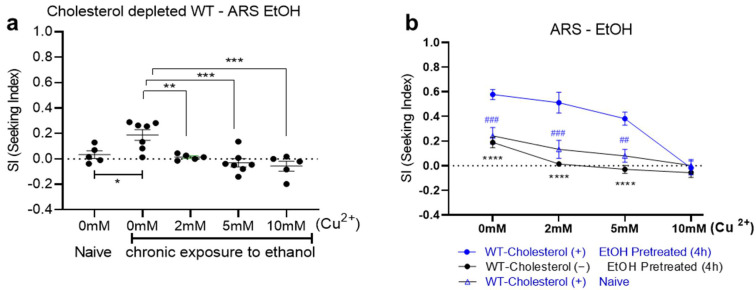
Behavioral quantification of ethanol preference and ARS of cholesterol-depleted WT animals (ARS: aversion-resistant seeking). (a) Strength of ethanol seeking is represented by the SI under different concentrations of a copper barrier (no barrier, 2 mM, 5 mM, and 10 mM). Compared to naïve WT animals grown in cholesterol-depleted conditions, cholesterol-depleted WT animals after ethanol pretreatment for 4 h developed ethanol preference. They showed mild chemotaxis to ethanol in the assay plate without an aversive barrier. However, few cholesterol-depleted WT animals crossed over aversive barriers. One-way ANOVA, p = 0.0002, F (4, 24) = 8.454, post hoc multiple comparison test; Dunnett’s (p < 0.05, *; p < 0.01, **; p < 0.001, ***). Each dot represents an assay that used a population of 100–150. (b) Data sets (a) from cholesterol-depleted animals were compared to those of the control group: cholesterol-fed WT animals. Cholesterol-fed WT animals developed ethanol preference and ARS after chronic exposure to ethanol, whereas the developments of ethanol preference and ARS were impaired in cholesterol-depleted WT animals. [Fcholesterol (1, 48) = 78.93, p < 0.0001; Fconc (3, 48) = 24.32, p < 0.0001; Fcholesterol x conc (3, 48) = 7.122, p = 0.0005]. N numbers were [0 mM = 10, 2 mM = 6, 5 mM = 6, 10 mM = 10 for WT cholesterol-fed; 0 mM = 7, 2 mM = 5, 5 mM = 7, 10 mM = 5 for WT cholesterol-depleted; and 0 mM = 6, 2 mM = 5, 5 mM = 6, 10 mM = 6 for WT cholesterol-fed naïve]. A two-way ANOVA comparison showed significant differences based on cholesterol feeding, barrier concentration, and the interaction of the two. Significant post hoc differences (multiple comparison correction using the Bonferroni method) between the cholesterol feedings (fed vs. depleted) at no barrier, the 2 mM barrier, and the 5 mM barrier are shown (p < 0.0001, ****). Significant post hoc differences (Bonferroni’s multiple comparison test) between naïve vs. ethanol-treated at no barrier, the 2 mM barrier, and the 5 mM barrier are shown (p < 0.01, ##; p < 0.001, ###).
Figure 3
Figure 3
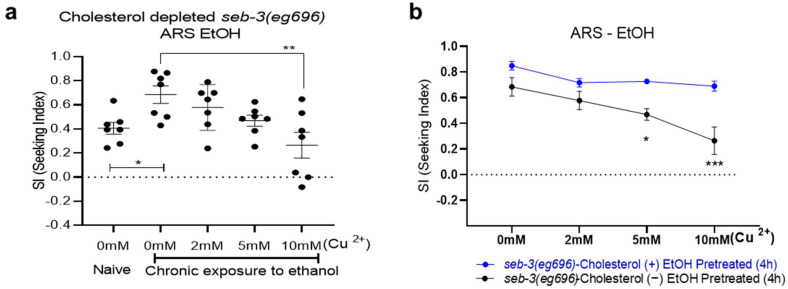
Cholesterol depletion suppressed the development of ARS in seb-3 gf animals that were susceptible to ethanol dependence (ARS: aversion-resistant seeking). (a) The cholesterol-depleted seb-3(eg696) animals developed ethanol preference after ethanol pretreatment for 4 h. One-way ANOVA, p = 0.0035, F (4, 30) = 4.948, post hoc multiple comparison test; Dunnett’s (p < 0.05, *; p < 0.01, **). Each dot represents an assay that used a population of 100–150. (b) Data sets (a) from cholesterol-depleted animals were compared to the control group: cholesterol-fed seb-3(eg696) animals. The cholesterol-depleted seb-3(eg696) animals demonstrated development of ethanol preference as much as did the animals that were fed cholesterol, whereas significantly reduced SIs in the 5 mM and 10 mM barriers represented ARS. [Fcholesterol (1, 40) = 26.29, p < 0.0001; Fconc (3, 40) = 6.210, p = 0.0015; Fcholesterol × conc (3, 40) = 1.811, p = 0.1607]. N numbers were [five in each cholesterol-fed seb-3(eg696) concentration and seven in each cholesterol-depleted seb-3(eg696) concentration]. A two-way ANOVA comparison showed significant differences based on cholesterol feeding, barrier concentration, and the interaction of the two. The Bonferroni method was used for multiple comparison correction as a post hoc test, and found significant differences in ARS (at 5 mM and 10 mM barriers) between cholesterol feedings (fed vs. depleted). p < 0.05, *; p < 0.001, ***.
Figure 4
Figure 4
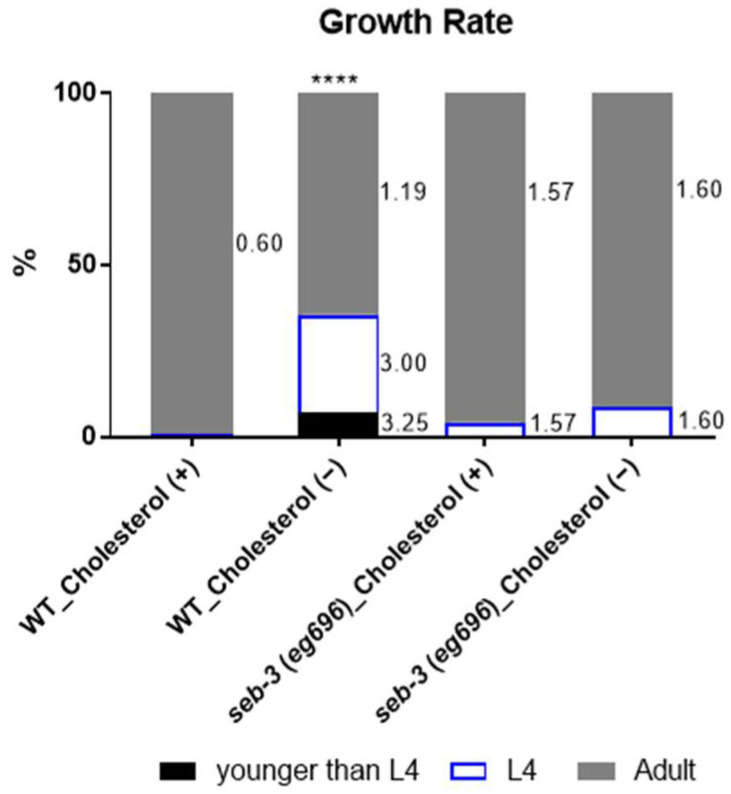
Cholesterol depletion altered developmental rates in WT C. elegans. The cholesterol depletion culture condition is demonstrated as the delayed growth rate that the WT animals should have shown. The number of animals in each developmental stage, after four days in embryos that were synchronized to the stage of birth for 1 h, is shown (younger than L4 stage, L4 stage, and adult). A total of 428 (WT-Chol_Fed), 628 (WT-Chol-depleted), 205 (seb-3-Chol_fed), and 189 (seb-3-Chol_depleted) worms from four replicates of biological samples were analyzed to obtain the average growth rate (%). The delayed growth-rate effect of cholesterol depletion was suppressed in the seb-3(eg696) variants. A chi-square test indicated **** p <0.0001. Error shown to the right of each section of the bar graph is SEM.
Figure 5
Figure 5
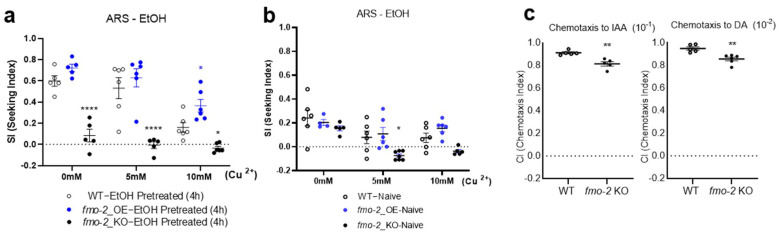
FMO-2 functions in modulation of ethanol preference and ARS. (a) fmo-2-overexpressing animals that were pretreated with ethanol for 4 h surmounted a stronger aversive barrier for ethanol. More fmo-2-overexpressing animals crossed over the barrier for ethanol (demonstrating ARS) than did the WT animals. The fmo-2 KO animals showed impaired ethanol preference and ARS. Strength of ethanol seeking was represented by SIs under different concentrations of the copper barrier (no barrier, 5 mM, and 10 mM). A two-way ANOVA comparison of the strains over different barrier concentrations showed significant differences based on genotype, concentration, and the interaction of the two. [FGenotype (2, 41) = 65.25, p < 0.0001; FConcentration (2, 41) = 19.98, p < 0.0001; FGenotype × Concentration (4, 41) = 2.668, p = 0.0456]. Significant post hoc differences (multiple comparison correction using Dunnett’s method) between strains in each condition (no barrier, 5 mM, or 10 mM) are shown (p < 0.05, *; p < 0.0001, ****). Each dot represents an assay that used a population of 100–150. (b) Naïve animals were used as controls in the ARS assay. A two-way ANOVA comparison of the strains over different barrier concentrations showed no significant differences based on the interaction of genotype and concentration. [FGenotype × Concentration (4, 26) = 1.328, p = 0.2858]. Significant post hoc differences (multiple comparison correction using Dunnett’s method) were only observed between the fmo-2 KO and the WT animals at a 5 mM barrier. p < 0.05, *. (c) Chemotaxis control of the fmo-2 KO animals. Mann–Whitney (p < 0.01., **). IAA: isoamyl alcohol; DA: diacetyl.

Similar articles

Cited by

References

    1. World Health O. Global Status Report on Alcohol and Health 2018. World Health Organization; Geneva, Switzerland: 2018.
    1. Esser M.B., Sherk A., Liu Y., Naimi T.S., Stockwell T., Stahre M., Kanny D., Landen M., Saitz R., Brewer R.D. Deaths and Years of Potential Life Lost from Excessive Alcohol Use — United States, 2011–2015. MMWR Morb. Mortal. Wkly. Rep. 2020;69:1428–1433. doi: 10.15585/mmwr.mm6939a6. - DOI - PMC - PubMed
    1. Rusyn I., Bataller R. Alcohol and toxicity. J. Hepatol. 2013;59:387–388. doi: 10.1016/j.jhep.2013.01.035. - DOI - PMC - PubMed
    1. Rehm J., Baliunas D., Borges G.L., Graham K., Irving H., Kehoe T., Parry C.D., Patra J., Popova S., Poznyak V., et al. The relation between different dimensions of alcohol consumption and burden of disease: An overview. Addiction. 2010;105:817–843. doi: 10.1111/j.1360-0443.2010.02899.x. - DOI - PMC - PubMed
    1. Belin D., Everitt B.J. Cocaine seeking habits depend upon dopamine-dependent serial connectivity linking the ventral with the dorsal striatum. Neuron. 2008;57:432–441. doi: 10.1016/j.neuron.2007.12.019. - DOI - PubMed

LinkOut - more resources