. 2023 Jan 1;11(1):118.
doi: 10.3390/microorganisms11010118.

Optimization of Transposon Mutagenesis Methods in Pseudomonas antarctica

Affiliations

Optimization of Transposon Mutagenesis Methods in Pseudomonas antarctica

Sangha Kim et al. Microorganisms. .

Abstract

Pseudomonas is a widespread genus in various host and environmental niches. Pseudomonas exists even in extremely cold environments such as Antarctica. Pseudomonas antarctica is a psychrophilic bacterium isolated from Antarctica. P. antarctica is also known to produce antimicrobial substances. Although P. antarctica can provide insight into how bacteria have adapted to low temperatures and has significant potential for developing novel antimicrobial substances, progress in genetic and molecular studies has not been achieved. Transposon mutagenesis is a useful tool to screen genes of interest in bacteria. Therefore, we attempted for the first time in P. antarctica to generate transposon insertion mutants using the transfer of a conjugational plasmid encoding a transposon. To increase the yield of transposon insertion mutants, we optimized the methods, in terms of temperature for conjugation, the ratio of donor and recipient during conjugation, and the concentration of antibiotics. Here, we describe the optimized methods to successfully generate transposon insertion mutants in P. antarctica.

Keywords: Pseudomonas; Pseudomonas antarctica; transposon; transposon insertion mutant library.


Conflict of interest statement

The authors declare no conflict of interest.

Figures
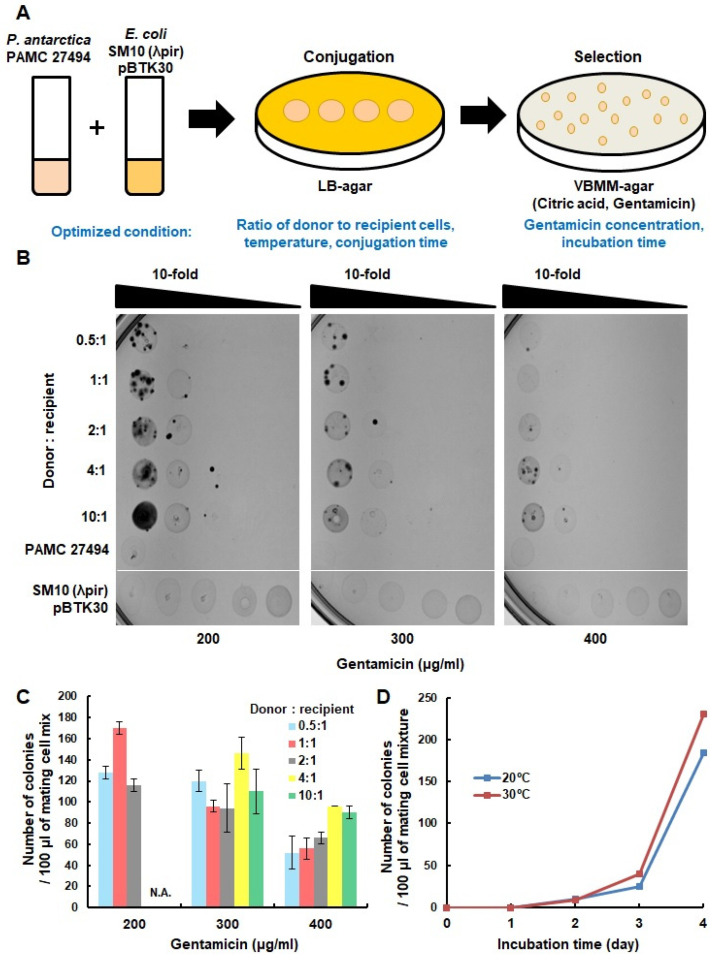
Figure 1
Figure 1
Optimization of transposon insertion methods in the P. antarctica PAMC 27494 strain. (A) Schematic workflow of transposon mutagenesis is shown. Donor and recipient cells were SM10(λpir) pBTK30 and P. antarctica PAMC 27494, respectively. The optimized parameters are stated. (B) A total of 10 μL of a 10-fold dilution of mating cell mixtures with various ratios of donor to recipient cells were spotted on VBMM–agar medium containing gentamicin. As a negative control, only donor cells or only recipient cells were spotted on the plate. Only the SM10(λpir) pBTK30 strain was spotted according to the applied density (ordering from left to right). (C) The colonies on each plate were counted, and the average was converted to 100 μL. The graph shows the efficiency according to the ratio of donor cells and recipient cells. Samples in which it was not possible to count the colonies due to background cells are indicated as ‘Not Applicable (N.A.)’. (D) The efficiency of conjugation at 20 °C and 30 °C for three hours of mating was compared.
Figure 2
Figure 2
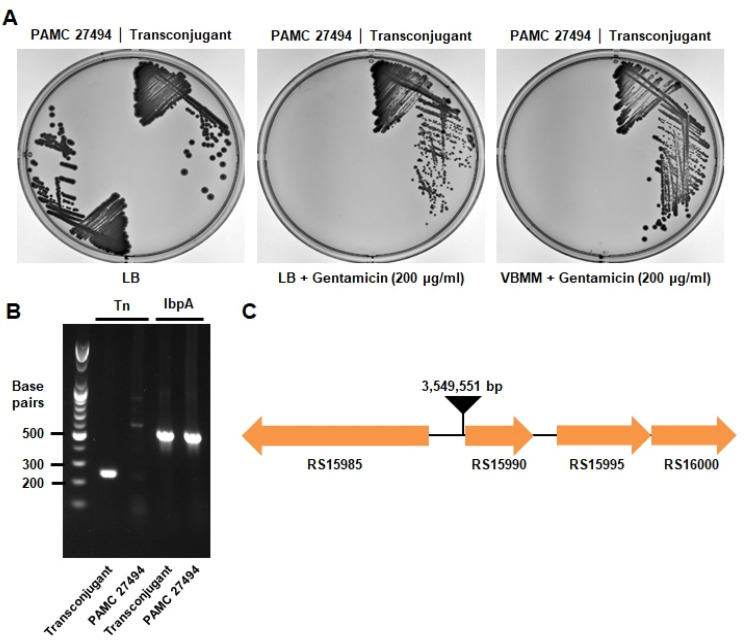
Confirmation of transposon insertion in the P. antarctica PAMC 27494 strain. (A) The P. antarctica PAMC 27494 strain and its transconjugant were streaked on LB, LB–gentamicin (200 μg/mL), and VBMM–gentamicin (200 μg/mL) and incubated at 20 °C for four days. (B) To verify the insertion of the transposon, PCR was performed by using two primer sets for targeting transposon-specific sequences and the ibpA gene as a PCR control. (C) By performing inverse PCR and subsequent sequencing, the insertion site of the transposon was determined, which is at 3,549,551 bp, the intergenic region between RS15985 and RS15990 genes in P. antarctica.

Similar articles

References

    1. Diggle S.P., Whiteley M. Microbe Profile: Pseudomonas aeruginosa: Opportunistic pathogen and lab rat. Microbiology. 2020;166:30. doi: 10.1099/mic.0.000860. - DOI - PMC - PubMed
    1. Xin X.-F., Kvitko B., He S.Y. Pseudomonas syringae: What it takes to be a pathogen. Nat. Rev. Microbiol. 2018;16:316–328. doi: 10.1038/nrmicro.2018.17. - DOI - PMC - PubMed
    1. Spiers A.J., Buckling A., Rainey P.B. The causes of Pseudomonas diversity. Microbiology. 2000;146:2345–2350. doi: 10.1099/00221287-146-10-2345. - DOI - PubMed
    1. Römling U., Wingender J., Müller H., Tümmler B. A major Pseudomonas aeruginosa clone common to patients and aquatic habitats. Appl. Environ. Microbiol. 1994;60:1734–1738. doi: 10.1128/aem.60.6.1734-1738.1994. - DOI - PMC - PubMed
    1. Reddy G.S., Matsumoto G.I., Schumann P., Stackebrandt E., Shivaji S. Psychrophilic pseudomonads from Antarctica: Pseudomonas antarctica sp. nov., Pseudomonas meridiana sp. nov. and Pseudomonas proteolytica sp. nov. Int. J. Syst. Evol. Microbiol. 2004;54:713–719. doi: 10.1099/ijs.0.02827-0. - DOI - PubMed

LinkOut - more resources