Review
. 2023 Jan 11;11(1):183.
doi: 10.3390/microorganisms11010183.

Influenza Treatment: Limitations of Antiviral Therapy and Advantages of Drug Combination Therapy

Affiliations
Review

Influenza Treatment: Limitations of Antiviral Therapy and Advantages of Drug Combination Therapy

Sania Batool et al. Microorganisms. .

Abstract

Influenza infection is serious and debilitating for humans and animals. The influenza virus undergoes incessant mutation, segment recombination, and genome reassortment. As a result, new epidemics and pandemics are expected to emerge, making the elimination challenging of the disease. Antiviral therapy has been used for the treatment of influenza since the development of amantadine in the 1960s; however, its use is hampered by the emergence of novel strains and the development of drug resistance. Thus, combinational therapy with two or more antivirals or immunomodulators with different modes of action is the optimal strategy for the effective treatment of influenza infection. In this review, we describe current options for combination therapy, their performance, and constraints imposed by resistance, calling attention to the advantages of combination therapy against severe influenza infections. We also discuss the challenges of influenza therapy and the limitations of approved antiviral drugs.

Keywords: antiviral drug resistance; antiviral drugs; drug combination therapy; influenza virus.


Conflict of interest statement

The authors declare no conflict of interest.

Figures

Figure 1
Figure 1
Schematic representation depicting the advantages of combination therapy over monotherapy. Combination therapy includes two or more drugs or immunomodulators with the same or different therapeutic targets. Antiviral combination with different therapeutic activities promotes synergistic action, reducing drug toxicity and drug resistance proportion. The combination of an antiviral and an immune modulator targets virus and host factors, thereby inhibiting virus replication and simultaneously enhancing the host defense mechanism and conferring morbidity and mortality benefits.
Figure 2
Figure 2
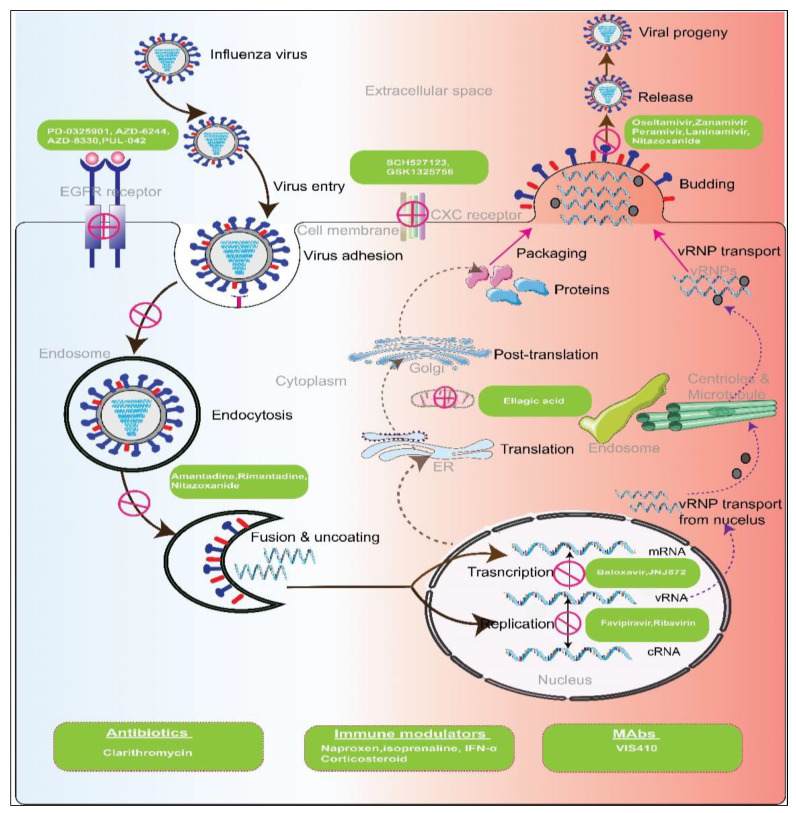
Potential targets of antiviral and other immunomodulators for different factors of pathogen and host. Influenza virus enters the cytoplasm by receptor-mediated endocytosis by recognition of sialic acid receptors. The low pH in the endosome induces the release of RNA, a therapeutic target of several antivirals. Transcription and replication from RNA occur in the nucleus, and both steps are inhibited by antivirals targeting the PA endonuclease and RdRps. Packaging and release of the virion occur at the cell membrane, and neuraminidase inhibitors block this step. Immunomodulators and other agents target host factors and stimulate the immune system against viral infection.

References

    1. Tong S., Zhu X., Li Y., Shi M., Zhang J., Bourgeois M., Yang H., Chen X., Recuenco S., Gomez J., et al. New World Bats Harbor Diverse Influenza A Viruses. PLoS Pathog. 2013;9:e1003657. doi: 10.1371/journal.ppat.1003657. - DOI - PMC - PubMed
    1. Richard M., Erny A., Caré B., Traversier A., Barthelemy M., Hay A., Lin Y.P., Ferraris O., Lina B. Rescue of a H3N2 Influenza Virus Containing a Deficient Neuraminidase Protein by a Hemagglutinin with a Low Receptor-Binding Affinity. PLoS ONE. 2012;7:e33880. doi: 10.1371/journal.pone.0033880. - DOI - PMC - PubMed
    1. Lo C.-Y., Tang Y.-S., Shaw P.-C. Structure and Function of Influenza Virus Ribonucleoprotein. Virus Protein Nucl. Complexes. 2018;88:95–128. doi: 10.1007/978-981-10-8456-0_5. - DOI - PubMed
    1. Noda T., Kawaoka Y. Structure of influenza virus ribonucleoprotein complexes and their packaging into virions. Rev. Med. Virol. 2010;20:380–391. doi: 10.1002/rmv.666. - DOI - PMC - PubMed
    1. Dawson A.R., Wilson G.M., Coon J.J., Mehle A. Post-Translation Regulation of Influenza Virus Replication. Annu. Rev. Virol. 2020;7:167–187. doi: 10.1146/annurev-virology-010320-070410. - DOI - PubMed