


Essential Oil from Coriandrum sativum: A review on Its Phytochemistry and Biological Activity
- PMID: 36677754
- PMCID: PMC9864992
- DOI: 10.3390/molecules28020696
Essential Oil from Coriandrum sativum: A review on Its Phytochemistry and Biological Activity
Abstract
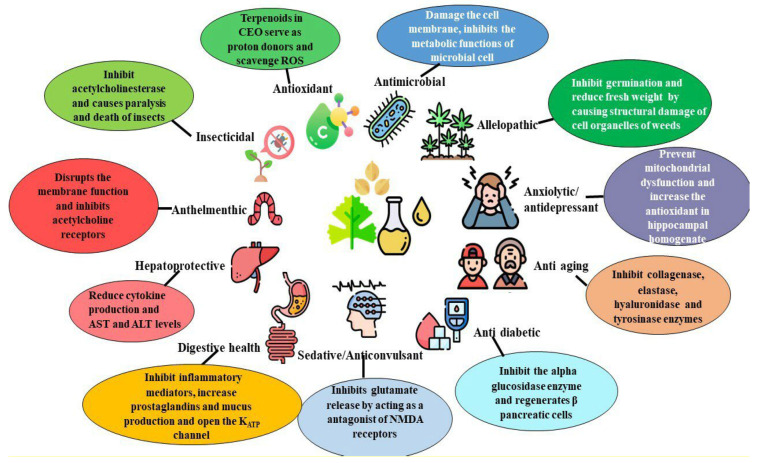
Essential oils are hydrophobic liquids produced as secondary metabolites by specialized secretory tissues in the leaves, seeds, flowers, bark and wood of the plant, and they play an important ecological role in plants. Essential oils have been used in various traditional healing systems due to their pharmaceutical properties, and are reported to be a suitable replacement for chemical and synthetic drugs that come with adverse side effects. Thus, currently, various plant sources for essential oil production have been explored. Coriander essential oil, obtained from the leaf and seed oil of Coriandrum sativum, has been reported to have various biological activities. Apart from its application in food preservation, the oil has many pharmacological properties, including allelopathic properties. The present review discusses the phytochemical composition of the seed and leaf oil of coriander and the variation of the essential oil across various germplasms, accessions, at different growth stages and across various regions. Furthermore, the study explores various extraction and quantification methods for coriander essential oils. The study also provides detailed information on various pharmacological properties of essential oils, such as antimicrobial, anthelmintic, insecticidal, allelopathic, antioxidant, antidiabetic, anticonvulsive, antidepressant, and hepatoprotective properties, as well as playing a major role in maintaining good digestive health. Coriander essential oil is one of the most promising alternatives in the food and pharmaceutical industries.
Keywords: EO variation; antimicrobial; biological activity; coriander essential oil (CEO); phytochemistry.
Conflict of interest statement
The authors declare no conflict of interest.
Figures
References
-
- Wu Y., Luo Y., Wang Q. Antioxidant and antimicrobial properties of essential oils encapsulated in Zein nanoparticles prepared by liquid–liquid dispersion method. LWT-Food Sci. Technol. 2012;48:283–290. doi: 10.1016/j.lwt.2012.03.027. - DOI
-
- Mandal S., Mandal M. Coriander (Coriandrum sativum L.) essential oil: Chemistry and biological activity. Asian Pac. J. Trop. Biomed. 2015;5:421–428. doi: 10.1016/j.apjtb.2015.04.001. - DOI
-
- Guenther E. The essential oils. J. Am. Pharm. Assoc. 1948;37:214. doi: 10.1021/ac60148a005. - DOI
-
- CheBi Volatile Oil Component (CHEBI:27311) [(accessed on 12 August 2022)]. Available online: https://www.ebi.ac.uk/chebi/searchId.do?chebiId=CHEBI:27311.
Publication types
MeSH terms
Substances
Grants and funding
LinkOut - more resources
Full Text Sources
Molecular Biology Databases
