


Association between Sugar-Sweetened Beverage Consumption and the Risk of the Metabolic Syndrome: A Systematic Review and Meta-Analysis
- PMID: 36678301
- PMCID: PMC9912256
- DOI: 10.3390/nu15020430
Association between Sugar-Sweetened Beverage Consumption and the Risk of the Metabolic Syndrome: A Systematic Review and Meta-Analysis
Abstract
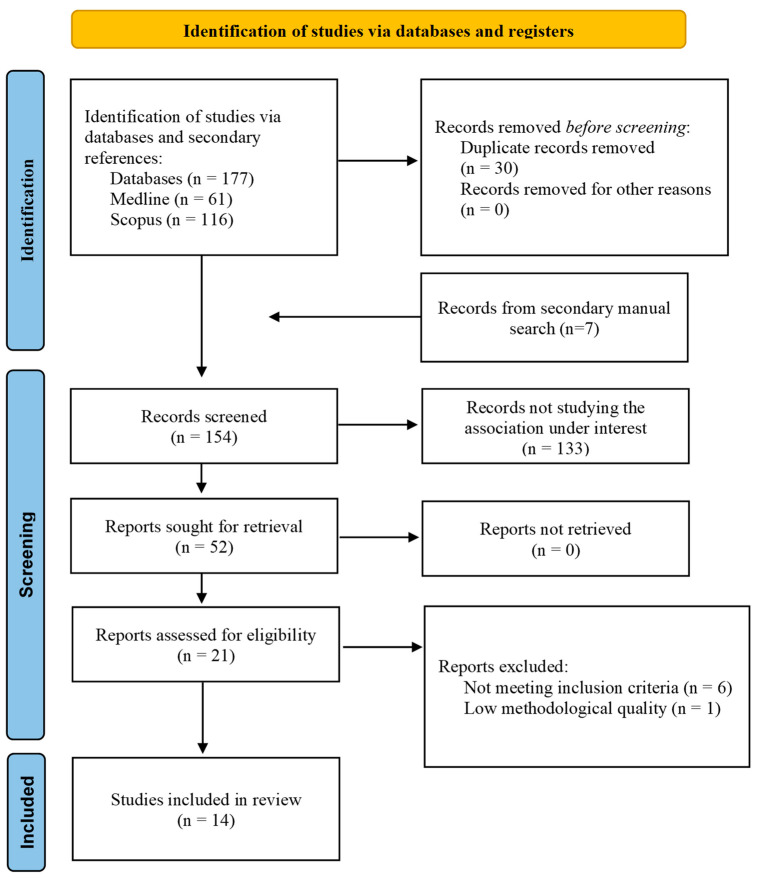
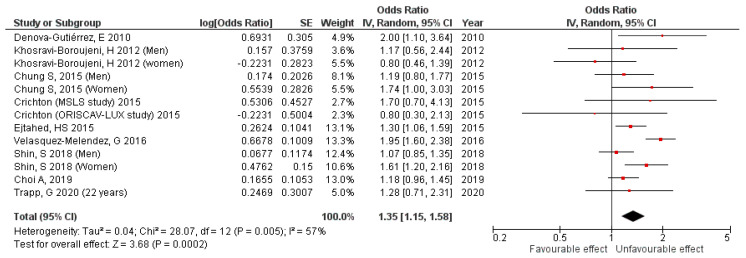
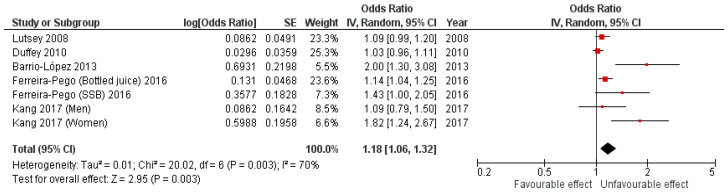
(1) Background: The increasing occurrence of the metabolic syndrome (MetS) is largely related to harmful food habits. Among them, the consumption of sugar-sweetened beverages (SSBs) is noteworthy. However, to our knowledge, there are not enough high-quality methodological studies summarizing the association between the intake of SSBs and the MetS. Therefore, the aim of this study is to examine the existing published results on this association among adults by synthesizing the existing evidence. (2) Methods: Systematic review and meta-analysis of observational studies following the PRISMA guidelines. Relevant information was extracted and presented following the PRISMA recommendations. PubMed and SCOPUS databases were searched for studies published until June 2022 that assessed the association between SSB consumption (including soft drinks, bottled fruit juices, energy drinks, and milkshakes) and the occurrence of MetS. Random effect models were used to estimate pooled odds ratios (ORs) with their 95% coefficient interval, and I2 was used to assess heterogeneity. (3) Results: A total of 14 publications from 6 different countries were included in this meta-analysis (9 cross-sectional and 5 cohort studies). For the cross-sectional studies, which included 62,693 adults, the pooled OR for the risk of MetS was 1.35 (95% CI 1.15, 1.58; I2 57%) when the highest versus the lowest categories of SSB consumption were compared. For the cohort studies, which included 28,932 adults, the pooled OR was 1.18 (95% CI 1.06, 1.32; I2 70%). (4) Conclusions: The consumption of SSBs was positively associated with an increased risk of MetS. The published literature supports public health strategies and the need to reduce the consumption of SSBs to prevent MetS.
Keywords: cardiovascular disease; meta-analysis; metabolic syndrome; sugar-sweetened beverages; systematic review.
Conflict of interest statement
The authors declare no conflict of interest.
Figures
References
-
- National Cholesterol Education Program (US) Third Report of the National Cholesterol Education Program (NCEP) Expert Panel on Detection, Evaluation, and Treatment of High Blood Cholesterol in Adults (Adult Treatment Panel III) Final Report. Circulation. 2002;106:3143. doi: 10.1161/circ.106.25.3143. - DOI - PubMed
-
- Cuesta M., Fuentes M., Rubio M., Bordiu E., Barabash A., Garcia De La Torre N., Rojo-Martinez G., Valdes S., Soriguer F., Vendrell J.J., et al. Incidence and Regression of Metabolic Syndrome in a Representative Sample of the Spanish Population: Results of the Cohort Di@ Bet. Es Study. BMJ Open Diab. Res. Care. 2020;8:23. doi: 10.1136/bmjdrc-2020-001715. - DOI - PMC - PubMed
Publication types
MeSH terms
Grants and funding
LinkOut - more resources
Full Text Sources
Medical
