Review
. 2023 Jan 11;12(2):342.
doi: 10.3390/plants12020342.

Recent Insights into Plant miRNA Biogenesis: Multiple Layers of miRNA Level Regulation

Affiliations
Review

Recent Insights into Plant miRNA Biogenesis: Multiple Layers of miRNA Level Regulation

Mateusz Bajczyk et al. Plants (Basel). .

Abstract

MicroRNAs are small RNAs, 20-22 nt long, the main role of which is to downregulate gene expression at the level of mRNAs. MiRNAs are fundamental regulators of plant growth and development in response to internal signals as well as in response to abiotic and biotic factors. Therefore, the deficiency or excess of individual miRNAs is detrimental to particular aspects of a plant's life. In consequence, the miRNA levels must be appropriately adjusted. To obtain proper expression of each miRNA, their biogenesis is controlled at multiple regulatory layers. Here, we addressed processes discovered to influence miRNA steady-state levels, such as MIR transcription, co-transcriptional pri-miRNA processing (including splicing, polyadenylation, microprocessor assembly and activity) and miRNA-encoded peptides synthesis. MiRNA stability, RISC formation and miRNA export out of the nucleus and out of the plant cell also define the levels of miRNAs in various plant tissues. Moreover, we show the evolutionary conservation of miRNA biogenesis core proteins across the plant kingdom.

Keywords: Arabidopsis; PTGS; core microprocessor evolutionary conservation; miRNA biogenesis; microRNA; microprocessor; plants; pri-miRNA degradation; regulation of miRNA level.


Conflict of interest statement

The authors declare no conflict of interest.

Figures

Figure 1
Figure 1
Roles of miRNAs in plant life. MiRNA156, miRNA172 and miRNA319 target SQUAMOSA promoter-binding protein-like (SPLs), APETALA2 (AP2) and TEOSINTE BRANCHED/CYCLOIDEA/PROLIFERATING CELL FACTOR1 (TCPs) mRNAs, respectively, to regulate a wide range of plant characteristics, such as the length of vegetative growth, flowering time, root and leaf architecture. Copper mobility is controlled by miRNA408-targeting mRNA of the copper-sequestrating protein—plantacyanin (PCY). Plant resistance to pathogens is modulated at the cellular level by downregulation of microrna-silenced toll/interleukin-1 domain (MIST1) transcript by miRNA825-5p. The export of miRNA159 and miRNA166 to pathogen tissues downregulates fungal proteins essential for virulence.
Figure 2
Figure 2
An overview of canonical miRNA biogenesis in plants. (a) RNA POLYMERASE II (RNAPII, blue) synthetizes pri-miRNA transcripts which are co-transcriptionally capped and polyadenylated (miRNA*—black bar—and miRNA—magenta bar). (b) Pri-miRNA transcripts form stem–loop structures. (c) Pri-miRNA transcripts are recognized by DICER-LIKE1 (DCL1) (orange) and other microprocessor proteins (not shown), then pre-miRNAs (stem–loop RNA) are excised with DCL1. DCL1 PAZ domain (yellow) recognizes the internal loop within pri-miRNA and RNase IIIa and RNase IIIb domains (scissors) cut in both strands, leaving two nucleotides overhang on 3′ end of the pre-miRNA. (d) Pre-miRNA molecule is translocated towards the PAZ domain and stopped when 3′ overhang reaches the PAZ domain. Then, DCL1 performs the second cut and produces miRNA/miRNA* dsRNA duplexes. (e) Later, 3′ ends of each RNA strand undergo methylation. (f) ARGONAUTE1 (AGO1) (light pink) binds miRNA and forms together the miRISC (RNA-INDUCED SILENCING COMPLEX).
Figure 3
Figure 3
MicroRNA biogenesis is a complex process requiring a plethora of accessory proteins to regulate a proper level of mature miRNA. (a) RNAPII, ELONGATOR complex, MEDIATOR complex, C-TERMINAL DOMAIN PHOSPHATASE-LIKE1 protein (CPL1), NEGATIVE ON TATA LESS2 protein (NOT2), CELL DIVISION CYCLE5 (CDC5), HASTY (HST), SUPPRESSOR OF NPR1-1, CONSTITUTIVE1 (SNC1) as well as TOPLESS-RELATED PROTEIN1 (TPR1) bind to MIR loci. Green color marks positive regulators of miRNA transcription and black color marks negative regulators. (b) miRNA gene is transcribed. Nuclear CAP-BINDING PROTEIN COMPLEX (CBC) binds to newly synthesized cap structure; SERRATE (SE) and DICER LIKE1 protein (DCL1) are assembled to miRNA precursor. (c) Pri-miRNA stem–loop structure is bound by HYPONASTIC LEAVES1 (HYL1) to stabilize the miRNA precursor hairpin. TOUGH (TGH), PLEIOTROPIC REGULATORY LOCUS1 (PRL1), MOS4-ASSOCIATED COMPLEX (MAC) and DAWDLE (DDL) assist HYL1 in this process. (d) Base-to-loop processing. (e) Loop-to-base processing. The scheme presented in Figure 3 shows how complex metabolic machinery is involved in fine-tuning miRNA biogenesis when compared with the simplified picture presented in Figure 2.
Figure 4
Figure 4
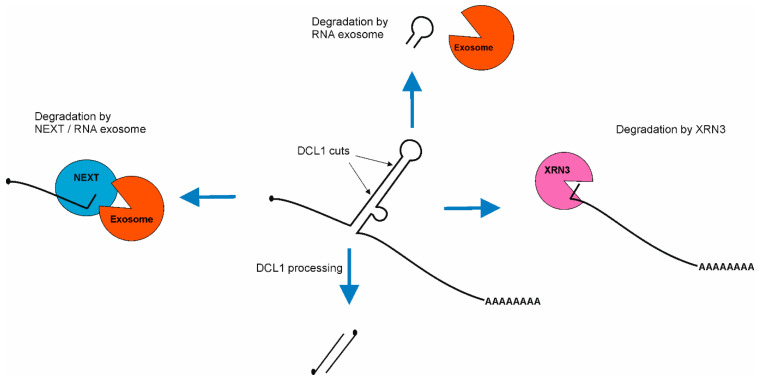
Scheme of pri-miRNA byproducts degradation after miRNA/miRNA* duplex excision. First, 5′ fragment of pri-miRNA is degraded using NEXT/RNA exosome machinery. Then, 3′ fragment of pri-miRNA is degraded using EXORIBONUCLEASE3 (XRN3). The apical fragment of stem–loop is degraded suing nuclear RNA exosome.
Figure 5
Figure 5
Conservation and divergence of DCL1 proteins across the plant kingdom. (a) Simplified phylogenetic tree representing relationships among major groups of the Streptophyta lineage. (b) Differences in domain architecture between DCL1 proteins from different representatives of plants: streptophyte algae—Klebsormidium nitens and Mesotaenium endlicheranum, bryophytes—Anthoceros agrestis, Marchantia polymorpha and Sphagnum fallax, fern—Ceratopteris richardii, gymnosperm—Ginko biloba, angiosperms—Nymphaea colorata, Citrus sinensis, Cuscuta campestris and Arabidopsis thaliana. Protein domains were annotated using the PfamScan tool and the Pfam database [153]. The figure includes the following Pfam accession numbers: DEAD (PF00270), Dicer_dimer (PF03368), DND1_DSRM (PF14709), DSRM (PF00035), Helicase C (PF00271), PAZ (PF02170), ResIII (PF04851), Ribonuclease III (PF00636).

References

    1. Lee R.C., Feinbaum R.L., Ambros V. The C. elegans heterochronic gene lin-4 encodes small RNAs with antisense complementarity to lin-14. Cell. 1993;75:843–854. doi: 10.1016/0092-8674(93)90529-Y. - DOI - PubMed
    1. Reinhart B.J., Weinstein E.G., Rhoades M.W., Bartel B., Bartel D.P. MicroRNAs in plants. Genes Dev. 2002;16:1616–1626. doi: 10.1101/gad.1004402. - DOI - PMC - PubMed
    1. Aukerman M.J., Sakai H. Regulation of flowering time and floral organ identity by a MicroRNA and its APETALA2-like target genes. Plant Cell. 2003;15:2730–2741. doi: 10.1105/tpc.016238. - DOI - PMC - PubMed
    1. Chen X. A microRNA as a translational repressor of APETALA2 in Arabidopsis flower development. Science. 2004;303:2022–2025. doi: 10.1126/science.1088060. - DOI - PMC - PubMed
    1. Jones-Rhoades M.W., Bartel D.P. Computational identification of plant microRNAs and their targets, including a stress-induced miRNA. Mol. Cell. 2004;14:787–799. doi: 10.1016/j.molcel.2004.05.027. - DOI - PubMed