


Current Trends for Lavender (Lavandula angustifolia Mill.) Crops and Products with Emphasis on Essential Oil Quality
- PMID: 36679071
- PMCID: PMC9861439
- DOI: 10.3390/plants12020357
Current Trends for Lavender (Lavandula angustifolia Mill.) Crops and Products with Emphasis on Essential Oil Quality
Abstract
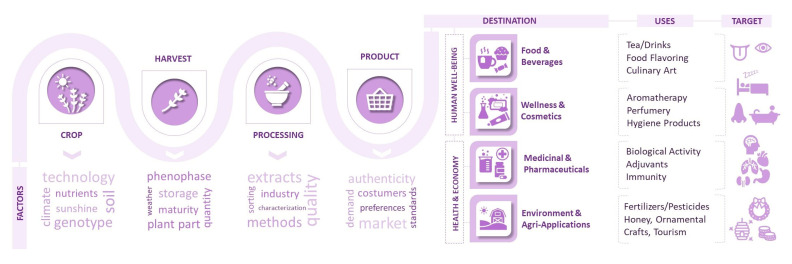
Lavender is in the research spotlight due to its increasing economic importance, while market demand is expected to continue to grow. Among the hundreds of essential-oil-bearing plants, Lavandula angustifolia Mill. remains one of the most valuable. This paper explores the lavender chain timeline from crop to products, examining the expanding knowledge on the characteristics, phytochemical profile and functional potential of lavender that could lead to new products and uses. Lavender crops can be expanded without competing for productive land, instead using marginal, contaminated or unproductive land. A novel cultivation trend proposes leveraging agri-background biodiversity, arbuscular mycorrhiza and the natural enemies of pests for healthy crops. Together with breeding efforts targeting highly performant genotypes with complex volatile profiles coupled with resistance to specific biotic (particularly Phytoplasma) and abiotic (salt, heavy metals) stressors, industry could have a steady supply of high-quality raw material. Besides the expansion of the uses of essential oil in cosmetics, pharmaceuticals, food and environmental and agri-applications, novel channels have appeared for the use of the solid by-product, which is rich in polyphenols and polysaccharides; these channels have the potential to create additional streams of value. The stabilization and optimization of techno-functional delivery systems through the encapsulation of essential oil can extend shelf-life and enhance biological activity efficiency.
Keywords: commercial; composition; farm; properties; standards; volatiles.
Conflict of interest statement
The authors declare no conflict of interest.
Figures

References
-
- Lubbe A., Verpoorte R. Cultivation of Medicinal and Aromatic Plants for Specialty Industrial Materials. Ind. Crops Prod. 2011;34:785–801. doi: 10.1016/j.indcrop.2011.01.019. - DOI
-
- Barbieri C., Borsotto P. Essential Oils: Market and Legislation. IntechOpen; London, UK: 2018.
-
- Gallotte P., Fremondière G., Gallois P., Bernier J.-P.B., Buchwalder A., Walton A., Piasentin J., Fopa-Fomeju B. Lavandula angustifolia Mill. and Lavandula x Intermedia Emeric Ex Loisel: Lavender and Lavandin. In: Novak J., Blüthner W.-D., editors. Medicinal, Aromatic and Stimulant Plants. Springer International Publishing; Cham, Switzerland: 2020. pp. 303–311. Handbook of Plant Breeding.
-
- Wells R., Truong F., Adal A.M., Sarker L.S., Mahmoud S.S. Lavandula Essential Oils: A Current Review of Applications in Medicinal, Food, and Cosmetic Industries of Lavender. Nat. Prod. Commun. 2018;13:1934578X1801301038. doi: 10.1177/1934578X1801301038. - DOI
-
- Muntean L.S., Tămaș M., Muntean S., Muntean L., Duda M.M., Vârban D.I., Florian S. Treatise of Cultivated and Spontaneous Medicinal Plants. Risoprint; Cluj-Napoca, Romania: 2016.
Publication types
LinkOut - more resources
Full Text Sources
