Review
. 2023 Jan 10;23(2):817.
doi: 10.3390/s23020817.

An Overview of Flexible Sensors: Development, Application, and Challenges

Affiliations
Review

An Overview of Flexible Sensors: Development, Application, and Challenges

Enze Liu et al. Sensors (Basel). .

Abstract

The emergence and advancement of flexible electronics have great potential to lead development trends in many fields, such as "smart electronic skin" and wearable electronics. By acting as intermediates to detect a variety of external stimuli or physiological parameters, flexible sensors are regarded as a core component of flexible electronic systems and have been extensively studied. Unlike conventional rigid sensors requiring costly instruments and complicated fabrication processes, flexible sensors can be manufactured by simple procedures with excellent production efficiency, reliable output performance, and superior adaptability to the irregular surface of the surroundings where they are applied. Here, recent studies on flexible sensors for sensing humidity and strain/pressure are outlined, emphasizing their sensory materials, working mechanisms, structures, fabrication methods, and particular applications. Furthermore, a conclusion, including future perspectives and a short overview of the market share in this field, is given for further advancing this field of research.

Keywords: flexible sensor; human machine interaction; humidity sensor; strain sensor.


Conflict of interest statement

The authors declare no conflict of interest.

Figures
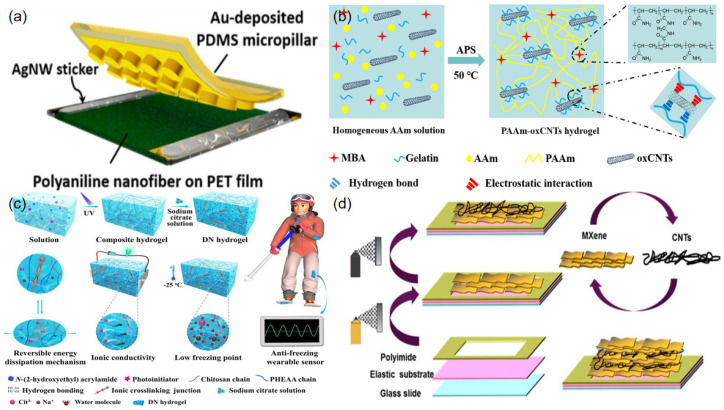
Figure 4
Figure 4
Schematic diagrams of flexible strain/pressure sensors using various materials: (a) polyaniline nanofibers and the conductive layer of Au (reproduced with permission from [85]); (b) carbon nanotube–reinforced hydrogel (reproduced with permission from [107]); (c) CS–PHEAA DN hydrogel (reproduced with permission from [108]); (d) Ti3C2Tx MXene/carbon nanotube composite (reproduced with permission from [110]).
Figure 6
Figure 6
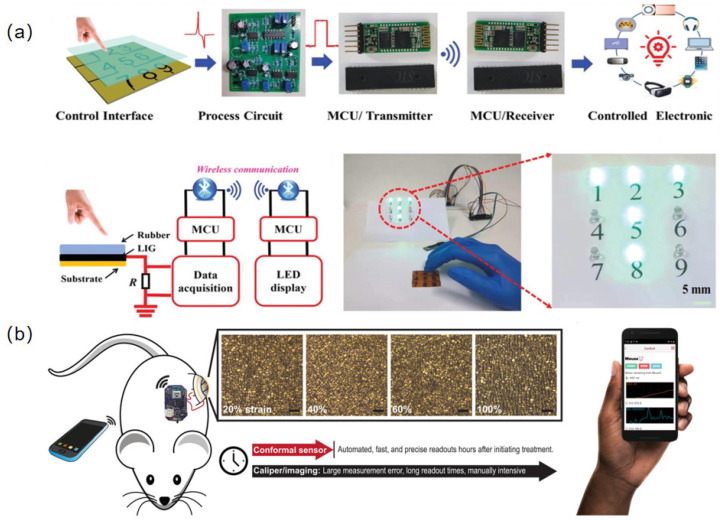
(a) Schematic illustration of a wireless control system for real-time motion tracking (reproduced with permission from [125]); (b) illustration of a strain sensor and its deployment in a rat model for monitoring the regression of tumors (reproduced with permission from [131]).
Figure 1
Figure 1
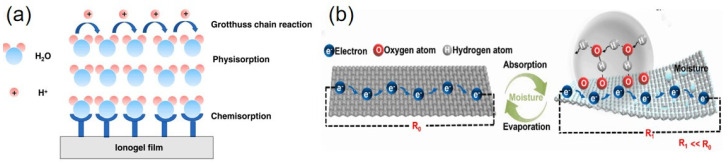
Example of the Grotthuss mechanism: (a) illustration of the humidity-sensing mechanism of the PIL (reproduced with permission from [32]); (b) principle of the OCF sensor (reproduced with permission from [33]).
Figure 2
Figure 2
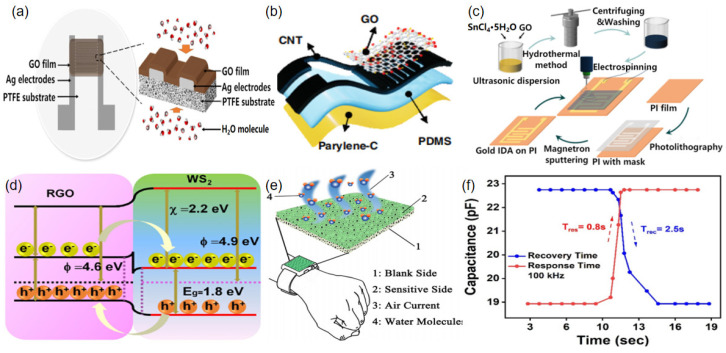
(a) Structure of a flexible humidity sensor using graphene oxide and PTFE (reproduced with permission from [47]); (b) exploded view of a CNT-based flexible sensor (reproduced with permission from [49]); (c) illustration of the process of preparing a SnO2/RGO humidity sensor (reproduced with permission from [50]); (d) illustration of the different mechanisms of interaction between RGO and WS2 (reproduced with permission from [53]); (e) illustration of a PANI/PVDF IFHS sensor (reproduced with permission from [55]); (f) response and recovery time of a capacitive humidity sensor at 10 kHz (reproduced with permission from [56]).
Figure 3
Figure 3
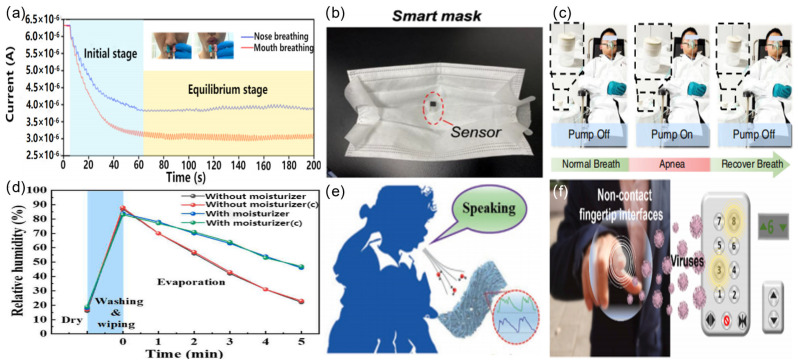
Applications of flexible humidity sensors: (a) the current signal profiles of human nose breathing and mouth breathing (reproduced with permission from [65]); (b) image of the application of the humidity sensor for monitoring human breath (reproduced with permission from [66]); (c) photos of a SAS diagnosing–treating system with an integrated CEH sensor (reproduced with permission from [67]); (d) a TiO2/CNC humidity sensor used in a moisturization experiment, in which a commercial skin moisture detector was used as a reference (marked as “C”) (reproduced with permission from [68]); (e) schematic illustration of MPHS for detecting exhaled air during speaking (reproduced with permission from [69]); (f) proof-of-concept of non-contact fingertip interfaces (reproduced with permission from [33]).
Figure 5
Figure 5
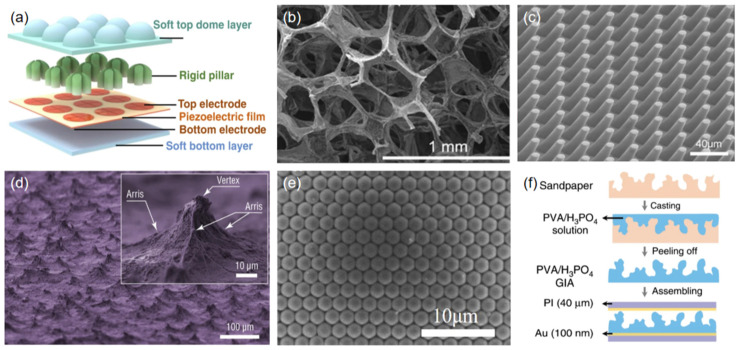
(a) Schematic diagram of a finger-shaped sensor (reproduced with permission from [111]); scanning electron microscope (SEM) images of (b) porous RGO foam (reproduced with permission from [115]); (c) micropillars (reproduced with permission from [116]); (d) micropyramids (reproduced with permission from [88]); (e) microconvex arrays (reproduced with permission from [89]); (f) schematic diagram of the architecture of GIA (reproduced with permission from [90]).

References

    1. Gao M.Y., Wang P., Jiang L.L., Wang B.W., Yao Y., Liu S., Chu D.W., Cheng W.L., Lu Y.R. Power generation for wearable systems. Energy Environ. Sci. 2021;14:2114–2157. doi: 10.1039/D0EE03911J. - DOI
    1. Wu H., Huang Y., Xu F., Duan Y., Yin Z. Energy Harvesters for Wearable and Stretchable Electronics: From Flexibility to Stretchability. Adv Mater. 2016;28:9881–9919. doi: 10.1002/adma.201602251. - DOI - PubMed
    1. Tan L., Yu K., Lin L., Cheng X., Srivastava G., Lin J.C.-W., Wei W. Speech Emotion Recognition Enhanced Traffic Efficiency Solution for Autonomous Vehicles in a 5G-Enabled Space–Air–Ground Integrated Intelligent Transportation System. IEEE Trans. Intell. Transp. Syst. 2022;23:2830–2842. doi: 10.1109/TITS.2021.3119921. - DOI
    1. Kong H., Lu L., Yu J., Chen Y., Tang F. Continuous Authentication Through Finger Gesture Interaction for Smart Homes Using WiFi. IEEE Trans. Mob. Comput. 2021;20:3148–3162. doi: 10.1109/TMC.2020.2994955. - DOI
    1. Kim J.J., Wang Y., Wang H., Lee S., Yokota T., Someya T. Skin Electronics: Next-Generation Device Platform for Virtual and Augmented Reality. Adv. Funct. Mater. 2021;31:2009602. doi: 10.1002/adfm.202009602. - DOI

LinkOut - more resources