. 2023 Jan 14;23(2):958.
doi: 10.3390/s23020958.

The Actigraphy-Based Identification of Premorbid Latent Liability of Schizophrenia and Bipolar Disorder

Affiliations

The Actigraphy-Based Identification of Premorbid Latent Liability of Schizophrenia and Bipolar Disorder

Ádám Nagy et al. Sensors (Basel). .

Abstract

(1) Background and Goal: Several studies have investigated the association of sleep, diurnal patterns, and circadian rhythms with the presence and with the risk states of mental illnesses such as schizophrenia and bipolar disorder. The goal of our study was to examine actigraphic measures to identify features that can be extracted from them so that a machine learning model can detect premorbid latent liabilities for schizotypy and bipolarity. (2) Methods: Our team developed a small wrist-worn measurement device that collects and identifies actigraphic data based on an accelerometer. The sensors were used by carefully selected healthy participants who were divided into three groups: Control Group (C), Cyclothymia Factor Group (CFG), and Positive Schizotypy Factor Group (PSF). From the data they collected, our team performed data cleaning operations and then used the extracted metrics to generate the feature combinations deemed most effective, along with three machine learning algorithms for categorization. (3) Results: By conducting the training, we were able to identify a set of mildly correlated traits and their order of importance based on the Shapley value that had the greatest impact on the detection of bipolarity and schizotypy according to the logistic regression, Light Gradient Boost, and Random Forest algorithms. (4) Conclusions: These results were successfully compared to the results of other researchers; we had a similar differentiation in features used by others, and successfully developed new ones that might be a good complement for further research. In the future, identifying these traits may help us identify people at risk from mental disorders early in a cost-effective, automated way.

Keywords: actigraphy; bipolar disorder; light gradient boost; linear regression; machine learning; random forest; schizophrenia.


Conflict of interest statement

The authors declare no conflict of interest that influenced the content of this paper.

Figures

Figure 1
Figure 1
SHAP (Shapley Additive exPlanations) values from the baseline logistic regression.
Figure 2
Figure 2
The density function of sleep times per group.
Figure 3
Figure 3
Sliding window analysis of ZCM (Zero Crossing Method) data.
Figure 4
Figure 4
Flowchart of the wavelet-based evaluation of nocturnal activity structures. (a) Activities of concatenated sleep periods of 5 subsequent nights. (b) Correlation-coefficient map of the time series in (a), as a result of continuous wavelet analysis. (c) Structure parameters derived from the map in (b), as a function of scale parameter in the 1 to 200 s time-window range. (d) Distribution of the integrated structure factors (structure_pms) among the three groups of volunteers (Control Group (blue), Cyclothymia Factor Group (red), and Positive Schizotypy Factor Group (green)).
Figure 5
Figure 5
Boxplot of models performing above the baseline in the CTF (Cyclothymia Factor) and PSF (Positive Schizotypy Factor) groups.
Figure 6
Figure 6
The correlation table of the 46 filtered features, ordered by number of occurrence.
Figure 7
Figure 7
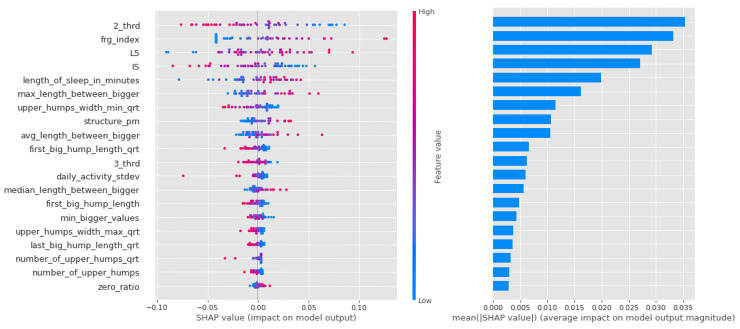
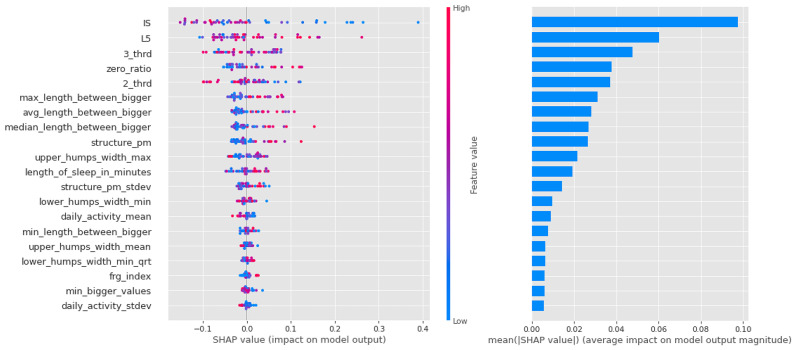
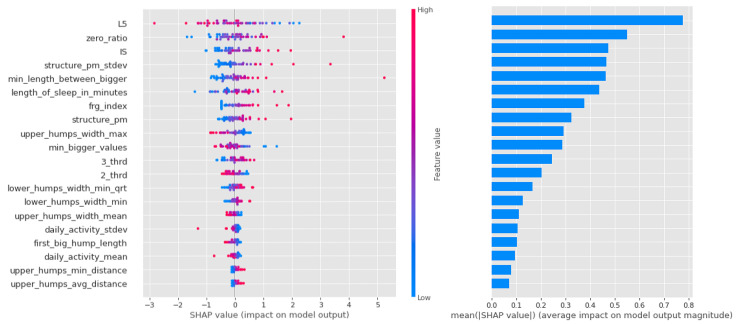
Shapley values of features taken from the best model for Logistic regression in the CTF (Cyclothymia Factor) group.
Figure 8
Figure 8
Shapley values of features from the best model for Light Gradient Boost in the CTF (Cyclothymia Factor) group.
Figure 9
Figure 9
Shapley values of features taken from the best model for Random forest in the CTF (Cyclothymia Factor) group.
Figure 10
Figure 10
Shapley values of features taken from the best model for Logistic regression in the PSF (Positive Schizotypy Factor) group.
Figure 11
Figure 11
Shapley values of features from the best model for Light Gradient Boost in the PSF (Positive Schizotypy Factor) group.
Figure 12
Figure 12
Shapley values of features from the best model for Random forest in the PSF (Positive Schizotypy Factor) group.
Figure 13
Figure 13
A comparison of our key features with those in the literature. All the features taken from the literature refer only to patients with bipolar or schizophrenic disorder, with the exception of longer sleep duration (highlighted in gray), as this also occurs in at-risk individuals. 1.: 2_thrd;2.: 3_thrd; 3.: L5; 4.: zero_ratio; 5.: frg_index; 6.: length_of sleep_in_minutes; 7.: IS; CTF: Cyclothymia Factor; PSF: Positive Schizotypy Factor. Berle et al., 2010 [27], Castro et al., 2015 [18], Dennison et al., 2021 [22], Meyer et al., 2020 [14], Murray et al., 2020 [23], Panchal et al., 2022 [24], Reinertsen et al., 2018 [25], Scott et al., 2017 [15], Wee et al., 2019 [26], Jones et al., 2005 [28].

References

    1. Yamada Y., Matsumoto M., Iijima K., Sumiyoshi T. Specificity and continuity of schizophrenia and bipolar disorder: Relation to biomarkers. Curr. Pharm. Des. 2020;26:191. doi: 10.2174/1381612825666191216153508. - DOI - PMC - PubMed
    1. Hegelstad W.T.V., Larsen T.K., Auestad B., Evensen J., Haahr U., Joa I., Johannesen J.O., Langeveld J., Melle I., Opjordsmoen S., et al. Long-term follow-up of the TIPS early detection in psychosis study: Effects on 10-year outcome. Am. J. Psychiatry. 2012;169:374–380. doi: 10.1176/appi.ajp.2011.11030459. - DOI - PubMed
    1. Klosterkotter J., Schultze-Lutter F., Bechdolf A., Ruhrmann S. Prediction and prevention of schizophrenia: What has been achieved and where to go next? World Psychiatry. 2011;10:165. doi: 10.1002/j.2051-5545.2011.tb00044.x. - DOI - PMC - PubMed
    1. McFarlane W.R. Prevention of the first episode of psychosis. Psychiatr. Clin. 2011;34:95–107. doi: 10.1016/j.psc.2010.11.012. - DOI - PMC - PubMed
    1. Häfner H., Maurer K., Löffler W., Munk-Jørgensen P., Hambrecht M., Riecher-Rössler A. The ABC Schizophrenia Study: A preliminary overview of the results. Soc. Psychiatry Psychiatr. Epidemiol. 1998;33:380–386. doi: 10.1007/s001270050069. - DOI - PubMed