


One Health Investigation of SARS-CoV-2 in People and Animals on Multiple Mink Farms in Utah
- PMID: 36680136
- PMCID: PMC9864593
- DOI: 10.3390/v15010096
One Health Investigation of SARS-CoV-2 in People and Animals on Multiple Mink Farms in Utah
Abstract
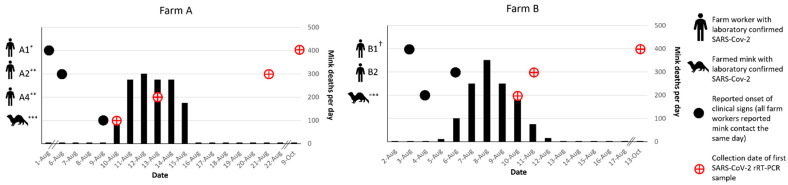
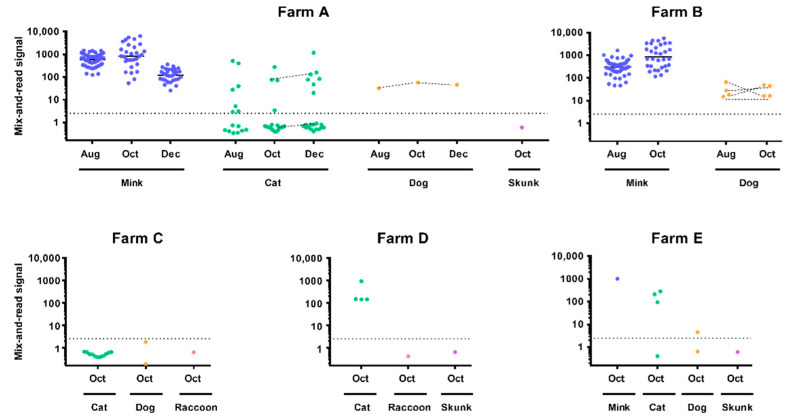
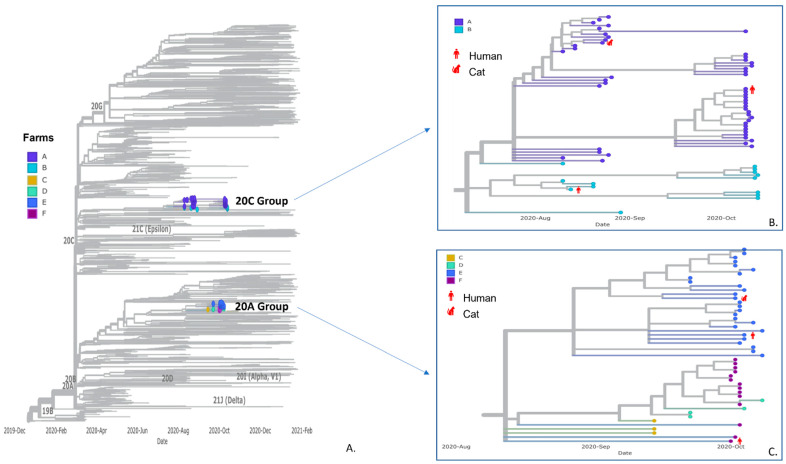
From July−November 2020, mink (Neogale vison) on 12 Utah farms experienced an increase in mortality rates due to confirmed SARS-CoV-2 infection. We conducted epidemiologic investigations on six farms to identify the source of virus introduction, track cross-species transmission, and assess viral evolution. Interviews were conducted and specimens were collected from persons living or working on participating farms and from multiple animal species. Swabs and sera were tested by SARS-CoV-2 real-time reverse transcription polymerase chain reaction (rRT-PCR) and serological assays, respectively. Whole genome sequencing was attempted for specimens with cycle threshold values <30. Evidence of SARS-CoV-2 infection was detected by rRT-PCR or serology in ≥1 person, farmed mink, dog, and/or feral cat on each farm. Sequence analysis showed high similarity between mink and human sequences on corresponding farms. On farms sampled at multiple time points, mink tested rRT-PCR positive up to 16 weeks post-onset of increased mortality. Workers likely introduced SARS-CoV-2 to mink, and mink transmitted SARS-CoV-2 to other animal species; mink-to-human transmission was not identified. Our findings provide critical evidence to support interventions to prevent and manage SARS-CoV-2 in people and animals on mink farms and emphasizes the importance of a One Health approach to address emerging zoonoses.
Keywords: COVID-19; Neogale vison; One Health; SARS-CoV-2; animals; coronavirus; mink; zoonotic transmission.
Conflict of interest statement
The authors declare no conflict of interest. The findings and conclusions in this report are those of the authors and do not necessarily represent the official position of the Centers for Disease Control and Prevention.
Figures
References
-
- Ghebreyesus T.A. WHO Director-General’s Opening Remarks at the Media Briefing on COVID-19—11 March 2020. World Health Organization (WHO); Geneva, Switzerland: 2020.
-
- Bosco-Lauth A.M., Hartwig A.E., Porter S.M., Gordy P.W., Nehring M., Byas A.D., Vande Woude S., Ragan I.K., Maison R.M., Bowen R.A. Experimental infection of domestic dogs and cats with SARS-CoV-2: Pathogenesis, transmission, and response to reexposure in cats. Proc. Natl. Acad. Sci. USA. 2020;117:26382–26388. doi: 10.1073/pnas.2013102117. - DOI - PMC - PubMed
Publication types
MeSH terms
LinkOut - more resources
Full Text Sources
Medical
Miscellaneous
