


Diagnosis, treatment and survival from bladder, upper urinary tract, and urethral cancers: real-world findings from NHS England between 2013 and 2019
- PMID: 36680312
- PMCID: PMC10952282
- DOI: 10.1111/bju.15970
Diagnosis, treatment and survival from bladder, upper urinary tract, and urethral cancers: real-world findings from NHS England between 2013 and 2019
Abstract
Objective: We report NHS England data for patients with bladder cancer (BC), upper tract urothelial cancer (UTUC: renal pelvic and ureteric), and urethral cancers from 2013 to 2019.
Materials and methods: Hospital episode statistics, waiting times, and cancer registrations were extracted from NHS Digital.
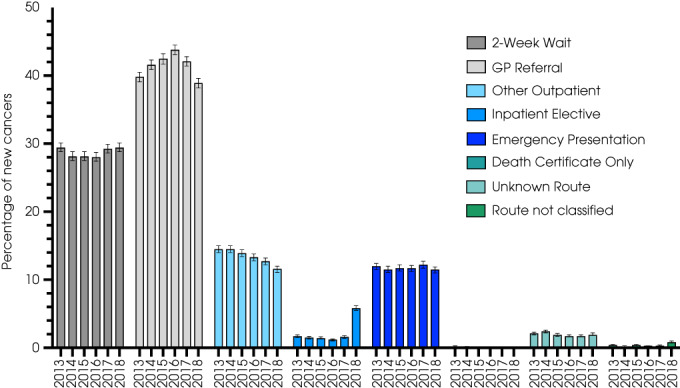
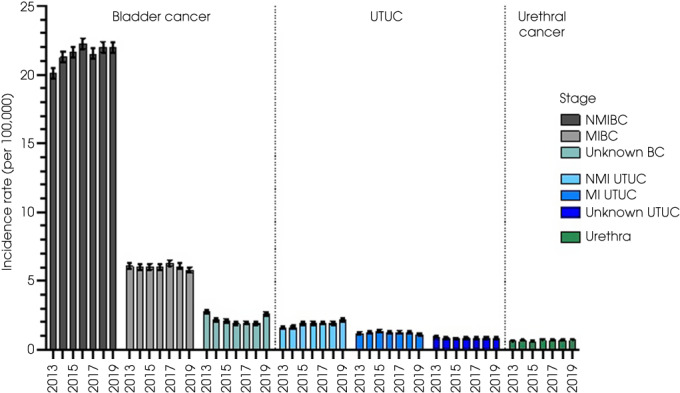
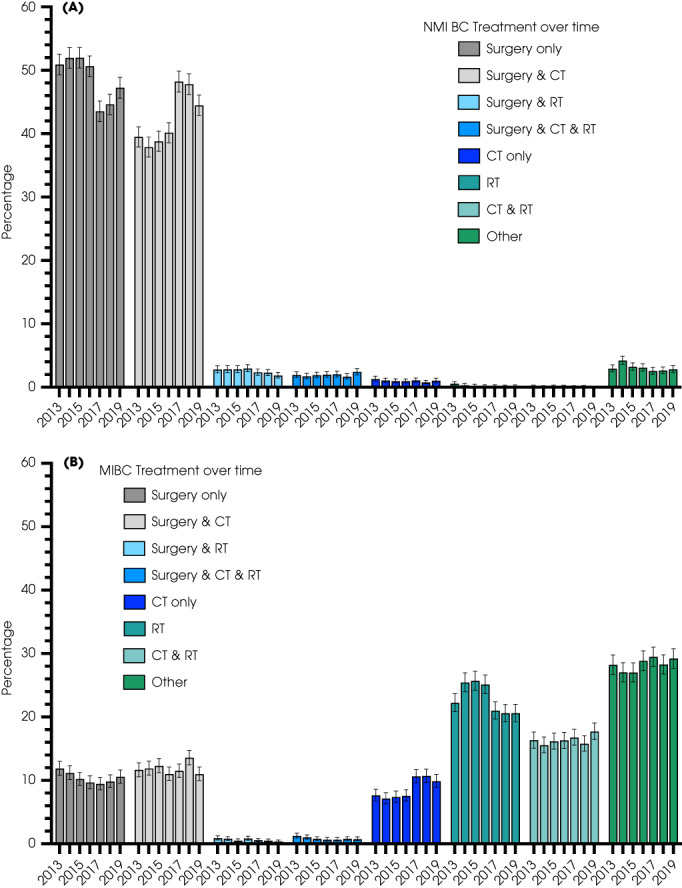
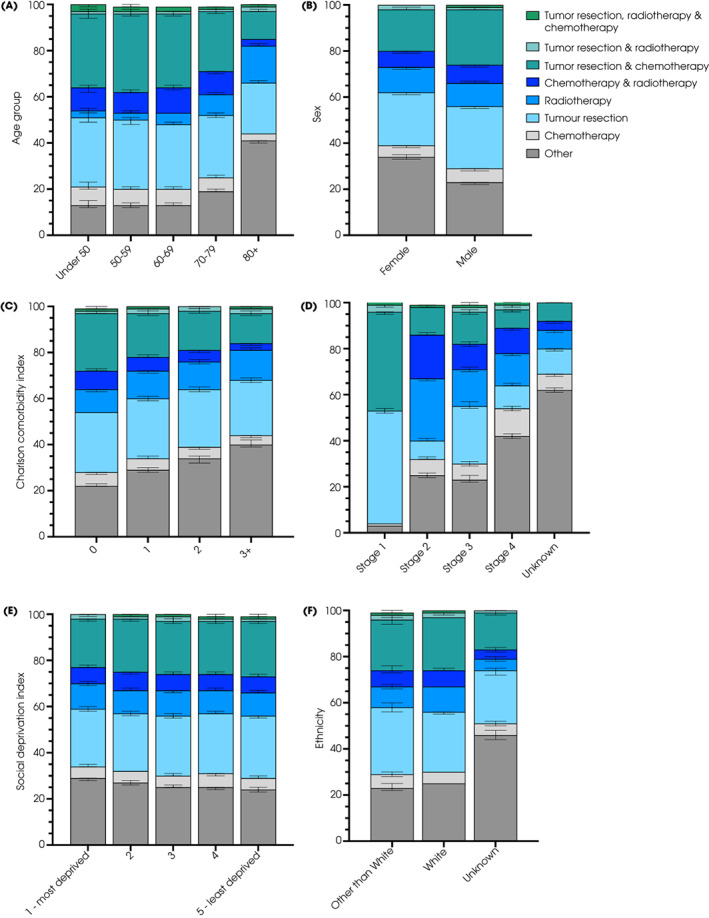
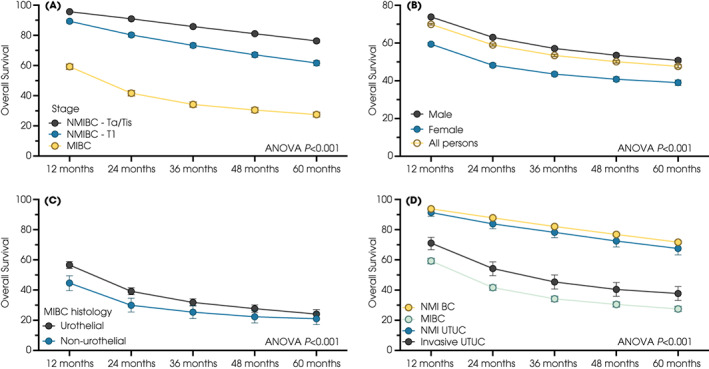
Results: Registrations included 128 823 individuals with BC, 16 018 with UTUC, and 2533 with urethral cancer. In 2019, 150 816 persons were living with a diagnosis of BC, of whom 113 067 (75.0%) were men, 85 117 (56.5%) were aged >75 years, and 95 553 (91.7%) were Caucasian. Incidence rates were stable (32.7-34.3 for BC, 3.9-4.2 for UTUC and 0.6-0.7 for urethral cancer per 100 000 population). Most patients 52 097 (mean [range] 41.3% [40.7-42.0%]) were referred outside the 2-week-wait pathway and 15 340 (mean [range] 12.2% [11.7-12.6%]) presented as emergencies. Surgery, radiotherapy, chemotherapy, or multimodal treatment use varied with disease stage, patient factors and Cancer Alliance. Between 27% and 29% (n = 6616) of muscle-invasive BCs did not receive radical treatment. Survival rates reflected stage, grade, location, and tumour histology. Overall survival rates did not improve over time (relative change: 0.97, 95% confidence interval 0.97-0.97) at 2 years in contrast to other cancers.
Conclusion: The diagnostic pathway for BC needs improvement. Increases in survival might be delivered through greater use of radical treatment. NHS Digital data offers a population-wide picture of this disease but does not allow individual outcomes to be matched with disease or patient features and key parameters can be missing or incomplete.
Keywords: NHS statistics; bladder cancer; cancer outcome; urothelial cell carcinoma.
© 2023 The Authors. BJU International published by John Wiley & Sons Ltd on behalf of BJU International.
Figures
References
-
- Cumberbatch MGK, Jubber I, Black PC et al. Epidemiology of bladder cancer: a systematic review and contemporary update of risk factors in 2018. Eur Urol 2018; 74: 784–95 - PubMed
-
- Teoh JY, Huang J, Ko WY et al. Global trends of bladder cancer incidence and mortality, and their associations with tobacco use and gross domestic product per capita. Eur Urol 2020; 78: 893–906 - PubMed
-
- Leal J, Luengo‐Fernandez R, Sullivan R, Witjes JA. Economic burden of bladder cancer across the European Union. Eur Urol 2016; 69: 438–47 - PubMed
-
- Uren AD, Cotterill N, Abrams P et al. The development of the cystectomy‐pathway assessment tool (C‐PAT): a concise tool to assess the quality of care in the cystectomy pathway. BJU Int 2022; 129: 708–17 - PubMed
