Review
. 2023 Nov;290(21):5040-5056.
doi: 10.1111/febs.16730. Epub 2023 Feb 8.

A guide to UFMylation, an emerging posttranslational modification

Affiliations
Review

A guide to UFMylation, an emerging posttranslational modification

David Millrine et al. FEBS J. 2023 Nov.

Abstract

Ubiquitin Fold Modifier-1 (UFM1) is a ubiquitin-like modifier (UBL) that is posttranslationally attached to lysine residues on substrates via a dedicated system of enzymes conserved in most eukaryotes. Despite the structural similarity between UFM1 and ubiquitin, the UFMylation machinery employs unique mechanisms that ensure fidelity. While physiological triggers and consequences of UFMylation are not entirely clear, its biological importance is epitomized by mutations in the UFMylation pathway in human pathophysiology including musculoskeletal and neurodevelopmental diseases. Some of these diseases can be explained by the increased endoplasmic reticulum (ER) stress and disrupted translational homeostasis observed upon loss of UFMylation. The roles of UFM1 in these processes likely stem from its function at the ER where ribosomes are UFMylated in response to translational stalling. In addition, UFMylation has been implicated in other cellular processes including DNA damage response and telomere maintenance. Hence, the study of UFM1 pathway mechanics and its biological function will reveal insights into fundamental cell biology and is likely to afford new therapeutic opportunities for the benefit of human health. To this end, we herein provide a comprehensive guide to the current state of knowledge of UFM1 biogenesis, conjugation, and function with an emphasis on the underlying mechanisms.

Keywords: UFM1; endoplasmic reticulum; ligase; protease; proteostasis; ubiquitin-like modifier.


Conflict of interest statement

The authors declare no conflict of interest.

Figures
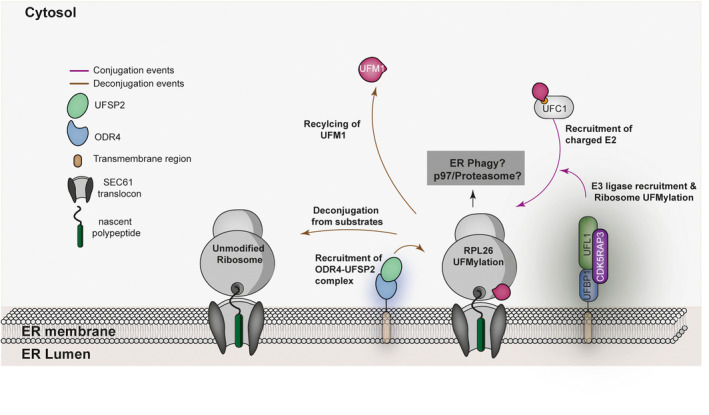
Fig. 1
Fig. 1
Schematic overview of the UFM1 pathway. Translational stalling triggers the posttranslational modification of the ribosomal subunit RPL26 with UFM1 via a classical thiolation, trans‐thiolation, and ligation pathway involving the enzymes UBA5, UFC1, and UFL1‐UFBP1. UFL1 functions as a scaffold‐type E3 ligase and is stabilized and anchored to the ER via an interaction with UFBP1. The pathway is negatively regulated by proteolysis through the action of the ER‐membrane‐associated ODR4‐UFSP2 complex. UFMylation of ribosomes is linked to a specialized autophagy of the ER‐membrane, ER‐phagy [49].
Fig. 2
Fig. 2
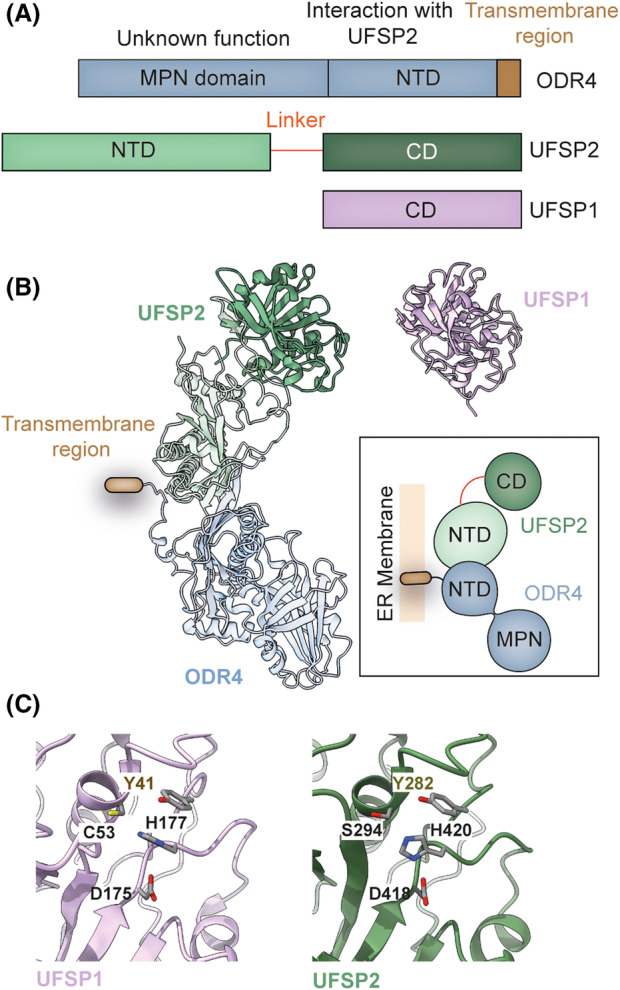
Features of UFSP proteases. (A) Schematic comparing key domains of human UFSP1, ODR4 and UFSP2. UFSP1 lacks the N‐terminal region responsible for UFSP2‐ODR4 interaction (NTD, N‐terminal domain; CD, catalytic domain; MPN, Mpr1, Pad1 N‐terminal). (B) Predicted structure of the UFSP2‐ODR4 complex (left) and crystal structure of murine UFSP1 (right) (PDB ID: 2Z84) shown in cartoon representation. Inset contains a schematic showing the mode of interaction between UFSP2 and ODR4. (C) Enlarged view of the catalytic cleft of murine UFSP1 (left) (PDB ID: 2Z84) and human UFSP2 (right) (PDB ID: 3OQC) shown in cartoon representation. Key catalytic residues are highlighted and shown as sticks. Catalytic cysteine of UFSP2 is mutated to serine in the crystal structure. Structures depicted in (B) and (C) were analysed and visualized using ucsf chimerax [91, 92].
Fig. 3
Fig. 3
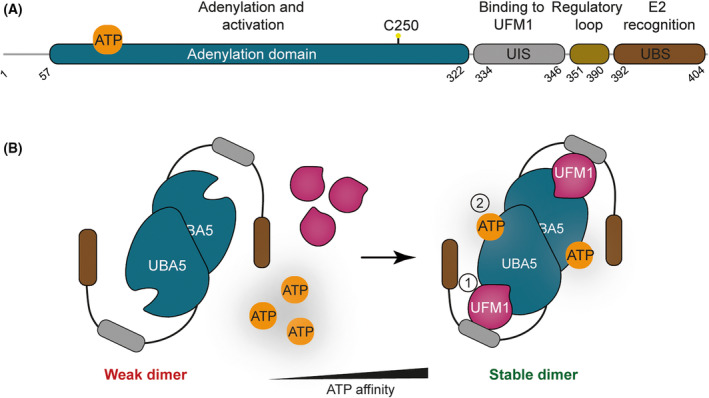
Mechanism of UFM1 activation. (A) Schematic showing key domains of UBA5. (B) Activation of UFM1 in trans. UFM1 binds one UBA5 monomer and is activated by the other. UBA5 is a weak dimer in solution. UFM1 binding stabilizes the UBA5 dimer which is accompanied by an increase in its affinity for ATP. UFM1‐interacting sequence (UIS) and the UFC1‐Binding Sequence (UBS) are shown in grey and brown respectively.
Fig. 4
Fig. 4
Distinguishing characteristics of UFC1. (A) Schematic showing the key domain features of UFC1. The K+6 auto‐UFMylation site situated six residues downstream of the catalytic site is highlighted. (B) Speculative model for the regulatory function of the K+6 auto‐modification. UFSP1 catalyses removal of UFM1 from K+6 lysine residue. (C) The N‐terminal helix of UFC1 negatively regulates intrinsic reactivity as UFC1 lacking this helix shows increased reactivity. (D) Catalytic residues and K+6 of UFC1 (PDB ID: 2Z6O) compared with UBE2S (PDB ID: 1ZDN). The structures depicted in (D) were analysed and visualized using ucsf chimerax [91, 92].
Fig. 5
Fig. 5
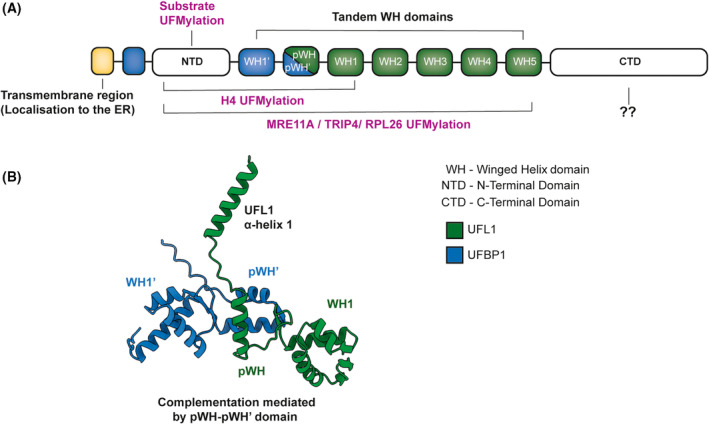
Features of the unusual E3 ligase complex. (A) Schematic showing key domains of the UFL1‐UFBP1 E3 ligase complex. Regions contributing to various functions of the E3 ligase complex are highlighted. NTD, N‐terminal domain; CTD, C‐terminal domain. (B) Alphafold prediction of UFL1‐UFBP1 interaction reveals complementary partial Winged‐Helix (pWH) domains at the interface. The predicted structure of the minimal catalytic domain formed by tandem WH domain and a helix extension of UFL1‐UFBP1 complex is shown in cartoon representation [4] generated using ucsf chimerax [91, 92].

References

    1. Cappadocia L & Lima CD (2018) Ubiquitin‐like protein conjugation: structures, chemistry, and mechanism. Chem Rev 118, 889–918. - PMC - PubMed
    1. Komatsu M, Chiba T, Tatsumi K, Iemura S, Tanida I, Okazaki N, Ueno T, Kominami E, Natsume T & Tanaka K (2004) A novel protein‐conjugating system for Ufm1, a ubiquitin‐fold modifier. EMBO J 23, 1977–1986. - PMC - PubMed
    1. Yoo HM, Kang SH, Kim JY, Lee JE, Seong MW, Lee SW, Ka SH, Sou YS, Komatsu M, Tanaka K et al. (2014) Modification of ASC1 by UFM1 is crucial for ERα transactivation and breast cancer development. Mol Cell 56, 261–274. - PubMed
    1. Peter JJ, Magnussen HM, DaRosa PA, Millrine D, Matthews SP, Lamoliatte F, Sundaramoorthy R, Kopito RR & Kulathu Y (2022) A non‐canonical scaffold‐type E3 ligase complex mediates protein UFMylation. EMBO J 41, e111015. - PMC - PubMed
    1. Banerjee S, Kumar M & Wiener R (2020) Decrypting UFMylation: how proteins are modified with UFM1. Biomolecules 10, 1442. - PMC - PubMed

Publication types

MeSH terms