


Ethnic-Racial Identity Developmental Trajectories Across the Transition to College
- PMID: 36680632
- PMCID: PMC9864504
- DOI: 10.1007/s10964-022-01724-z
Ethnic-Racial Identity Developmental Trajectories Across the Transition to College
Abstract
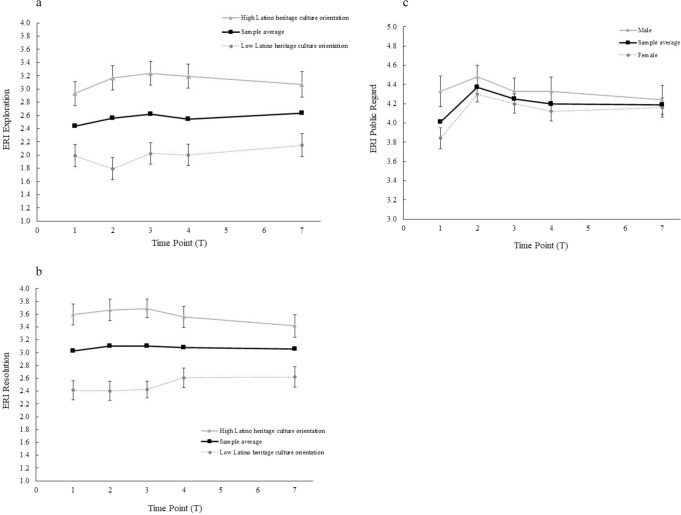
There is limited longitudinal research examining multiple ethnic-racial identity (ERI) components from adolescence into young adulthood. The current study modeled Latino adolescents' ERI trajectories across the college transition (N = 206; Mage = 18.10 years, SD = 0.41; 65.0% female). Longitudinal data from a survey administered on five occasions across 3 years were analyzed using multilevel growth modeling. Prior to college, Latino heritage culture orientation was positively associated with ERI exploration and resolution. ERI exploration increased over time. ERI resolution was high with no average change; Latino heritage culture orientation predicted variability in resolution over time. Before college, male-identifying youth reported higher ERI public regard from teachers/professors compared to female-identifying youth. Public regard increased to a greater extent for female compared to male adolescents. The findings join evidence for lifespan and intersectional models of ERI development.
Keywords: Adolescents; College; Cultural orientation; Ethnic-Racial identity; Gender; Latino.
© 2023. The Author(s), under exclusive licence to Springer Science+Business Media, LLC, part of Springer Nature.
Conflict of interest statement
The authors declare no competing interests.
Figures
References
-
- Aguirre A. Arizona’s SB1070, Latino immigrants and the framing of anti-immigrant policies. Latino Studies. 2012;10(3):385–394. doi: 10.1057/LST.2012.28. - DOI
-
- Arizona State University (2021). Facts at a Glance. Institutional Analysis. https://uoia.asu.edu/. Accessed November 17, 2022.
-
- Arizona State University (2022). Hispanic Serving Institution. https://hsi.asu.edu/about. Accessed November 17, 2022.
MeSH terms
LinkOut - more resources
Full Text Sources
