. 2023 Jan 23;408(1):55.
doi: 10.1007/s00423-023-02809-4.

A nationwide population-based study on the clinical and economic burden of anastomotic leakage in colorectal surgery

Affiliations

A nationwide population-based study on the clinical and economic burden of anastomotic leakage in colorectal surgery

Marie-Christin Weber et al. Langenbecks Arch Surg. .

Abstract

Aim: Anastomotic leakage (AL) is one of the most dreaded complications in colorectal surgery. In 2013, the International Classification of Diseases code K91.83 for AL was introduced in Germany, allowing nationwide analysis of AL rates and associated parameters. The aim of this population-based study was to investigate the current incidence, risk factors, mortality, clinical management, and associated costs of AL in colorectal surgery.

Methods: A data query was performed based on diagnosis-related group data of all hospital cases of inpatients undergoing colon or sphincter-preserving rectal resections between 2013 and 2018 in Germany.

Results: A total number of 690,690 inpatient cases were included in this study. AL rates were 6.7% for colon resections and 9.2% for rectal resections in 2018. Regarding the treatment of AL, the application of endoluminal vacuum therapy increased during the studied period, while rates of relaparotomy, abdominal vacuum therapy, and terminal enterostomy remained stable. AL was associated with significantly increased in-house mortality (7.11% vs. 20.11% for colon resections and 3.52% vs. 11.33% for rectal resections in 2018) and higher socioeconomic costs (mean hospital reimbursement volume per case: 14,877€ (no AL) vs. 37,521€ (AL) for colon resections and 14,602€ (no AL) vs. 30,606€ (AL) for rectal resections in 2018).

Conclusions: During the studied time period, AL rates did not decrease, and associated mortality remained at a high level. Our study provides updated population-based data on the clinical and economic burden of AL in Germany. Focused research in the field of AL is still urgently necessary to develop targeted strategies to prevent AL, improve patient care, and decrease socioeconomic costs.

Keywords: Anastomotic leakage; Colorectal surgery; Postoperative complications.


Conflict of interest statement

The authors declare no competing interests.

Figures
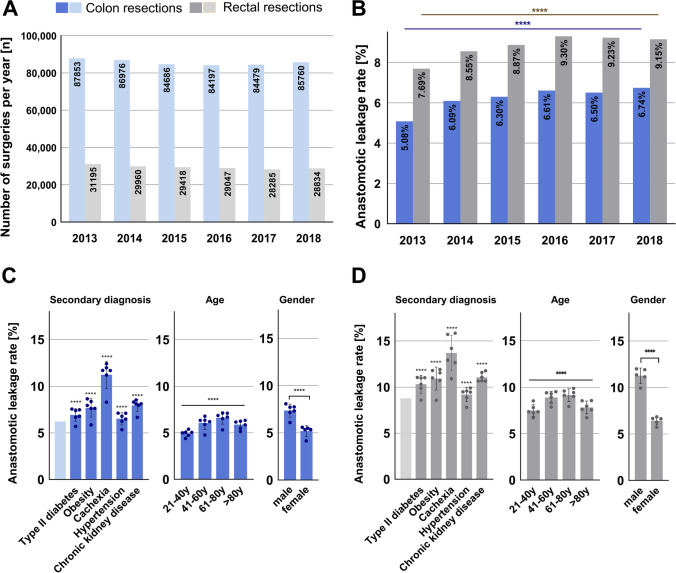
Fig. 1
Fig. 1
Development of surgery numbers from 2013 to 2018 for colon resection and sphincter-preserving rectal resection, anastomotic leakage rates, and risk factors. (A) The total number for colon resections was 87,853 in 2013 and 85,760 in 2018 and for sphincter-preserving rectal resections 31,195 in 2013 and 28,834 in 2018, decreasing slightly over the years. Data are absolute numbers per year. (B) The data show relative anastomotic leakage rates of 5.08% in 2013 and 6.74% in 2018 for colon resections and for sphincter-preserving rectal resections of 7.69% in 2013 and 9.15% in 2018. Data show relative rate per year. A linear trend towards higher leakage rates is shown. Chi-square test for trend, p ≤ 0.0001 = ****. (C, D) Anastomotic leakage rates with regard to secondary diagnosis, age range, and gender for colon resections (C) and sphincter-preserving rectal resections (D). Data are mean ± SD, dots are individual years. Bright blue and bright gray bar are mean leakage rates for all colon resections and all rectal resections. Two-sided Fisher’s exact test (secondary diagnosis, gender), chi-square test (age), p ≤ 0.0001 = ****. AL, anastomotic leakage
Fig. 2
Fig. 2
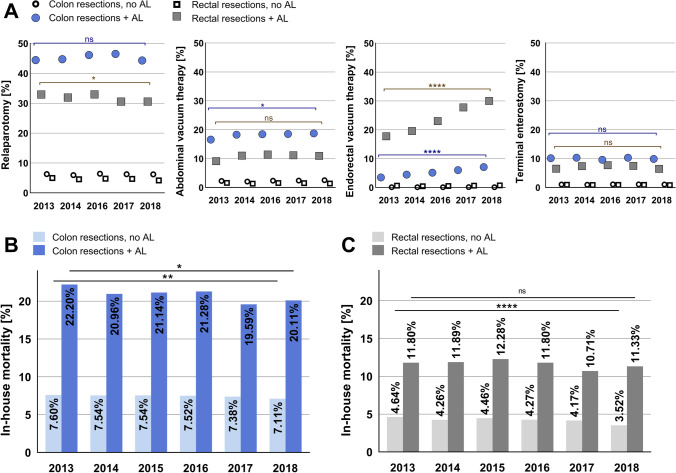
Management of anastomotic leakage and in-house mortality. (A) Procedures following anastomotic leakage after colon and rectal resections (relaparotomy, abdominal vacuum therapy, endorectal vacuum therapy, terminal enterostomy). Rates of procedures in cases with no anastomotic leakage (AL) are depicted for comparison. Data show relative rate per year. Chi-square test for trend. p < 0.05 = *, p ≤ 0.0001 = ****. Data for 2015 not available. (B, C) In-house mortality in % of cases undergoing colon resections (B) or rectal resections (C) without and with anastomotic leakage (AL). Data show relative rate per year. Chi-square test for trend. p < 0.05 = *, p ≤ 0.01 = **, p ≤ 0.0001 = ****. AL, anastomotic leakage
Fig. 3
Fig. 3
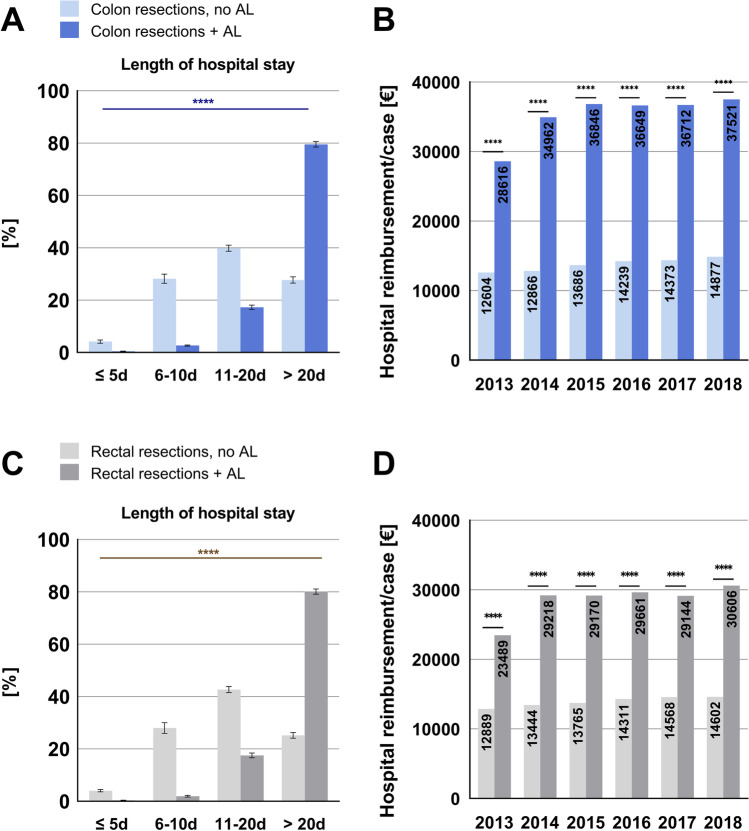
Length of hospital stay and hospital reimbursement. (A, C) Distribution of cases to the length of hospital stay (≤ 5 days, 6–10 days, 11–20 days, ≥ 20 days). Data is depicted as percentage of total cases for colon resection ± anastomotic leakage (A) and rectal resection ± anastomotic leakage (C). A significant association between anastomotic leakage and length of hospital stay can be shown. Data are mean ± SD. Chi-square test. p ≤ 0.0001 = ****. (B, D) Mean hospital reimbursement sum per case for colon and rectal resections with and without anastomotic leakage. Data are mean reimbursement sum per year, t-test, p ≤ 0.0001 = ****. AL, anastomotic leakage

References

    1. Lee SW, Gregory D, Cool CL. Clinical and economic burden of colorectal and bariatric anastomotic leaks. Surg Endosc. 2020;34(10):4374–4381. doi: 10.1007/s00464-019-07210-1. - DOI - PubMed
    1. Gessler B, Eriksson O, Angenete E. Diagnosis, treatment, and consequences of anastomotic leakage in colorectal surgery. Int J Colorectal Dis. 2017;32(4):549–556. doi: 10.1007/s00384-016-2744-x. - DOI - PMC - PubMed
    1. Ammann EM, Goldstein LJ, Nagle D, Wei D, Johnston SS. A dual-perspective analysis of the hospital and payer-borne burdens of selected in-hospital surgical complications in low anterior resection for colorectal cancer. Hosp Pract (1995) 2019;47(2):80–7. doi: 10.1080/21548331.2019.1568718. - DOI - PubMed
    1. McDermott FD, Heeney A, Kelly ME, Steele RJ, Carlson GL, Winter DC. Systematic review of preoperative, intraoperative and postoperative risk factors for colorectal anastomotic leaks. Br J Surg. 2015;102(5):462–479. doi: 10.1002/bjs.9697. - DOI - PubMed
    1. Kruschewski M, Rieger H, Pohlen U, Hotz HG, Buhr HJ. Risk factors for clinical anastomotic leakage and postoperative mortality in elective surgery for rectal cancer. Int J Colorectal Dis. 2007;22(8):919–927. doi: 10.1007/s00384-006-0260-0. - DOI - PubMed

LinkOut - more resources