


Factors affecting public transport performance due to the COVID-19 outbreak: A worldwide analysis
- PMID: 36683673
- PMCID: PMC9841081
- DOI: 10.1016/j.cities.2023.104206
Factors affecting public transport performance due to the COVID-19 outbreak: A worldwide analysis
Abstract
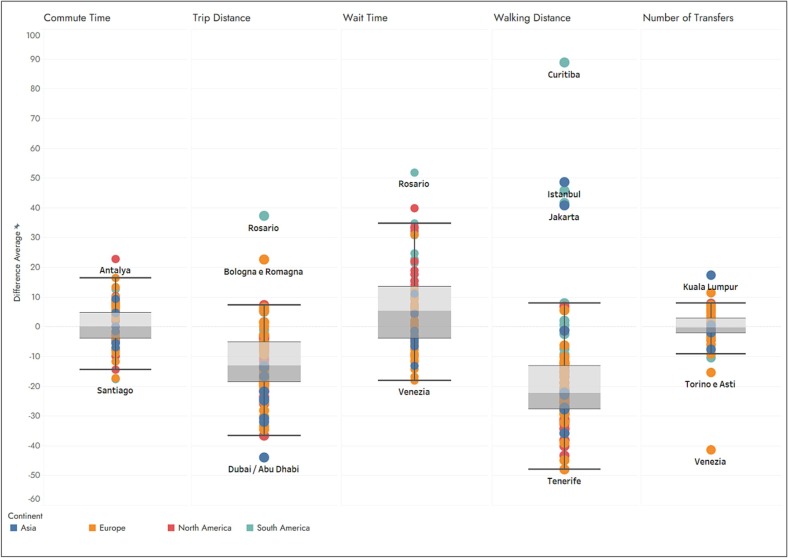
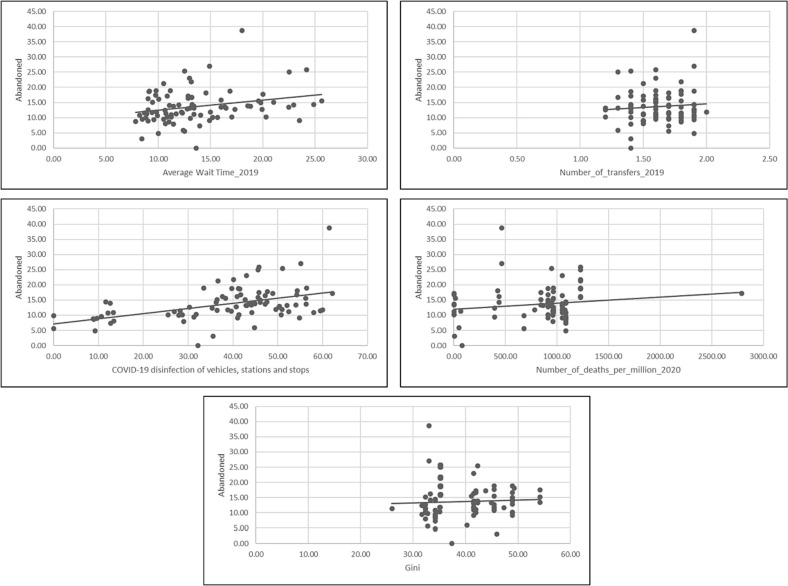
In this paper we investigate the public transport trip frequency variations, as well as the reasons that led to the shift away from public transport means, due to the COVID-19 pandemic. We studied relevant data from the Moovit platform, and we compared operational and trip frequency characteristics of public transport systems before and after the outbreak of the pandemic in 87 cities worldwide. On average, waiting times at public transport stops/stations increased while trip distances decreased, apparently due to the mobility restriction and social distancing measures implemented in 2020. Most of the Moovit users who said that they abandoned public transport in 2020 were found in Italy and Greece. We developed linear regression analysis models to investigate (among the 35 variables examined in the study) the relationship between public transport abandonment rates and socioeconomic factors, quality of service characteristics, and indicators of pandemic's spread. Empirical findings show that public transport dropout rates are positively correlated with the COVID-19 death toll figures, the cleanliness of public transport vehicles and facilities, as well as with the income inequality (GINI) index of the population, and thus reconfirm previous research findings. In addition, the waiting time at stops/stations and the number of transfers required for commute trips appeared to be the most critical public transport trip segments, which significantly determine the discontinuation of public transport use under pandemic circumstances. Our research findings indicate specific aspects of public transport services, which require tailored adjustments in order to recover ridership in the post-pandemic period.
Keywords: COVID-19; Income inequality; Moovit; Public transport; Quality of service; Trip frequency; Waiting time.
© 2023 The Authors.
Conflict of interest statement
The authors declare that they have no known competing financial interests or personal relationships that could have appeared to influence the work reported in this paper.
Figures
References
-
- Alyavina E., Nikitas A., Njoya E.T. Mobility as a service (MaaS): A thematic map of challenges and opportunities. Research in Transportation Business & Management. 2022;43 doi: 10.1016/j.rtbm.2022.100783. - DOI
-
- Angell C., Potoglou D. An insight into the impacts of COVID-19 on work-related travel behaviours in the Cardiff capital region and following the UK’s first national lockdown. Cities. 2022;124 doi: 10.1016/j.cities.2022.103602. - DOI
-
- Aparicio J.T., Arsenio E., Henriques R. Understanding the impacts of the COVID-19 pandemic on public transportation travel patterns in the city of Lisbon. Sustainability (Switzerland) 2021;13(15) doi: 10.3390/su13158342. - DOI
LinkOut - more resources
Full Text Sources