


Challenges and exploration for immunotherapies targeting cold colorectal cancer
- PMID: 36684057
- PMCID: PMC9850757
- DOI: 10.4251/wjgo.v15.i1.55
Challenges and exploration for immunotherapies targeting cold colorectal cancer
Abstract
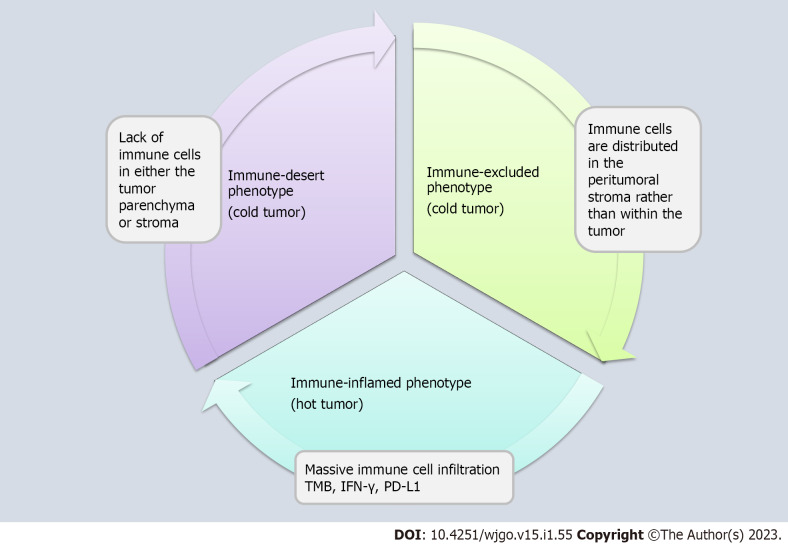
In recent years, immune checkpoint inhibitors (ICIs) have made significant breakthroughs in the treatment of various tumors, greatly improving clinical efficacy. As the fifth most common antitumor treatment strategy for patients with solid tumors after surgery, chemotherapy, radiotherapy and targeted therapy, the therapeutic response to ICIs largely depends on the number and spatial distribution of effector T cells that can effectively identify and kill tumor cells, features that are also important when distinguishing malignant tumors from "cold tumors" or "hot tumors". At present, only a small proportion of colorectal cancer (CRC) patients with deficient mismatch repair (dMMR) or who are microsatellite instability-high (MSI-H) can benefit from ICI treatments because these patients have the characteristics of a "hot tumor", with a high tumor mutational burden (TMB) and massive immune cell infiltration, making the tumor more easily recognized by the immune system. In contrast, a majority of CRC patients with proficient MMR (pMMR) or who are microsatellite stable (MSS) have a low TMB, lack immune cell infiltration, and have almost no response to immune monotherapy; thus, these tumors are "cold". The greatest challenge today is how to improve the immunotherapy response of "cold tumor" patients. With the development of clinical research, immunotherapies combined with other treatment strategies (such as targeted therapy, chemotherapy, and radiotherapy) have now become potentially effective clinical strategies and research hotspots. Therefore, the question of how to promote the transformation of "cold tumors" to "hot tumors" and break through the bottleneck of immunotherapy for cold tumors in CRC patients urgently requires consideration. Only by developing an in-depth understanding of the immunotherapy mechanisms of cold CRCs can we screen out the immunotherapy-dominant groups and explore the most suitable treatment options for individuals to improve therapeutic efficacy.
Keywords: Cold tumors; Colorectal cancer; Combination therapy; Effector T cells; Immune checkpoint inhibitors; Immunotherapy mechanism.
©The Author(s) 2023. Published by Baishideng Publishing Group Inc. All rights reserved.
Conflict of interest statement
Conflict-of-interest statement: All the authors report no relevant conflicts of interest for this article.
Figures
References
-
- Sung H, Ferlay J, Siegel RL, Laversanne M, Soerjomataram I, Jemal A, Bray F. Global Cancer Statistics 2020: GLOBOCAN Estimates of Incidence and Mortality Worldwide for 36 Cancers in 185 Countries. CA Cancer J Clin. 2021;71:209–249. - PubMed
-
- Weiden J, Tel J, Figdor CG. Synthetic immune niches for cancer immunotherapy. Nat Rev Immunol. 2018;18:212–219. - PubMed
-
- Le DT, Uram JN, Wang H, Bartlett BR, Kemberling H, Eyring AD, Skora AD, Luber BS, Azad NS, Laheru D, Biedrzycki B, Donehower RC, Zaheer A, Fisher GA, Crocenzi TS, Lee JJ, Duffy SM, Goldberg RM, de la Chapelle A, Koshiji M, Bhaijee F, Huebner T, Hruban RH, Wood LD, Cuka N, Pardoll DM, Papadopoulos N, Kinzler KW, Zhou S, Cornish TC, Taube JM, Anders RA, Eshleman JR, Vogelstein B, Diaz LA Jr. PD-1 Blockade in Tumors with Mismatch-Repair Deficiency. N Engl J Med. 2015;372:2509–2520. - PMC - PubMed
Publication types
LinkOut - more resources
Full Text Sources
Research Materials
